Ch.18 - Chemistry of the Environment
Brown - Chemistry: The Central Science 15th Edition
Brown15th EditionChemistry: The Central ScienceISBN: 9780137542970Non è quello che usi tu?Cambia libro di testo
Capitolo 18, Problema 71a

(a) The EPA threshold for acceptable levels of lead ions in water is 615 ppb. What is the molarity of an aqueous solution with a concentration of 15 ppb?

Guida verificata passo dopo passo
1
Understand the concept of parts per billion (ppb). It is a unit of concentration that denotes the number of parts of a substance in a billion parts of the solution. For lead ions in water, 15 ppb means 15 grams of lead ions in 1 billion grams of water.
Convert the concentration from ppb to grams per liter. Since 1 billion grams of water is approximately 1 million liters (assuming the density of water is 1 g/mL), 15 ppb is equivalent to 15 grams of lead ions per 1 million liters of water.
Calculate the number of moles of lead ions. Use the molar mass of lead (Pb), which is approximately 207.2 g/mol. The formula to find moles is: \( \text{moles} = \frac{\text{mass (g)}}{\text{molar mass (g/mol)}} \).
Determine the molarity of the solution. Molarity (M) is defined as the number of moles of solute per liter of solution. Use the formula: \( M = \frac{\text{moles of solute}}{\text{liters of solution}} \).
Combine the calculations to find the molarity. Use the number of moles calculated in step 3 and the volume in liters from step 2 to find the molarity of the solution.

Risposta video verificata per un problema simile:

Questa soluzione video è stata consigliata dai nostri tutor come utile per risolvere questo problema.
Durata del video:
4m

Concetti chiave

Ecco i concetti essenziali che devi comprendere per rispondere correttamente alla domanda.

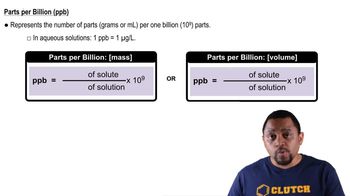
Parts Per Billion (ppb)

Parts per billion (ppb) is a unit of measurement used to describe the concentration of a substance in a solution. It indicates how many parts of a substance are present in one billion parts of the total solution. In the context of the question, 15 ppb means that there are 15 micrograms of lead ions in one liter of water.
Video consigliato:
Percorso guidato
00:57
Parts per Billion (ppb)

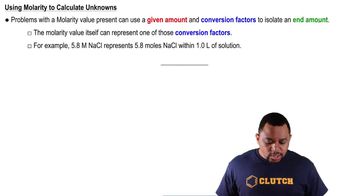
Molarity

Molarity is a measure of concentration defined as the number of moles of solute per liter of solution. It is expressed in moles per liter (mol/L). To convert ppb to molarity, one must first convert the mass of the solute to moles using its molar mass and then divide by the volume of the solution in liters.
Video consigliato:

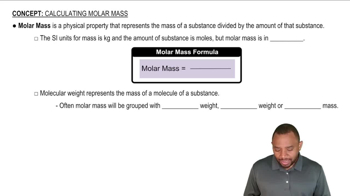
Molar Mass

Molar mass is the mass of one mole of a substance, typically expressed in grams per mole (g/mol). For lead (Pb), the molar mass is approximately 207.2 g/mol. This value is essential for converting the mass of lead ions in ppb to moles, which is necessary for calculating the molarity of the solution.
Video consigliato:
Percorso guidato
02:11
Molar Mass Concept
Pratica correlata
Domanda del libro di testo

(b) Will Mg(OH)2 precipitate when 4.0 g of Na2CO3 is added to 1.00 L of a solution containing 125 ppm of Mg2+?

367
views
Domanda del libro di testo

(b) Concentrations of lead in the bloodstream are often quoted in units of μg/dL. Averaged over the entire country, the mean concentration of lead in the blood was measured to be 1.6 μg/dL in 2008. Express this concentration in ppb.

378
views
Domanda del libro di testo

In 1986 an electrical power plant in Taylorsville, Georgia, burned 8,376,726 tons of coal, a national record at that time. (a) Assuming that the coal was 83% carbon and 2.5% sulfur and that combustion was complete, calculate the number of tons of carbon dioxide and sulfur dioxide produced by the plant during the year.

1470
views
Domanda del libro di testo

The water supply for a midwestern city contains the following impurities: coarse sand, finely divided particulates, nitrate ions, trihalomethanes, dissolved phosphorus in the form of phosphates, potentially harmful bacterial strains, dissolved organic substances. Which of the following processes or agents, if any, is effective in removing each of these impurities: coarse sand filtration, activated carbon filtration, aeration, ozonization, precipitation with aluminum hydroxide?

406
views
Domanda del libro di testo

Write balanced chemical equations for each of the following reactions: (a) The nitric oxide molecule undergoes photodissociation in the upper atmosphere. (b) The nitric oxide molecule undergoes photoionization in the upper atmosphere. (c) Nitric oxide undergoes oxidation by ozone in the stratosphere.

396
views
Domanda del libro di testo

Write balanced chemical equations for each of the following reactions: (d) Nitrogen dioxide dissolves in water to form nitric acid and nitric oxide.

536
views