Ch.2 - Atoms, Molecules, and Ions
Brown - Chemistry: The Central Science 15th Edition
Brown15th EditionChemistry: The Central ScienceISBN: 9780137542970Non è quello che usi tu?Cambia libro di testo
Capitolo 2, Problema 20c

An atom of rhodium (Rh) has a diameter of about 2.7×10⁻⁸ cm. c. If you assume that the Rh atom is a sphere, what is the volume in m3 of a single atom?

Guida verificata passo dopo passo
1
Convert the diameter of the Rhodium atom from centimeters to meters by multiplying by \(10^{-2}\), since there are 100 centimeters in a meter.
Calculate the radius of the Rhodium atom by dividing the diameter by 2.
Use the formula for the volume of a sphere, which is \(V = \frac{4}{3} \pi r^3\), where \(r\) is the radius of the sphere.
Substitute the radius value obtained in step 2 into the volume formula.
Ensure the final volume is expressed in cubic meters (m^3).

Risposta video verificata per un problema simile:

Questa soluzione video è stata consigliata dai nostri tutor come utile per risolvere questo problema.
Durata del video:
2m

Concetti chiave

Ecco i concetti essenziali che devi comprendere per rispondere correttamente alla domanda.

Volume of a Sphere

The volume of a sphere can be calculated using the formula V = (4/3)πr³, where r is the radius of the sphere. To find the volume of a rhodium atom, one must first convert the diameter into radius by dividing it by two. This formula is essential for determining the space occupied by the atom when modeled as a sphere.
Video consigliato:
Percorso guidato
02:35
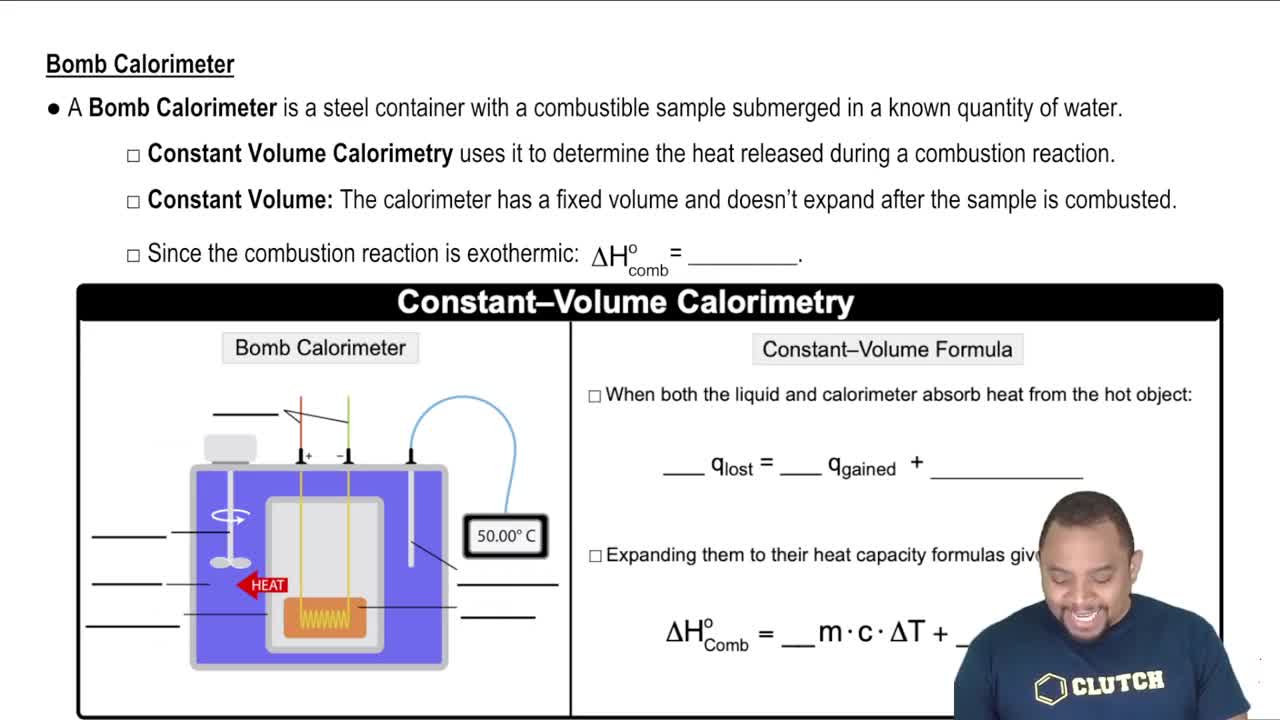
Constant-Volume Calorimetry

Unit Conversion

In chemistry, it is often necessary to convert units to ensure consistency, especially when dealing with measurements in different systems. In this case, the diameter of the rhodium atom is given in centimeters, but the final volume needs to be expressed in cubic meters (m³). Understanding how to convert between these units is crucial for accurate calculations.
Video consigliato:
Percorso guidato
01:56
Conversion Factors

Scientific Notation

Scientific notation is a way of expressing very large or very small numbers in a compact form, using powers of ten. For example, 2.7×10⁻⁸ cm represents a very small measurement. Familiarity with scientific notation is important in chemistry for handling measurements and calculations involving atomic and molecular scales.
Video consigliato:
Percorso guidato
02:50
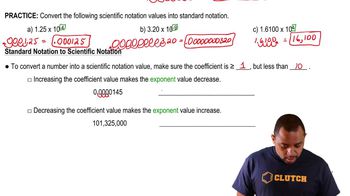
Standard Notation to Scientific Notation