

Ch.2 - Atoms, Molecules, and Ions
Brown - Chemistry: The Central Science 15th Edition
Brown15th EditionChemistry: The Central ScienceISBN: 9780137542970Non è quello che usi tu?Cambia libro di testo
Capitolo 2, Problema 19b

The radius of an atom of gold (Au) is about 1.35 Å. b. How many gold atoms would have to be lined up to span 1.0 mm?

Guida verificata passo dopo passo
1
Convert the radius of a gold atom from angstroms to millimeters. Recall that 1 Å = 1 imes 10^{-10} meters and 1 mm = 1 imes 10^{-3} meters.
Calculate the diameter of a gold atom by multiplying the radius by 2, as the diameter is twice the radius.
Determine how many gold atom diameters fit into 1.0 mm by dividing 1.0 mm by the diameter of a gold atom in millimeters.
Since the question asks for the number of atoms, not diameters, and each diameter represents one atom, the result from the previous step represents the number of gold atoms needed to span 1.0 mm.
Ensure the final answer is in whole numbers since you cannot have a fraction of an atom in this context.

Risposta video verificata per un problema simile:

Questa soluzione video è stata consigliata dai nostri tutor come utile per risolvere questo problema.
Durata del video:
3m

Concetti chiave

Ecco i concetti essenziali che devi comprendere per rispondere correttamente alla domanda.

Atomic Radius

The atomic radius is a measure of the size of an atom, typically defined as the distance from the nucleus to the outermost electron shell. For gold (Au), the atomic radius is approximately 1.35 Å (angstroms), which is a unit of length equal to 10^-10 meters. Understanding atomic radius is crucial for calculating how many atoms can fit into a given length.
Video consigliato:

Unit Conversion

Unit conversion is the process of converting a quantity expressed in one unit to another unit. In this question, it is necessary to convert the length from millimeters (mm) to angstroms (Å) to match the units of the atomic radius. Since 1 mm equals 10^7 Å, this conversion is essential for accurately determining the number of gold atoms that can span the specified distance.
Video consigliato:
Percorso guidato
01:56
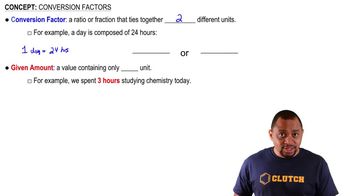
Conversion Factors

Avogadro's Number

Avogadro's number, approximately 6.022 x 10^23, is the number of atoms, ions, or molecules in one mole of a substance. While not directly needed for this specific calculation, understanding Avogadro's number is fundamental in chemistry for relating macroscopic measurements to atomic-scale quantities. It provides context for the scale of atoms and helps in visualizing how many atoms are involved in larger quantities.
Video consigliato:
Pratica correlata
Domanda del libro di testo

Millikan determined the charge on the electron by studying the static charges on oil drops falling in an electric field (Figure 2.5). A student carried out this experiment using several oil drops for her measurements and calculated the charges on the drops. She obtained the following data: Droplet Calculated Charge (C) A 1.60 * 10-19 B 3.15 * 10-19 C 4.81 * 10-19 D 6.31 * 10-19 (b) What conclusion can the student draw from these data regarding the charge of the electron?

1377
views
Domanda del libro di testo

An atom of rhodium (Rh) has a diameter of about 2.7×10⁻⁸ cm. a. What is the radius of a rhodium atom in angstroms (Å) and in meters (m)?

2
views
Domanda del libro di testo

An atom of rhodium (Rh) has a diameter of about 2.7×10⁻⁸ cm. c. If you assume that the Rh atom is a sphere, what is the volume in m3 of a single atom?

3
views
Domanda del libro di testo

The radius of an atom of gold (Au) is about 1.35 Å. a. Express this distance in nanometers (nm) and in picometers (pm).

2
views
Domanda del libro di testo

The radius of an atom of gold (Au) is about 1.35 Å. c. If the atom is assumed to be a sphere, what is the volume in cm3 of a single Au atom?

1
views
Domanda del libro di testo

Millikan determined the charge on the electron by studying the static charges on oil drops falling in an electric field (Figure 2.5). A student carried out this experiment using several oil drops for her measurements and calculated the charges on the drops. She obtained the following data: Droplet Calculated Charge (C) A 1.60 * 10-19 B 3.15 * 10-19 C 4.81 * 10-19 D 6.31 * 10-19 (c) What value (and to how many significant figures) should she report for the electronic charge?

579
views