A compressed air tank carried by scuba divers has a volume
of 8.0 L and a pressure of 140 atm at 20 °C. What is the
volume of air in the tank in liters at STP?
Guida verificata passo dopo passo
1
Step 1: Identify the given values. The volume (V1) is 8.0 L, the pressure (P1) is 140 atm, and the temperature (T1) is 20 °C. Convert the temperature to Kelvin by adding 273 to the Celsius temperature, so T1 = 293 K. The conditions at STP are a pressure (P2) of 1 atm and a temperature (T2) of 273 K.
Step 2: Use the combined gas law, which states that the ratio of the product of pressure and volume to temperature is constant for a given amount of gas. The formula is (P1*V1)/T1 = (P2*V2)/T2.
Step 3: Rearrange the formula to solve for the unknown volume at STP (V2). The rearranged formula is V2 = (P1*V1*T2) / (P2*T1).
Step 4: Substitute the given values into the formula. P1 is 140 atm, V1 is 8.0 L, T2 is 273 K, P2 is 1 atm, and T1 is 293 K.
Step 5: Calculate the value of V2. This will give you the volume of the air in the tank at STP in liters.
Risposta video verificata per un problema simile:
Questa soluzione video è stata consigliata dai nostri tutor come utile per risolvere questo problema.
Durata del video:
3m
Guarda un video:
0 Commenti
Concetti chiave
Ecco i concetti essenziali che devi comprendere per rispondere correttamente alla domanda.
Ideal Gas Law
The Ideal Gas Law relates the pressure, volume, temperature, and number of moles of a gas through the equation PV = nRT. This law is essential for understanding how gases behave under different conditions, allowing us to calculate changes in volume or pressure when temperature or the amount of gas changes.
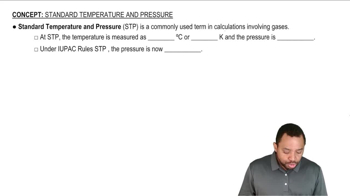
Standard Temperature and Pressure (STP) is defined as a temperature of 0 °C (273.15 K) and a pressure of 1 atm. At STP, one mole of an ideal gas occupies 22.4 liters. Understanding STP is crucial for converting gas volumes from one set of conditions to another, as it provides a reference point for calculations.
Gas volume conversion involves using the Ideal Gas Law to determine how the volume of a gas changes with variations in pressure and temperature. By applying the combined gas law (P1V1/T1 = P2V2/T2), we can find the volume of gas at STP based on its initial conditions, which is key to solving the given problem.


 Guida verificata passo dopo passo

 01:15
01:15