If 15.0 g of CO2 gas has a volume of 0.30 L at 300 K, what is its pressure in millimeters of mercury?
Guida verificata passo dopo passo
1
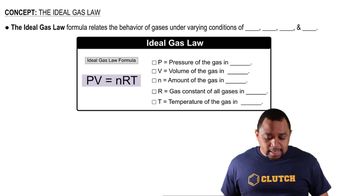
Identify the ideal gas law equation: $PV = nRT$.
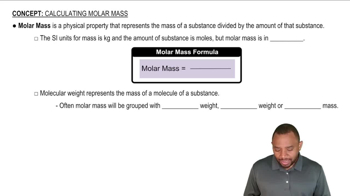
Calculate the number of moles of CO2 using its molar mass: \(n = \frac{\text{mass}}{\text{molar mass}}\).
Substitute the known values into the ideal gas law equation: \(P = \frac{nRT}{V}\).
Convert the pressure from atmospheres to millimeters of mercury using the conversion factor: \(1 \text{ atm} = 760 \text{ mmHg}\).
Solve for the pressure in millimeters of mercury.
Risposta video verificata per un problema simile:
Questa soluzione video è stata consigliata dai nostri tutor come utile per risolvere questo problema.
Durata del video:
5m
Guarda un video:
0 Commenti
Concetti chiave
Ecco i concetti essenziali che devi comprendere per rispondere correttamente alla domanda.
Ideal Gas Law
The Ideal Gas Law is a fundamental equation in chemistry that relates the pressure, volume, temperature, and number of moles of a gas. It is expressed as PV = nRT, where P is pressure, V is volume, n is the number of moles, R is the ideal gas constant, and T is temperature in Kelvin. This law allows us to calculate one property of a gas if the others are known.
Molar mass is the mass of one mole of a substance, typically expressed in grams per mole (g/mol). For carbon dioxide (CO2), the molar mass is approximately 44.01 g/mol, calculated from the atomic masses of carbon and oxygen. Knowing the molar mass is essential for converting between grams and moles, which is necessary for using the Ideal Gas Law.
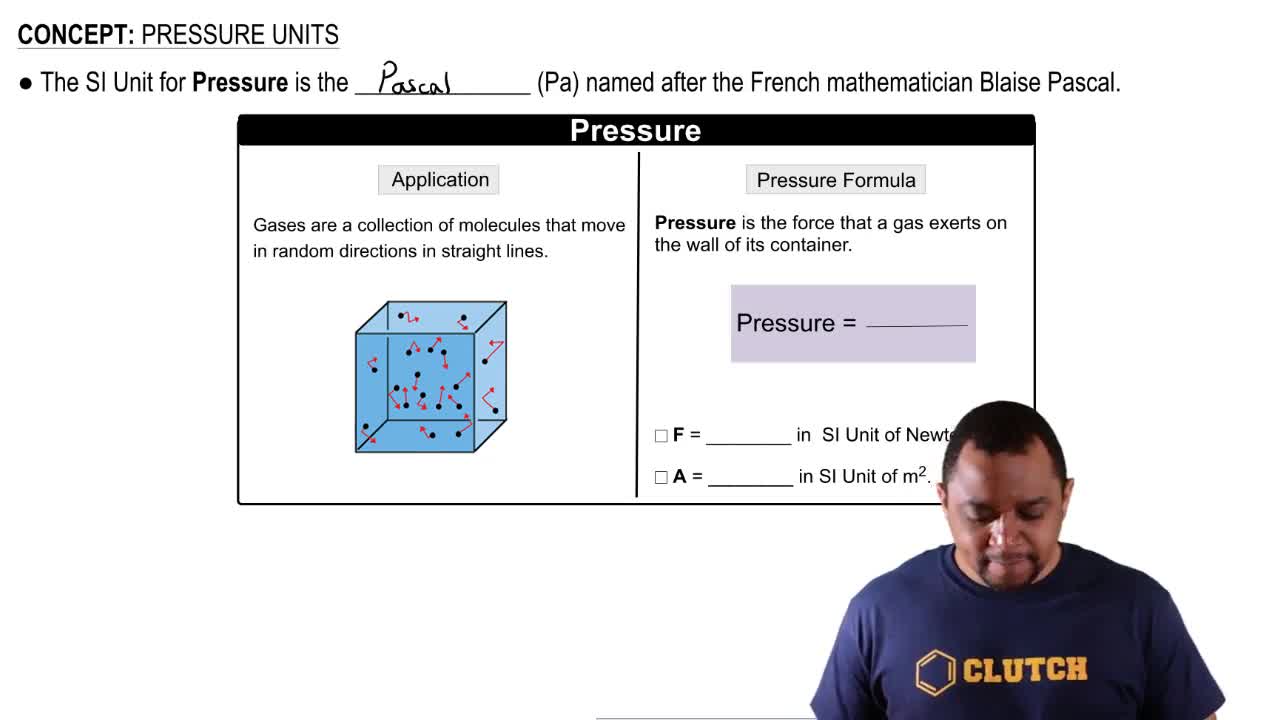
Pressure is a measure of force exerted per unit area and can be expressed in various units, including atmospheres (atm), pascals (Pa), and millimeters of mercury (mmHg). To convert between these units, it is important to know that 1 atm is equivalent to 760 mmHg. Understanding pressure units is crucial for accurately reporting and interpreting gas behavior in experiments.

 Guida verificata passo dopo passo

 01:15