 Indietro
Chromosome Mapping and Genetic Linkage in Eukaryotes
Guida di studio - Note intelligenti
 Appunti personalizzati basati sui tuoi materiali, ampliati con definizioni chiave, esempi e contesto.
Chromosome Mapping in Eukaryotes
Introduction to Chromosome Structure and Gene Arrangement
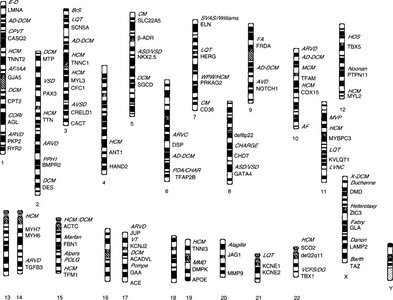
Eukaryotic chromosomes contain large numbers of genes, each occupying a fixed position (locus) along the chromosome. The arrangement of genes and their behavior during meiosis are foundational to understanding genetic inheritance and mapping.
Genes are segments of DNA that encode functional products, typically proteins.
Genes on different chromosomes assort independently, while genes on the same chromosome may be linked and inherited together.
The physical location of a gene on a chromosome is called its locus.
Independent Assortment and Linkage
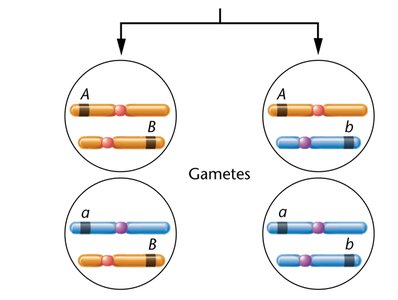
During meiosis, genes located on different chromosomes segregate independently, following Mendel's law of independent assortment. However, genes located close together on the same chromosome tend to be inherited together, a phenomenon known as genetic linkage.
Independent assortment produces gametes with all possible combinations of alleles for genes on different chromosomes.
Linkage occurs when genes are close together on the same chromosome, reducing the likelihood of their separation during meiosis.
Crossing Over and Recombination
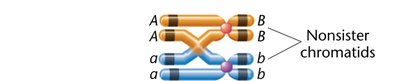
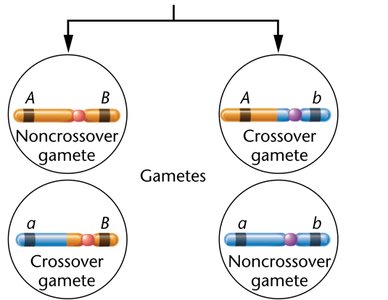
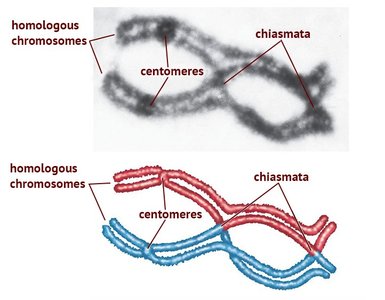
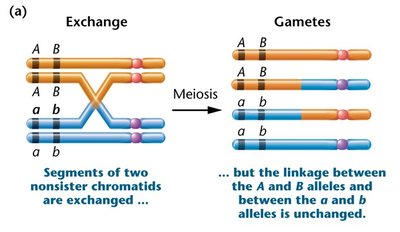
Crossing over is the exchange of genetic material between nonsister chromatids of homologous chromosomes during meiosis. This process increases genetic variation by producing recombinant chromosomes with new combinations of alleles.
Crossing over occurs at structures called chiasmata.
Recombination frequency between two genes is proportional to their physical distance on the chromosome.
Genetic Linkage and Complete Linkage
Complete Linkage
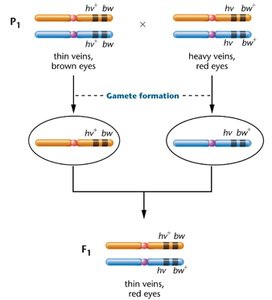
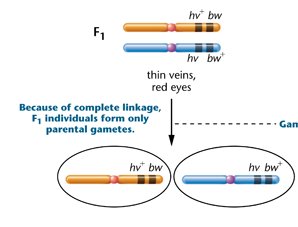
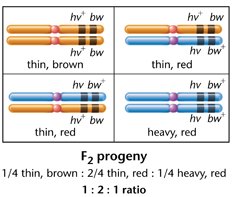
When two genes are very close together on the same chromosome, crossing over between them is extremely rare or absent, resulting in complete linkage. In this case, only parental (nonrecombinant) gametes are produced.
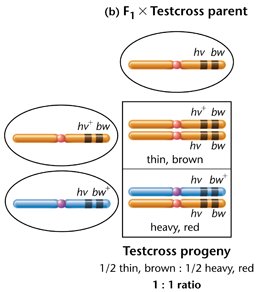
Example: In Drosophila, the hv (heavy veins) and bw (brown eyes) genes can exhibit complete linkage.
F1 individuals heterozygous for both genes produce only parental gametes.
Test Crosses and Linkage Analysis
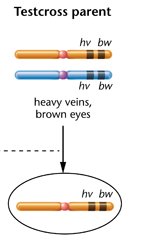
A test cross involves crossing an individual heterozygous for two genes with an individual homozygous recessive for both genes. This allows the detection of recombinant and parental types, revealing the degree of linkage between the genes.
Test crosses are essential for mapping gene distances and determining linkage relationships.
Mechanisms and Importance of Crossing Over
Role of Crossing Over in Genetic Variation
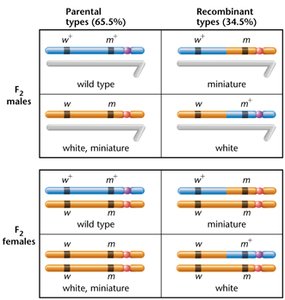
Crossing over during meiosis is a major source of genetic diversity. It results in recombinant gametes, which carry new combinations of alleles not found in the parents.
Occurs between homologous chromosomes at chiasmata.
The frequency of recombination is used to estimate the distance between genes on a chromosome.
Linkage Groups
Genes that are linked together on the same chromosome are said to belong to the same linkage group. In theory, each chromosome represents a single linkage group.
Linkage groups can be identified by analyzing recombination frequencies among multiple genes.
Chromosome Mapping Using Recombination Frequencies
Historical Perspective: Morgan and Sturtevant
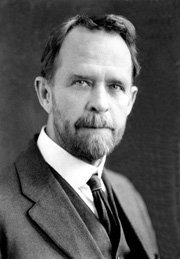
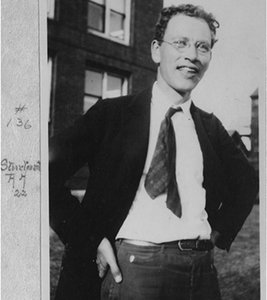
Thomas Hunt Morgan and his student Alfred Sturtevant pioneered the use of recombination frequencies to construct genetic maps. Sturtevant realized that the percentage of recombinant offspring could be used to estimate the distance between genes.
1 map unit (mu) = 1% recombination frequency.
Genetic maps are constructed by analyzing the outcomes of test crosses and calculating recombination frequencies.
Calculating Map Distances
Recombination frequencies between gene pairs are used to calculate map distances. For example, if the recombination frequency between two genes is 15.6%, the genes are 15.6 map units apart.
Map distances are additive for genes in a linear arrangement.
Three-Point Test Crosses
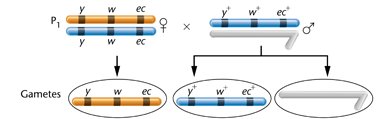
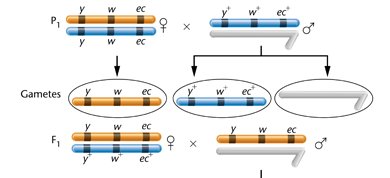
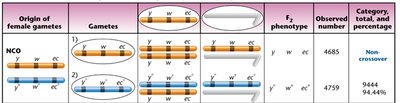
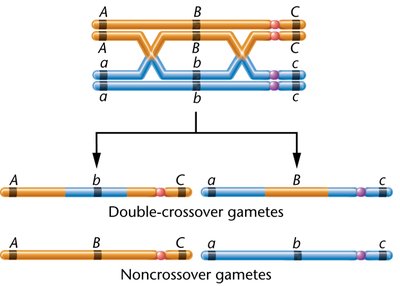
Three-point test crosses allow the mapping of three genes simultaneously and can reveal the order of genes on a chromosome. The rarest recombinant classes indicate double crossovers, which help determine the gene order.
Example: Mapping the y (yellow), w (white), and m (miniature) genes in Drosophila.

Types of Crossovers
There are two main types of crossovers: single crossovers (SCOs) and double crossovers (DCOs). The probability of a double crossover is the product of the probabilities of each single crossover event.
Single crossover (SCO): Exchange between two nonsister chromatids at one location.
Double crossover (DCO): Two exchanges occur, involving three loci.
Mapping Units and Limitations
Mapping units (mu) are based on recombination frequencies, but there are limitations. Multiple crossovers between distant genes can underestimate the true physical distance. Genetic maps are most accurate for closely linked genes.
Maximum observable recombination frequency is 50% (genes appear unlinked).
Physical maps (based on DNA sequence) provide higher resolution than genetic maps.
Modern Chromosome Mapping Techniques
DNA Markers and Bioinformatics
Modern mapping relies on molecular markers and bioinformatics tools rather than classical breeding experiments. Common markers include:
Restriction Fragment Length Polymorphisms (RFLPs)
Microsatellites
Single Nucleotide Polymorphisms (SNPs)
These markers allow for high-resolution mapping and are essential for genome-wide association studies (GWAS) and other applications in genetics and genomics.
Summary Table: Types of Crossovers and Their Outcomes
Type of Crossover | Description | Outcome |
|---|---|---|
Single Crossover (SCO) | Exchange between two nonsister chromatids at one locus | Produces two recombinant and two parental gametes |
Double Crossover (DCO) | Two exchanges occur, involving three loci | Produces double recombinant gametes, rarest class |
No Crossover | No exchange between chromatids | All gametes are parental types |
Key Equations
Recombination frequency (RF):
Map distance (in map units, mu):
Probability of double crossover (DCO):
Conclusion
Chromosome mapping is a fundamental tool in genetics, allowing researchers to determine the relative positions of genes on chromosomes. By analyzing recombination frequencies and using both classical and modern molecular techniques, geneticists can construct detailed maps that are essential for understanding inheritance, genetic diseases, and evolutionary biology.
