 Indietro
Chromosome Mapping and Linkage in Eukaryotes: Study Notes
Guida di studio - Note intelligenti
 Appunti personalizzati basati sui tuoi materiali, ampliati con definizioni chiave, esempi e contesto.
Chromosome Mapping in Eukaryotes
Law of Independent Assortment
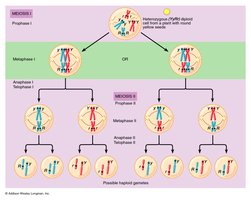
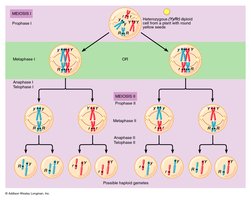
The Law of Independent Assortment states that two different genes will randomly assort their alleles during gamete formation. This means that the inheritance of one gene does not influence the inheritance of another, provided the genes are on different chromosomes or far apart on the same chromosome.
Random assortment occurs due to the random lining up of homologous chromosomes at metaphase I of meiosis.
Each gene's alleles are distributed independently into gametes.
This principle is foundational for predicting genetic ratios using Punnett squares.
Breaking the Law of Independent Assortment: Linked Genes
Sometimes, genes do not assort independently. This occurs when genes are located close together on the same chromosome, a phenomenon known as linkage. Linked genes are inherited together, violating the law of independent assortment.
Linkage means that chromosomes, rather than individual genes, are the units assorted into gametes.
Genes found together on the same chromosome tend to be passed together to offspring.
The Chromosomal Theory of Inheritance
The Chromosomal Theory of Inheritance explains how chromosomes carry genetic material and are responsible for inheritance patterns.
Chromosomes contain genetic material transmitted from parent to offspring.
Chromosomes are replicated and passed along generations and from cell to cell during mitosis.
Most eukaryotic cells are diploid, containing homologous pairs of chromosomes.
During meiosis, homologous chromosomes segregate independently, producing haploid cells.
Each parent contributes one set of chromosomes, functionally equivalent, to its offspring.
Linked Genes and Chromosome Mapping
Linked genes can be mapped to determine their relative positions on a chromosome. The frequency of recombination between linked genes is used to estimate the distance between them.
The farther apart two genes are, the more likely crossing over (recombination) will occur between them.
Recombination results in new combinations of alleles, called recombinant offspring.
Mapping uses recombination frequency to calculate genetic distance, measured in map units (centiMorgans, cM).
Meiosis and Linked Genes
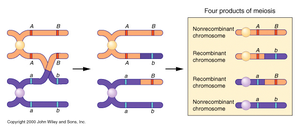
During meiosis, linked alleles can segregate together or be reassorted through crossing over. The products of meiosis reflect whether recombination has occurred.
Without crossing over, linked alleles segregate together, producing only parental types.
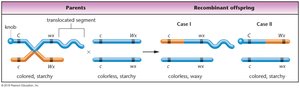
With crossing over, recombinant types are produced.
Recombination Frequency and Genetic Mapping
The frequency of recombination between linked genes is used to estimate their distance apart. The more recombination, the farther apart the genes are.
Parental phenotypes match the starting parents; nonparental (recombinant) phenotypes differ.
Recombination frequency is calculated using the formula:
Test crosses are essential for accurate mapping.
Example: Drosophila Test Cross
To map linked genes in Drosophila, a female heterozygote is crossed with a male homozygous recessive for both traits. The expected ratio is 1:1:1:1 if genes are unlinked. Deviations from this ratio indicate linkage.
Parentals: star eyes, normal wings; normal eyes, dumpy wings
Nonparentals: star eyes, dumpy wings; normal eyes, normal wings
Observed counts: parentals much greater than nonparentals
Chi Square Analysis for Linkage
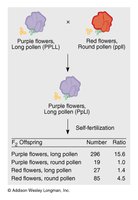
Chi square analysis is used to test the hypothesis that genes are not linked. If observed data significantly deviate from expected ratios, linkage is inferred.
Formula:
Degrees of freedom and critical values are used to determine significance.
Mapping Linked Genes: Calculation Example
Using test cross data, the map distance is calculated based on the number of recombinant offspring.
Example: cM
Map units reflect the frequency of recombination; higher values indicate greater distance.
Mapping Accuracy and Linkage Groups
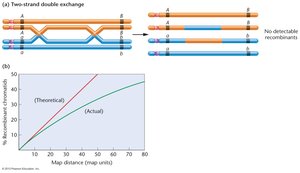
Mapping is relative; the closer two genes are, the more precise the map units. The farther apart, the less accurate the mapping becomes due to multiple crossovers.
Crossing Over: Physical Exchange Between Chromatids
Crossing over involves a physical exchange of genetic material between chromatids during meiosis, resulting in recombinant chromosomes.
Exceptions and Extensions
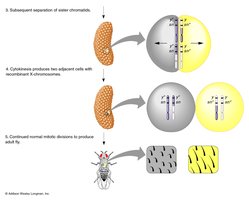
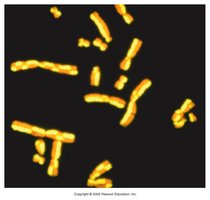
Sometimes inheritance violates the law of independent assortment due to linkage. Recombination can also occur in mitosis, leading to phenomena such as twin spot formation and sister chromatid exchanges.
Summary Table: Key Concepts in Chromosome Mapping
Concept | Definition | Application |
|---|---|---|
Independent Assortment | Random segregation of alleles | Punnett square predictions |
Linkage | Genes inherited together on same chromosome | Mapping, recombination analysis |
Recombination Frequency | Proportion of recombinant offspring | Genetic distance calculation |
Chi Square Analysis | Statistical test for linkage | Hypothesis testing |
Map Units (cM) | Distance between genes | Chromosome mapping |
