 Indietro
Chromosomes and Cellular Reproduction: Mitosis, Meiosis, and Genetic Variation
Guida di studio - Note intelligenti
 Appunti personalizzati basati sui tuoi materiali, ampliati con definizioni chiave, esempi e contesto.
Chromosome Structure and Organization
Chromosome Number and Karyotype
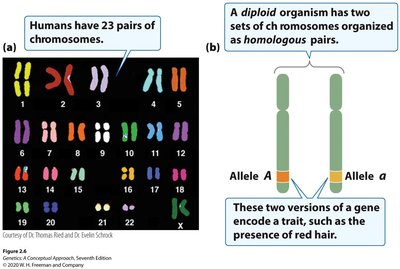
Chromosomes are the carriers of genetic information in cells. In humans, the diploid (2N) number of chromosomes is 46, organized into 23 homologous pairs. The haploid (1N) number, found in gametes, is 23. A karyotype is the complete set of chromosomes in a cell, used to study chromosomal abnormalities and genetic inheritance.
Homologous chromosomes: Pairs of chromosomes, one from each parent, carrying the same genes but possibly different alleles.
Locus: The specific location of a gene on a chromosome.
Centromere: The region responsible for chromosome segregation during cell division.
Telomeres: Protective structures at chromosome ends, maintaining length during replication.
The Cell Cycle
Phases of the Cell Cycle
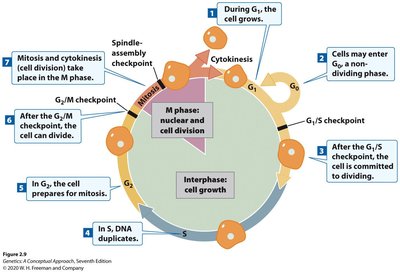
The cell cycle is the sequence of events that a cell undergoes to grow and divide. It consists of interphase (G1, S, G2) and the M phase (mitosis and cytokinesis).
G1 phase: Cell growth and preparation for DNA synthesis.
S phase: DNA replication, resulting in duplicated chromosomes (sister chromatids).
G2 phase: Preparation for mitosis.
M phase: Nuclear division (mitosis) and cytoplasmic division (cytokinesis).
Mitosis
Overview and Stages
Mitosis is the process by which a eukaryotic cell divides to produce two genetically identical daughter cells. It ensures equal distribution of chromosomes.
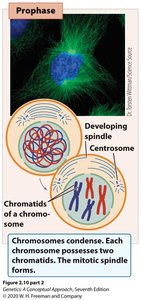
Prophase: Chromosomes condense, each with two sister chromatids; spindle apparatus forms.
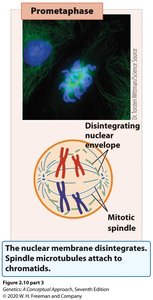
Prometaphase: Nuclear envelope disintegrates; spindle microtubules attach to kinetochores.
Metaphase: Chromosomes align at the metaphase plate.
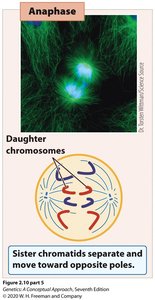
Anaphase: Sister chromatids separate and move to opposite poles.
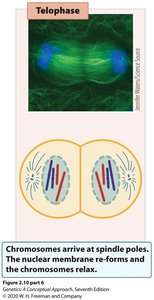
Telophase: Chromosomes arrive at poles, nuclear envelope reforms, chromosomes decondense.
Cytokinesis: Division of the cytoplasm, resulting in two cells.
Mitotic Spindle and Chromosome Movement
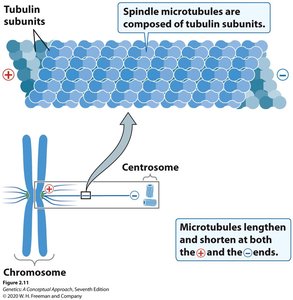
The mitotic spindle is a network of microtubules that segregates chromosomes during mitosis. Microtubules are dynamic, lengthening and shortening by adding or removing tubulin subunits. The spindle attaches to chromosomes at the kinetochore, a protein complex at the centromere.
Role of Cohesin
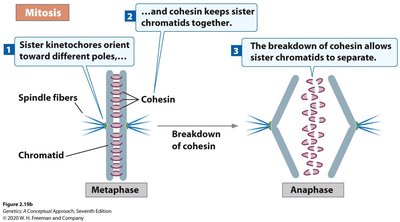
Cohesin is a protein complex that holds sister chromatids together. Its regulated degradation at the metaphase-anaphase transition allows chromatids to separate.
Genetic Consequences of Mitosis
Produces two genetically identical daughter cells.
Each cell receives a full set of chromosomes.
Chromosome and DNA Molecule Numbers During Mitosis
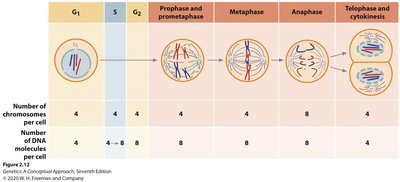
The number of chromosomes per cell equals the number of functional centromeres. After DNA replication, each chromosome consists of two sister chromatids (thus, twice the number of DNA molecules as chromosomes).
Phase | Chromosomes per cell | DNA molecules per cell |
|---|---|---|
G1 | 4 | 4 |
S | 4 | 4 → 8 |
G2 | 4 | 8 |
Prophase/Prometaphase | 4 | 8 |
Metaphase | 4 | 8 |
Anaphase | 8 | 8 |
Telophase/Cytokinesis | 4 | 4 |
Meiosis and Sexual Reproduction
Overview of Meiosis
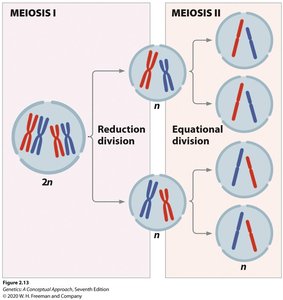
Meiosis is the process by which diploid cells produce haploid gametes, enabling sexual reproduction and genetic diversity. It consists of two divisions: Meiosis I (reductional) and Meiosis II (equational).
Meiosis I: Homologous chromosomes separate, reducing chromosome number by half.
Meiosis II: Sister chromatids separate, similar to mitosis.
Stages of Meiosis I
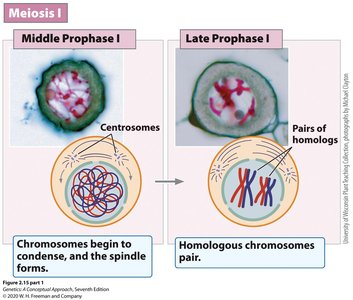
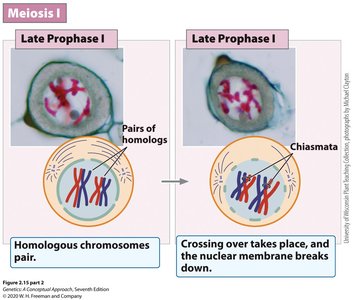
Prophase I: Chromosomes condense, homologs pair (synapsis), and crossing over occurs at chiasmata.
Metaphase I: Homologous pairs align at the metaphase plate.
Anaphase I: Homologous chromosomes separate; sister chromatids remain together.
Telophase I: Chromosomes arrive at poles; cells may enter a brief interkinesis.
Stages of Meiosis II
Prophase II: Chromosomes recondense if necessary.
Metaphase II: Chromosomes align at the metaphase plate.
Anaphase II: Sister chromatids separate and move to opposite poles.
Telophase II: Chromosomes arrive at poles; nuclei reform; cytokinesis produces four haploid cells.
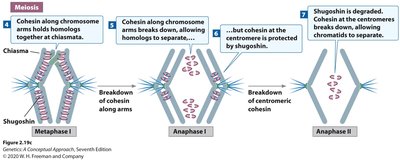
Role of Cohesin and Shugoshin in Meiosis
During meiosis, cohesin holds sister chromatids together, while shugoshin protects centromeric cohesin during Anaphase I, allowing only homologs to separate. In Anaphase II, shugoshin is degraded, permitting sister chromatid separation.
Genetic Consequences of Meiosis
Four genetically unique haploid cells are produced from each original diploid cell.
Chromosome number is halved in gametes.
Genetic variation arises from crossing over and independent assortment.
Genetic Variation: Crossing Over and Independent Assortment
Crossing Over
Crossing over is the exchange of genetic material between nonsister chromatids of homologous chromosomes during Prophase I. This process creates new combinations of alleles on the same chromosome, increasing genetic diversity.

Independent Assortment
Independent assortment refers to the random alignment and separation of homologous chromosome pairs during Metaphase I and Anaphase I. This shuffles alleles on different chromosomes, producing a vast number of possible genetic combinations in gametes.
The number of possible combinations is , where n is the number of chromosome pairs.
For humans (n = 23): possible combinations.
The Chromosome Theory of Inheritance
Historical Foundations
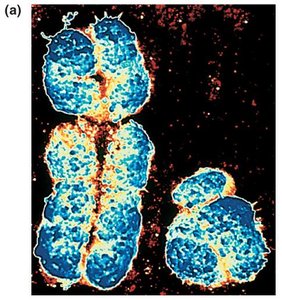
The chromosome theory of inheritance states that genes are located on chromosomes, and their behavior during meiosis explains Mendel's laws of inheritance. Walter Sutton and Theodor Boveri provided key evidence by studying chromosome behavior in grasshoppers, showing that chromosomes segregate and assort independently during gamete formation.
Sex determination in grasshoppers is based on the presence of X and Y chromosomes.
Fertilization restores the diploid number and determines the sex of the offspring (XX = female, XY = male).
Connection to Mendel's Laws
The physical separation of homologous chromosomes during meiosis forms the basis for Mendel's law of segregation and independent assortment.
Summary Table: Mitosis vs. Meiosis
Feature | Mitosis | Meiosis |
|---|---|---|
Number of divisions | 1 | 2 |
Number of daughter cells | 2 | 4 |
Chromosome number in daughter cells | Diploid (2N) | Haploid (N) |
Genetic identity | Identical | Unique |
Role | Growth, repair | Gamete production |
Practice Problems
Suggested problems for further study: Chapter 2 (9-12, 14-16, 29, 31, 32, 34, 35, 37) and Problem 30 from Chapter 3.
