 Indietro
DNA and the Molecular Structure of Chromosomes: Study Notes for Genetics Students
Guida di studio - Note intelligenti
 Appunti personalizzati basati sui tuoi materiali, ampliati con definizioni chiave, esempi e contesto.
DNA and the Molecular Structure of Chromosomes
Introduction
The molecular structure of chromosomes is fundamental to understanding genetics. Chromosomes are composed of DNA and associated proteins, which together store and regulate genetic information. This section explores the structure of DNA and RNA, the organization of nucleic acids, and the packaging of DNA within chromosomes.
Nucleic Acids: DNA and RNA
Types of Nucleic Acids
There are two primary types of nucleic acids in cells:
Deoxyribonucleic acid (DNA): The main carrier of genetic information in most organisms.
Ribonucleic acid (RNA): Functions in protein synthesis and regulation of gene expression.
Structure of Nucleic Acids
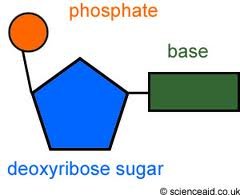
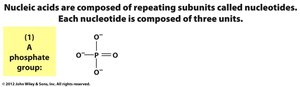
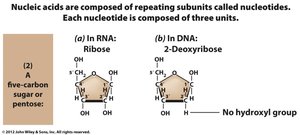
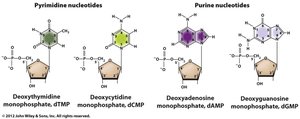
Nucleic acids are polymers made up of repeating subunits called nucleotides. Each nucleotide consists of three components:
Phosphate group
Five-carbon sugar (deoxyribose in DNA, ribose in RNA)
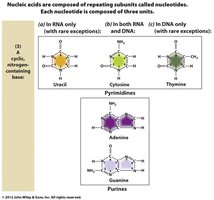
Nitrogenous base (purine or pyrimidine)
Nitrogenous Bases
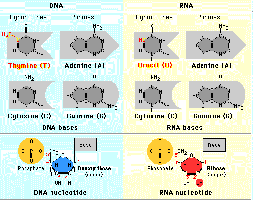
There are four bases in DNA:
Adenine (A)
Guanine (G)
Thymine (T)
Cytosine (C)
RNA contains:
Adenine (A)
Guanine (G)
Uracil (U) (replaces thymine)
Cytosine (C)
Bases are classified as:
Purines: Adenine and Guanine (double-ring structure)
Pyrimidines: Cytosine, Thymine, and Uracil (single-ring structure)
DNA vs. RNA
Structural Differences
DNA and RNA differ in several key aspects:
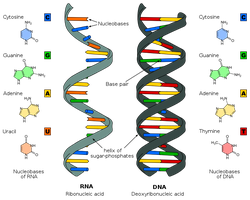
Strandedness: DNA is double-stranded (forms a double helix), while RNA is single-stranded.
Sugar: DNA contains deoxyribose; RNA contains ribose.
Bases: DNA uses thymine; RNA uses uracil.
Polymerization and Backbone Structure
Formation of Nucleic Acid Chains
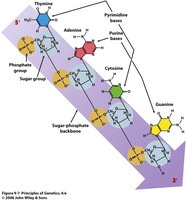
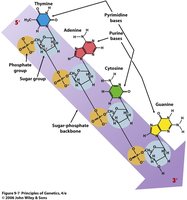
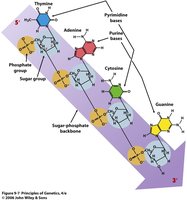
Nucleotides are joined together by covalent bonds between the 5’ carbon of one sugar and the 3’ carbon of the next, creating a sugar-phosphate backbone. This backbone is strong and provides chemical polarity (5’ to 3’ directionality).
Backbones and Rungs
The backbone consists of alternating sugars and phosphates, while the bases project inward and form the "rungs" of the DNA ladder.
Double Helix Structure
DNA Double Helix
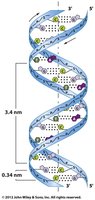
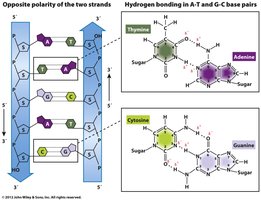
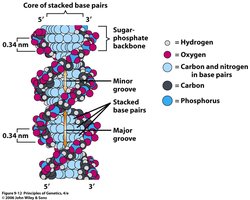
DNA is a double-stranded molecule, with two antiparallel strands forming a double helix. The bases pair specifically via hydrogen bonds:
Adenine (A) pairs with Thymine (T) (two hydrogen bonds)
Guanine (G) pairs with Cytosine (C) (three hydrogen bonds)
Base Pairing and Complementarity
Base pairing is highly specific, ensuring complementarity between the two strands. The concentration of A equals T, and G equals C. Each base pair consists of one purine and one pyrimidine.
Antiparallel Orientation
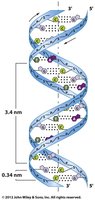
The two strands of DNA run in opposite directions (antiparallel), which is crucial for replication and transcription.
Stability of DNA
Forces Stabilizing DNA
DNA stability arises from:
Hydrogen bonds between base pairs (collectively strong)
Stacking forces (hydrophobic interactions between adjacent base pairs)
DNA Packaging in Chromosomes
Levels of DNA Packaging
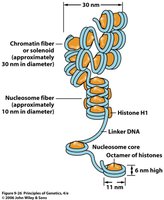
DNA is highly compacted within chromosomes through three levels of packaging:
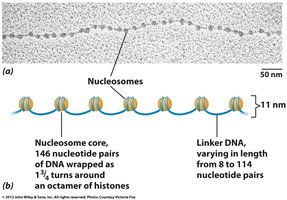
Nucleosome formation: DNA wraps around histone proteins, forming nucleosomes (11 nm fiber).
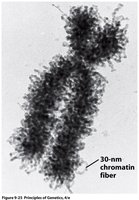
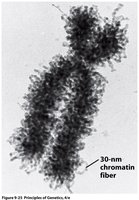
Chromatin fiber: Nucleosomes coil into a 30 nm chromatin fiber.
Higher-order structures: Chromatin fibers are further condensed by nonhistone proteins into metaphase chromosomes.
Chromosomal Features: Centromeres and Telomeres
Centromeres
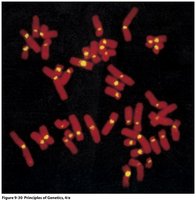
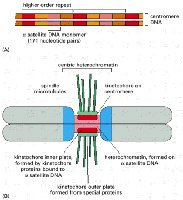
Centromeres are essential for chromosome segregation during cell division. They contain specific DNA sequences (satellite DNA) and protein binding sites.
Telomeres
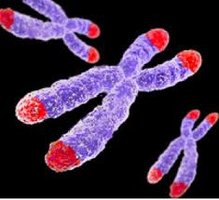
Telomeres are located at the ends of eukaryotic chromosomes and have unique properties that protect chromosome integrity.
Summary Table: DNA vs. RNA
Feature | DNA | RNA |
|---|---|---|
Strandedness | Double-stranded | Single-stranded |
Sugar | Deoxyribose | Ribose |
Bases | A, T, G, C | A, U, G, C |
Function | Genetic information storage | Protein synthesis, regulation |
Key Equations
Base Pairing:
DNA Double Helix:
Conclusion
Understanding the molecular structure of DNA and chromosomes is foundational for genetics. The organization, stability, and packaging of DNA enable the accurate transmission and expression of genetic information.
