 Indietro
DNA as the Genetic Material: Historical Experiments and Molecular Structure
Guida di studio - Note intelligenti
 Appunti personalizzati basati sui tuoi materiali, ampliati con definizioni chiave, esempi e contesto.
DNA as the Genetic Material
Introduction to the Genetic Material
The identification of DNA as the genetic material was a pivotal moment in genetics. Early geneticists defined genes by patterns of inheritance, but the molecular nature of genes was not understood until the mid-20th century. This section explores the historical experiments that established DNA as the genetic material and describes the molecular structure of DNA.
Historical Perspectives in Genetics
Four Major Periods of Genetics History
1850–1900: Mendel’s studies on heredity and the discovery of chromosomes.
1900–1953: Rediscovery of Mendel’s work, chromosome theory of heredity, and the identification of DNA as the genetic material.
1953–2003: Elucidation of the central dogma, molecular biology revolution, and recombinant DNA technology.
2003–present: Era of genomics and comprehensive analysis of genomes and gene expression.
Defining Genes
Classical and Molecular Definitions
Classical genetics: Genes are units of inheritance that control phenotypic traits and reside on chromosomes.
Molecular genetics: A gene is a segment of DNA that encodes the information to produce a functional product, usually a protein.
Genotype refers to the genetic constitution of an organism, while phenotype is the observable expression of the genotype.
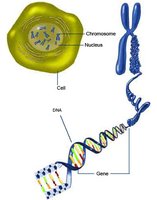
The Central Dogma of Molecular Biology
Flow of Genetic Information
The central dogma describes the flow of genetic information from DNA to RNA to protein, which determines an organism’s form and function.
DNA stores genetic information.
RNA acts as an intermediary.
Proteins perform cellular functions.
Mutations in DNA can lead to changes in RNA and proteins, resulting in altered phenotypes.
Discovery of Nucleic Acids
Miescher and the Identification of Nuclein
Friedrich Miescher isolated a substance from cell nuclei, termed "nuclein," which contained carbon, hydrogen, oxygen, nitrogen, and phosphorus.
Later identified as a mixture of proteins and nucleic acids (chromatin).
Edmund Wilson suggested nuclein might be the genetic material.
Protein or DNA: The Genetic Material Debate
Early 20th Century Understanding
Chromosomes were known to contain both protein and DNA.
Proteins, with 20 amino acids, were considered more complex than DNA, which has only 4 bases.
Many scientists initially believed proteins were the genetic material.
Griffith’s Experiments and the Transforming Principle
Griffith’s Pneumococcus Experiments (1928)
Used two strains of Pneumococcus bacteria: Smooth (S, virulent) and Rough (R, non-virulent).
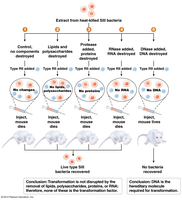
Heat-killed S strain could not cause disease, but when mixed with live R strain, mice died and live S bacteria were recovered.
Conclusion: A "transforming principle" from dead S bacteria transformed R bacteria into virulent S type.
Avery, MacLeod, and McCarty’s Experiments
Identification of DNA as the Transforming Principle (1944)
Cell extracts from S strain were treated with enzymes to destroy polysaccharides, lipids, proteins, or RNA—transformation still occurred.
When DNA was destroyed with DNase, transformation did not occur.
Conclusion: DNA is the transforming principle and carries genetic information.
The Hershey-Chase Experiment (1952)
Confirmation that DNA is the Genetic Material
Bacteriophages (viruses that infect bacteria) were labeled with radioactive isotopes: phosphorus-32 (DNA) and sulfur-35 (protein).
After infection of E. coli, only the radioactive DNA entered the bacterial cells, not the protein.
Conclusion: DNA, not protein, is the genetic material in phages.
Properties Required of Genetic Material
Stable storage of information controlling form, structure, function, development, and behavior.
Accurate replication for inheritance.
Capacity for change (mutation) to allow evolution.
Molecular Structure of DNA and RNA
Nucleic Acids and Nucleotides
DNA (deoxyribonucleic acid) and RNA (ribonucleic acid) are polymers of nucleotides.
Each nucleotide consists of a pentose sugar, a phosphate group, and a nitrogenous base (purine or pyrimidine).
A nucleoside is a sugar plus a base; a nucleotide is a nucleoside plus phosphate.
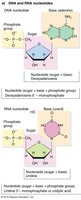
DNA Bases and Nucleotides
Four bases in DNA: Adenine (A), Guanine (G), Cytosine (C), Thymine (T).
Four nucleotides: dAMP, dGMP, dCMP, dTMP.
Chargaff’s Rules
Base Composition of DNA
DNA contains four bases: A, C, G, T.
The amount of A equals T, and the amount of G equals C in any species (1:1 ratio of purines to pyrimidines).
Base composition varies between species.
Determining the Structure of DNA
Contributions of Franklin, Wilkins, Watson, and Crick
Rosalind Franklin’s X-ray crystallography revealed repeating structures in DNA (0.34 nm and 3.4 nm).
Watson and Crick (1953) proposed the double helix model based on available data.
DNA consists of two antiparallel, complementary strands forming a right-handed double helix.
The sugar-phosphate backbone forms the outside, while paired bases (A-T, G-C) form the rungs, held together by hydrogen bonds.
