 Indietro
DNA Damage, Mutation Types, and Their Consequences
Guida di studio - Note intelligenti
 Appunti personalizzati basati sui tuoi materiali, ampliati con definizioni chiave, esempi e contesto.
DNA Damage and Mutation
Introduction to DNA Mutations
Mutations are permanent changes in the DNA sequence that can affect gene function and phenotype. They arise from errors during DNA replication, environmental factors, or spontaneous chemical changes. Understanding the molecular basis of mutation is essential for genetics, as mutations are the source of genetic variation and can lead to disease.
Main Types of DNA Mutations
DNA mutations are classified based on their effect on the sequence and protein product:
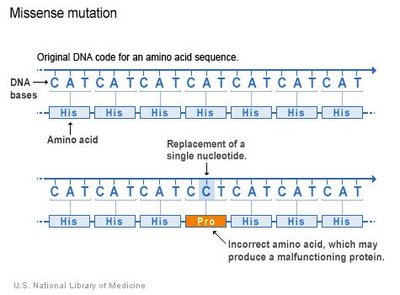
Missense Mutation: A single nucleotide change results in the substitution of one amino acid for another in a protein, potentially altering its function.
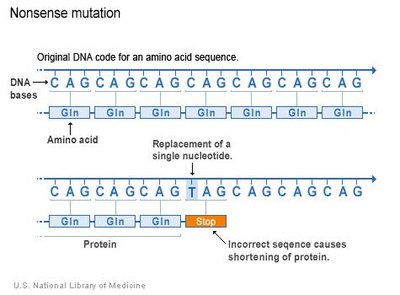
Nonsense Mutation: A nucleotide change creates a premature stop codon, leading to a truncated, usually nonfunctional protein.
Silent Mutation: A nucleotide change does not alter the amino acid sequence due to the redundancy of the genetic code; phenotype remains unchanged.
Insertion: Addition of one or more DNA bases, which can disrupt the reading frame if not in multiples of three.
Deletion: Removal of one or more DNA bases, potentially causing frameshift mutations.
Frameshift Mutation: Insertions or deletions that are not multiples of three shift the reading frame, altering downstream amino acids.
Repeat Expansion: Increase in the number of repeated DNA sequences, often associated with genetic disorders (e.g., Huntington disease).
Base Pair Substitutions: Transitions and Transversions
Base pair substitutions are categorized as:
Transition: Replacement of a purine with another purine (A ↔ G) or a pyrimidine with another pyrimidine (C ↔ T).
Transversion: Replacement of a purine with a pyrimidine or vice versa (A ↔ T/C, G ↔ T/C). Transversions are less frequent and often cause more dramatic structural changes in DNA.
Molecular Mechanisms of Mutation
Tautomeric Shifts and Base Pairing Errors
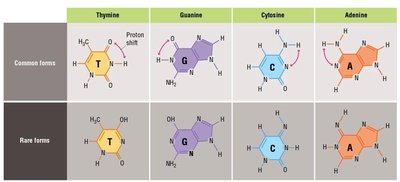
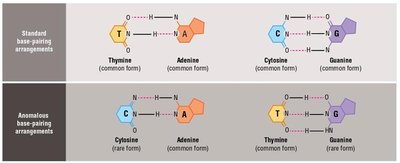
Alternate forms of nucleotides, called tautomers, arise from proton shifts and double bond rearrangements. These rare forms can mispair during DNA replication, leading to mutations.
Tautomeric shifts: Cause incorrect hydrogen bonding between bases, resulting in base pair substitutions.
DNA Polymerase Proofreading
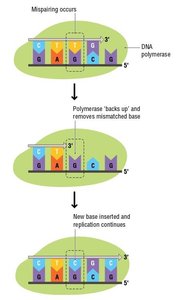
DNA polymerase enzymes possess proofreading activity, which significantly reduces mutation rates during DNA replication.
Proofreading: The enzyme detects and removes mismatched bases, decreasing error rates from 1 in 105-106 to about 1 in 109 per replication cycle.
Environmental DNA Damage
UV-Induced DNA Damage
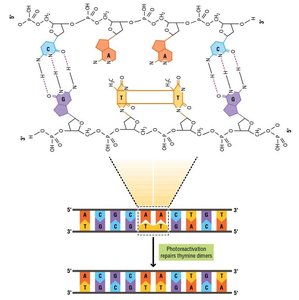
Ultraviolet (UV) irradiation causes the formation of thymine dimers, which create a bulge in the DNA helix and block replication and transcription. DNA repair enzymes recognize and remove these lesions.
Thymine dimers: Covalent bonds between adjacent thymine bases, leading to DNA distortion.
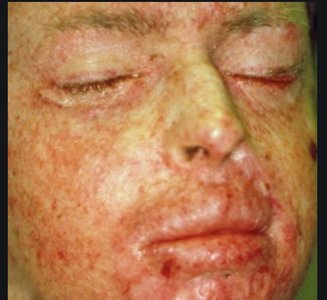
Clinical relevance: Xeroderma pigmentosum is a rare autosomal recessive disorder characterized by extreme sensitivity to UV light due to defective DNA repair.
Replication Slippage and Repeat Expansion
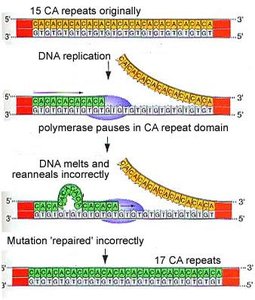
Replication Slippage
Replication slippage occurs when DNA polymerase stutters at repeated DNA motifs, leading to the addition or loss of repeat units. This mechanism is responsible for repeat expansion disorders.
Example: Huntington disease is caused by expansion of CAG trinucleotide repeats.
Cell Cycle Checkpoints and DNA Repair
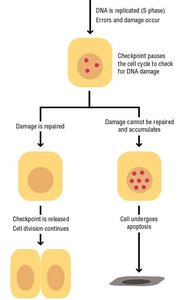
Cell Cycle Checkpoints
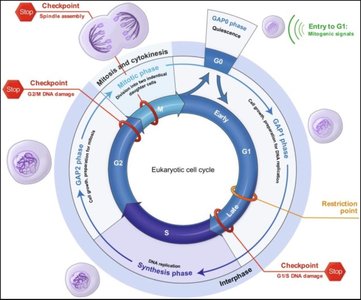
Cell cycle checkpoints monitor DNA integrity and prevent the propagation of damaged DNA. If errors are detected, cells activate repair mechanisms or undergo apoptosis.
TP53: A tumor suppressor gene that activates DNA damage response and halts the cell cycle. Mutations in TP53 are common in cancer.
Consequences of DNA Mutations
Genes Affected by Mutations
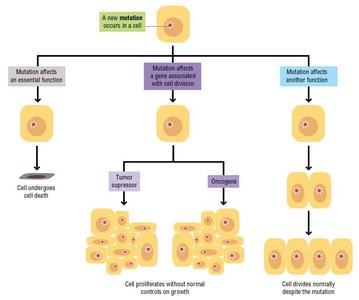
Mutations can affect different classes of genes:
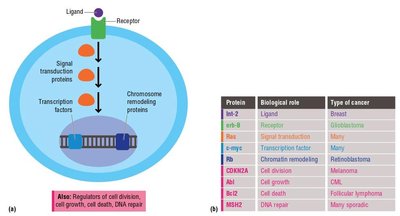
Tumor Suppressor Genes: Normally prevent cancer by regulating cell growth, DNA repair, and cell cycle checkpoints. Loss-of-function mutations promote cancer.
Oncogenes: Genes that, when mutated (gain-of-function), drive cancer progression by enhancing cell proliferation. Examples include Ras.
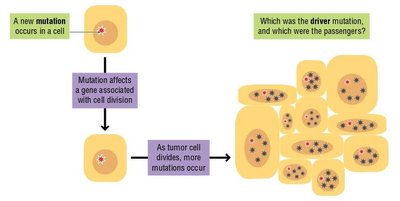
Driver vs. Passenger Mutations
In cancer, mutations are classified as:
Driver mutations: Initiate or promote cancer development.
Passenger mutations: Accumulate as a consequence of the original driver mutation and may further enhance cancer progression.
Summary Table: Types of DNA Mutations
Type of Mutation | Effect | Example |
|---|---|---|
Missense | Single amino acid change | Sickle cell anemia |
Nonsense | Premature stop codon | Duchenne muscular dystrophy |
Silent | No change in protein | Synonymous codon change |
Insertion | Adds bases | Cystic fibrosis (3 bp deletion) |
Deletion | Removes bases | Alpha-thalassemia |
Frameshift | Alters reading frame | Tay-Sachs disease |
Repeat Expansion | Increases repeat number | Huntington disease |
Additional info: Academic context was added to clarify mutation types, mechanisms, and clinical relevance. Examples and table entries were inferred for completeness.
