 Indietro
DNA Replication: Mechanisms, Proteins, and Differences in Prokaryotes and Eukaryotes
Guida di studio - Note intelligenti
 Appunti personalizzati basati sui tuoi materiali, ampliati con definizioni chiave, esempi e contesto.
DNA Replication: An Introduction
Definition and Purpose
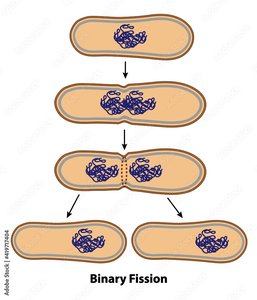
DNA replication is the biological process by which a cell copies its DNA, ensuring genetic information is accurately transmitted to daughter cells during cell division. This process is essential for cell survival, growth, and division.
Definition: The synthesis of new DNA molecules from an existing template.
Purpose: To maintain genetic continuity across generations of cells.
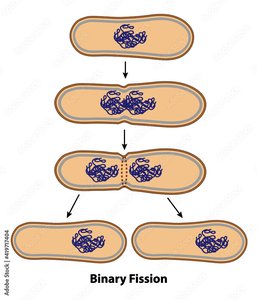
Modes of DNA Replication
There are three theoretical modes of DNA replication: conservative, semi-conservative, and dispersive. The actual mode is determined experimentally.
Conservative: The parental DNA remains intact, and a completely new molecule is synthesized.
Semi-conservative: Each new DNA molecule contains one parental strand and one newly synthesized strand.
Dispersive: Both strands of each new DNA molecule contain interspersed segments of parental and new DNA.
Meselson and Stahl’s Experiment
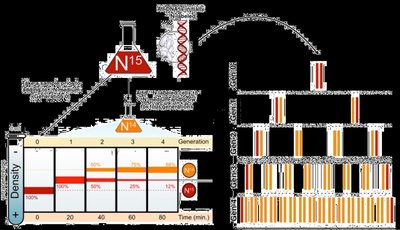
This classic experiment demonstrated that DNA replication is semi-conservative. Bacteria were grown in media containing heavy (15N) and then light (14N) nitrogen isotopes. DNA was extracted and analyzed by density gradient centrifugation.
Key Steps: Growth in 15N, switch to 14N, DNA extraction, centrifugation, observation of DNA bands.
Result: After one replication, DNA had intermediate density; after two, both intermediate and light bands appeared, confirming semi-conservative replication.
Mechanism of DNA Replication
Overview of Steps
DNA replication occurs in three main steps: initiation, elongation, and termination. The general mechanism is conserved in prokaryotes and eukaryotes, though eukaryotic replication is more complex.
Initiation: DNA is unwound to form single strands.
Elongation: New DNA strand is synthesized.
Termination: Replication is completed and DNA molecules are separated.
Initiation of DNA Replication
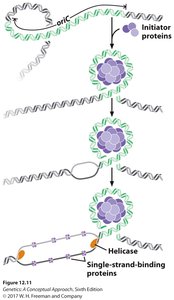
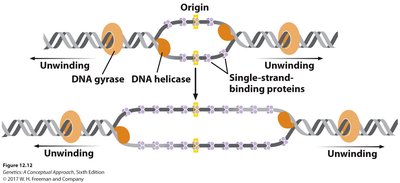
Replication begins at specific sites called origins of replication. Initiator proteins bind to these sites, unwinding the DNA and recruiting helicase to further separate the strands.
Origin of Replication: The site where DNA synthesis begins. Prokaryotes typically have a single origin, while eukaryotes have multiple origins per chromosome.
Initiator Proteins: Bind to the origin and start unwinding the DNA.
DNA Helicase: Further unwinds the DNA, creating single-stranded regions.
Single-Strand-Binding Proteins (SSBs): Stabilize single-stranded DNA and keep bases exposed for replication.
Relieving Torsional Strain
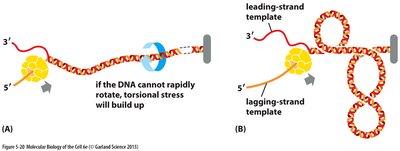
As helicase unwinds DNA, supercoiling and torsional strain occur ahead of the replication fork. DNA gyrase (a type of topoisomerase) relieves this strain by cutting, rotating, and rejoining the DNA.
DNA Gyrase/Topoisomerase: Enzyme that relieves torsional strain by temporarily breaking and rejoining DNA strands.
Replication Fork
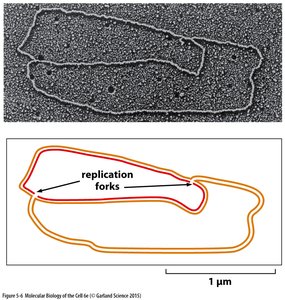
The replication fork is the region where the DNA is actively unwound and new strands are synthesized. Each origin of replication generates two replication forks that move in opposite directions.
Replication Fork: The Y-shaped region where DNA is split into two single strands for replication.
Proteins Involved in Initiation
Multiple proteins coordinate the initiation of DNA replication, including initiator proteins, helicase, SSBs, and DNA gyrase.
Initiator Proteins: Recognize and bind to the origin.
Helicase: Unwinds DNA.
SSBs: Stabilize single-stranded DNA.
DNA Gyrase: Relieves supercoiling.
Elongation of DNA Replication
Key Steps and Proteins
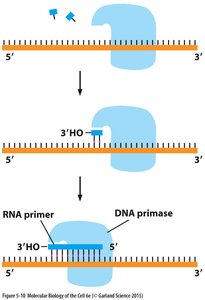
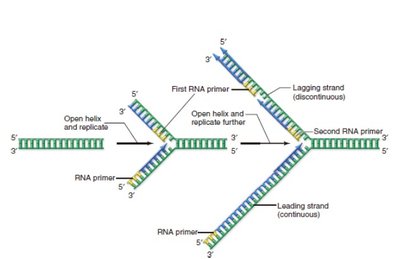
During elongation, DNA polymerase synthesizes new DNA strands using the parental DNA as a template. DNA polymerase requires a primer with a free 3'-OH group to begin synthesis.
DNA Polymerase: Enzyme that adds nucleotides to the growing DNA strand.
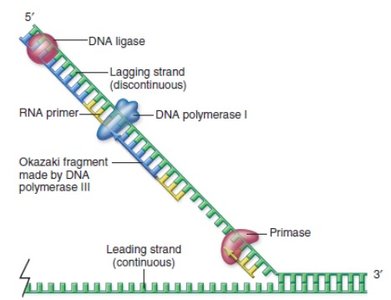
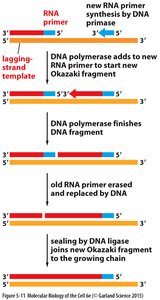
Primase: Synthesizes a short RNA primer complementary to the template strand, providing a free 3'-OH group.
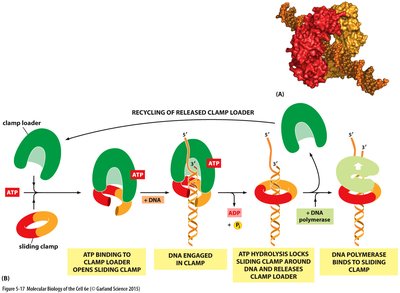
Sliding Clamp: Holds DNA polymerase in place for efficient synthesis.
Leading and Lagging Strands
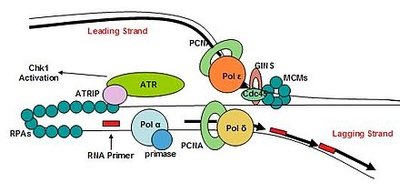
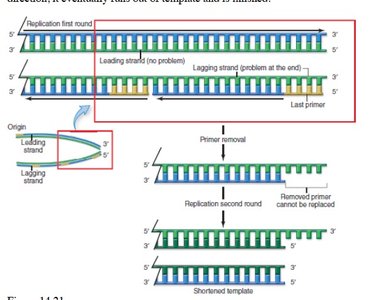
DNA polymerase synthesizes DNA only in the 5' to 3' direction. The leading strand is synthesized continuously, while the lagging strand is synthesized discontinuously in short fragments called Okazaki fragments.
Leading Strand: Synthesized continuously in the direction of the replication fork.
Lagging Strand: Synthesized discontinuously, opposite to the direction of the replication fork, in Okazaki fragments.
Okazaki Fragments: Short DNA fragments synthesized on the lagging strand.
Fidelity (Accuracy) in DNA Replication
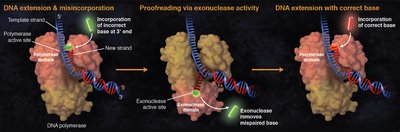
DNA replication is highly accurate due to the correct selection of nucleotides and proofreading by DNA polymerase. The enzyme's exonuclease activity removes incorrectly paired nucleotides.
Proofreading: DNA polymerase senses mismatches and removes incorrect nucleotides using its 3' to 5' exonuclease activity.
Error Rate: Approximately 1 in 10 million nucleotides.
Termination of DNA Replication
Mechanisms of Termination
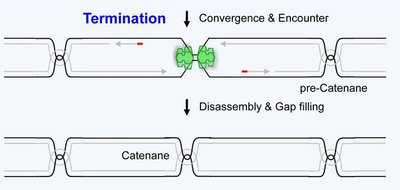
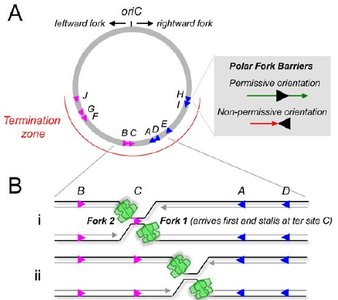
Replication is terminated when two replication forks meet or when specific termination sequences (Ter sites) are encountered. The process involves removal of RNA primers, gap filling, and ligation.
Fork Convergence: Replication ends when forks meet.
Ter Sites: Specific DNA sequences that signal termination.
RNA Primer Removal: RNAse H removes primers; DNA polymerase fills gaps; DNA ligase joins fragments.
Decatenation: Topoisomerases resolve interlocked DNA molecules (catenanes) to produce independent daughter DNA molecules.
DNA Replication in Eukaryotes: Overview and Differences
Key Differences Between Prokaryotic and Eukaryotic DNA Replication
Eukaryotic DNA replication is more complex due to linear chromosomes, multiple origins of replication, and the presence of telomeres.
Multiple Origins: Eukaryotic chromosomes have many origins of replication.
Linear DNA: Eukaryotic DNA is linear, creating challenges at chromosome ends.
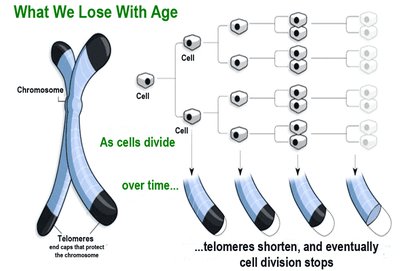
Telomeres: Repetitive DNA sequences at chromosome ends that protect genetic information.
Telomeres and Telomerase
Telomeres shorten with each round of replication, acting as an internal clock for cell division. Telomerase, an RNA-dependent DNA polymerase, extends telomeres in certain cells, allowing continued division.
Telomeres: Protective caps at chromosome ends; prevent loss of genetic information.
Telomerase: Enzyme with an RNA template that extends telomeres, active in stem cells and cancer cells.
Cell Aging: Telomere shortening limits cell division; when telomeres are depleted, cells stop dividing.
Summary Table: Key Proteins in DNA Replication
Protein/Enzyme | Function |
|---|---|
Initiator Proteins | Bind to origin of replication and start unwinding DNA |
DNA Helicase | Unwinds DNA strands |
Single-Strand-Binding Proteins (SSBs) | Stabilize single-stranded DNA |
DNA Gyrase/Topoisomerase | Relieves torsional strain |
Primase | Synthesizes RNA primer |
DNA Polymerase | Synthesizes new DNA strand |
Sliding Clamp | Holds DNA polymerase in place |
RNAse H | Removes RNA primers |
DNA Ligase | Joins DNA fragments |
Telomerase | Extends telomeres in eukaryotes |
Key Equations
Directionality of DNA Synthesis:
Proofreading Activity:
Summary
DNA replication is essential for genetic continuity.
Replication is semi-conservative, as shown by Meselson and Stahl.
Initiation, elongation, and termination involve coordinated action of multiple proteins.
Eukaryotic replication is more complex due to linear chromosomes and telomeres.
Telomerase extends telomeres, allowing continued cell division in certain cells.
