 Indietro
DNA Structure and Analysis: Foundations of Genetic Material
Guida di studio - Note intelligenti
 Appunti personalizzati basati sui tuoi materiali, ampliati con definizioni chiave, esempi e contesto.
DNA Structure and Analysis
Introduction
This chapter explores the discovery, structure, and properties of DNA as the genetic material. It covers the historical experiments that established DNA's role, the chemical nature of nucleic acids, and the molecular architecture of DNA and RNA. Understanding these concepts is fundamental to all of genetics.
Historical Foundations of DNA as Genetic Material
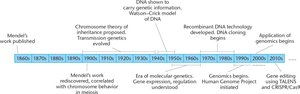
Timeline of Key Discoveries
The identification of DNA as the genetic material was a cumulative process involving many scientists and technological advances.
1860s: Mendel's work on inheritance published.
1900s: Chromosome theory of inheritance proposed.
1940s: DNA shown to carry genetic information.
1950s: Structure of DNA elucidated by Watson and Crick.
1970s–2000s: Recombinant DNA technology, genomics, and gene editing developed.
Essential Characteristics of Hereditary Material
For a molecule to serve as genetic material, it must:
Replicate accurately for inheritance.
Store information for cellular structure and function.
Express information to direct cellular processes.
Transmit information to the next generation.
Mutate to allow genetic variation.
DNA vs. Protein as Genetic Material
Early 20th-century scientists debated whether DNA or protein was the genetic material. Proteins, with 20 amino acids, were considered more complex than DNA, which was thought to be a simple polymer of four nucleotides.
Griffith's Transformation Experiment
Frederick Griffith (1928) demonstrated that a "transforming principle" from dead virulent bacteria could convert non-virulent bacteria into a virulent form, suggesting the transfer of genetic information.
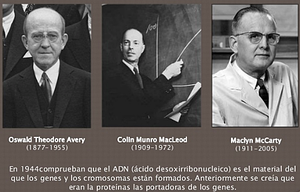
Avery, MacLeod, and McCarty Experiment
These scientists fractionated bacterial extracts and showed that only the DNA fraction could transform non-virulent bacteria, providing strong evidence that DNA is the genetic material.
Hershey-Chase Blender Experiment
Using bacteriophages labeled with radioactive isotopes, Hershey and Chase demonstrated that DNA, not protein, enters bacterial cells and directs viral replication, confirming DNA as the genetic material.
Supporting Evidence: UV Mutagenesis and DNA Content
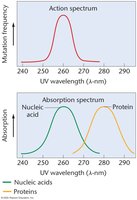
DNA absorbs UV light at 260 nm, the same wavelength most effective at inducing mutations, further linking DNA to genetic function. Additionally, the amount of DNA correlates with chromosome number in cells.
Chemical Structure of DNA and RNA
Nucleotides: The Building Blocks
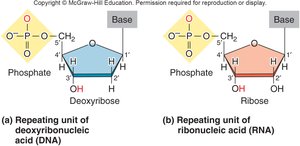
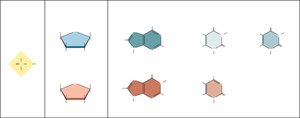
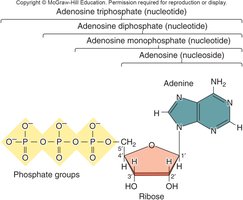
Nucleic acids are polymers of nucleotides, each consisting of a phosphate group, a five-carbon sugar (deoxyribose in DNA, ribose in RNA), and a nitrogenous base.
Nitrogenous Bases
Purines: Adenine (A) and Guanine (G) – double-ring structures.
Pyrimidines: Cytosine (C), Thymine (T, in DNA), and Uracil (U, in RNA) – single-ring structures.
Nucleosides and Nucleotides
A nucleoside is a base plus sugar; a nucleotide is a base, sugar, and phosphate group. Nucleotides are joined by phosphodiester bonds between the 5' phosphate and 3' hydroxyl groups of adjacent sugars, giving the strand directionality (5' to 3').
Discovery of DNA Structure
Chargaff's Rules
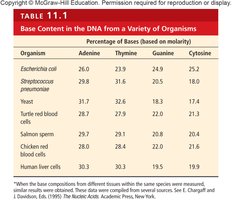
Erwin Chargaff found that in DNA, the amount of adenine equals thymine (A = T) and guanine equals cytosine (G = C), suggesting base pairing.
Organism | Adenine (%) | Thymine (%) | Guanine (%) | Cytosine (%) |
|---|---|---|---|---|
Escherichia coli | 26.0 | 23.9 | 24.9 | 25.2 |
Streptococcus | 29.8 | 31.6 | 20.5 | 18.0 |
Turtle red blood cells | 28.7 | 27.7 | 17.3 | 21.3 |
Salmon sperm | 29.2 | 29.1 | 20.8 | 21.0 |
Chicken red blood cells | 28.0 | 23.4 | 22.0 | 21.6 |
Human liver cells | 30.3 | 30.3 | 19.5 | 19.9 |
Rosalind Franklin's X-ray Diffraction
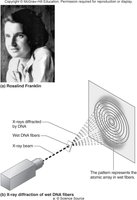
Franklin's X-ray diffraction images revealed that DNA is a helical molecule with a regular structure, about 2 nm in diameter, and 10 base pairs per turn.
Watson and Crick Model
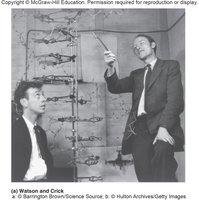
Watson and Crick integrated Chargaff's rules and Franklin's data to propose the double helix model of DNA in 1953. The two strands are antiparallel and held together by hydrogen bonds between complementary bases (A-T and G-C).
Key Features of DNA Structure
Double Helix and Base Pairing
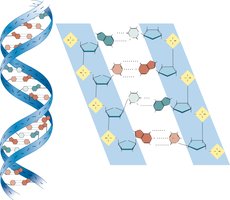
Two antiparallel strands (5' to 3' and 3' to 5').
Right-handed helix with 10 base pairs per turn.
Sugar-phosphate backbone on the outside, bases on the inside.
Base pairs: A-T (2 hydrogen bonds), G-C (3 hydrogen bonds).
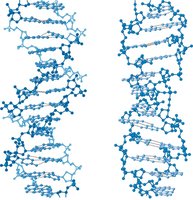
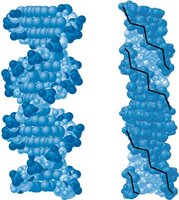
Major and minor grooves provide binding sites for proteins.
Antiparallel Polarity
The two DNA strands run in opposite directions, which is essential for replication and function.
Phosphodiester Bonds
Phosphodiester bonds link nucleotides, forming the sugar-phosphate backbone and giving DNA its stability and directionality.
Structural Forms of DNA
DNA can exist in several forms, including B-DNA (the most common in cells), A-DNA, and Z-DNA. These forms differ in helical structure and conditions of formation.
RNA Structure and Types
Differences Between DNA and RNA
RNA contains ribose sugar; DNA contains deoxyribose.
RNA uses uracil (U) instead of thymine (T).
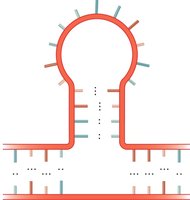
RNA is usually single-stranded but can form secondary structures (hairpins, loops).
RNA Secondary Structures
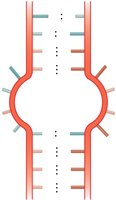
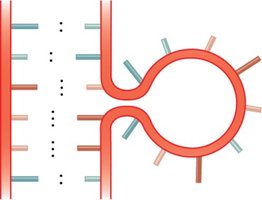
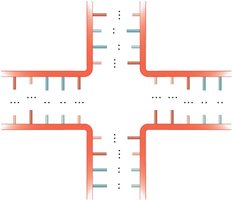
RNA molecules can fold into complex shapes due to intramolecular base pairing, forming structures such as bulge loops, internal loops, multibranched junctions, and stem-loops.
Major Classes of RNA
mRNA (messenger RNA): Template for protein synthesis.
tRNA (transfer RNA): Brings amino acids to ribosomes during translation.
rRNA (ribosomal RNA): Structural and catalytic component of ribosomes.
Summary: DNA as the Genetic Material
DNA fulfills all criteria for genetic material: information storage, replication, transmission, and variation.
Its double helix structure enables accurate replication and expression of genetic information.
