 Indietro
DNA Structure and Replication: Foundations of Heredity
Guida di studio - Note intelligenti
 Appunti personalizzati basati sui tuoi materiali, ampliati con definizioni chiave, esempi e contesto.
DNA Structure and Replication
Introduction
This chapter explores the molecular basis of heredity by examining the structure of DNA and the mechanisms of its replication. Understanding these processes is fundamental to genetics, as they underpin the transmission and expression of genetic information in all living organisms.
DNA as the Hereditary Molecule
Essential Characteristics of Hereditary Material
Localization: Hereditary material is found in the nucleus and is a component of chromosomes.
Stability: It exists in a stable form within cells.
Complexity: It is sufficiently complex to encode all information necessary for structure, function, development, and reproduction.
Replication: It can accurately replicate itself, ensuring daughter cells inherit identical information.
Mutability: It can undergo rare mutations, introducing genetic variation essential for evolution.
Discovery of DNA as Hereditary Material
Friedrich Miescher (1869): Isolated "nuclein" (DNA) from white blood cell nuclei.
Edmund Wilson (1895): Suggested DNA might be hereditary material, noting equal chromosome contribution from sperm and egg.
Mendelian Principles Rediscovered (1900): Sutton and Boveri linked chromosome behavior to inheritance.
DNA Chemistry: Identified as a polynucleotide with four bases: adenine (A), thymine (T), cytosine (C), guanine (G).
Experimental Evidence for DNA as Hereditary Material
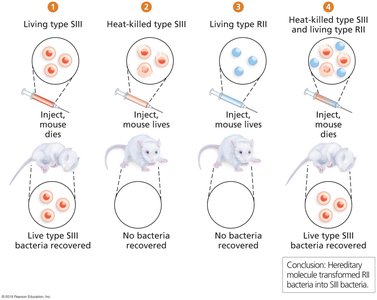
Griffith’s Transformation Experiment
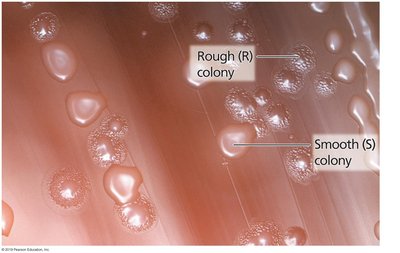
Used Pneumococcus bacteria: smooth (S) strain (virulent) and rough (R) strain (non-virulent).
Showed that a "transformation factor" from heat-killed S strain could convert R strain into virulent S strain.
Avery, MacLeod, and McCarty Experiment
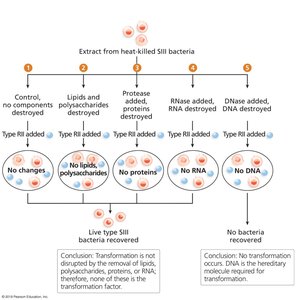
Demonstrated that DNA, not protein or RNA, is the transformation factor responsible for heredity.
Destruction of DNA in extracts prevented transformation; destruction of proteins or RNA did not.
Hershey-Chase Experiment
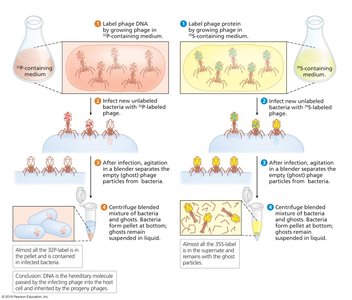
Used bacteriophages labeled with radioactive isotopes to show that DNA, not protein, enters bacterial cells and directs viral replication.
Confirmed DNA as the hereditary molecule.
The Structure of DNA
DNA Nucleotides
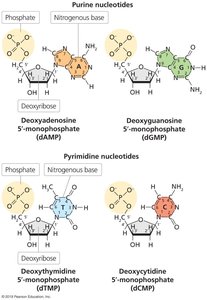
Each nucleotide consists of a deoxyribose sugar, a phosphate group, and a nitrogenous base.
Bases are either purines (adenine, guanine) or pyrimidines (thymine, cytosine).
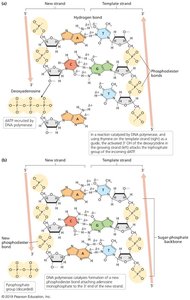
Nucleotides are linked by phosphodiester bonds between the 3' hydroxyl and 5' phosphate groups.
Assembly of Polynucleotide Chains
DNA polymerase catalyzes the formation of phosphodiester bonds, creating a sugar-phosphate backbone.
Chains have directionality: a 5' end (phosphate) and a 3' end (hydroxyl).
The Double Helix
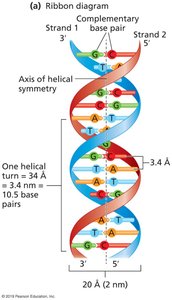
DNA consists of two antiparallel strands forming a right-handed double helix (B-form).
Base pairing is complementary: A pairs with T (2 hydrogen bonds), G pairs with C (3 hydrogen bonds).
Base stacking and helical twisting stabilize the structure.
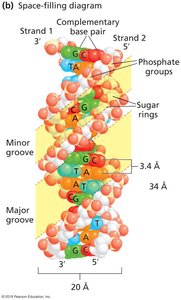
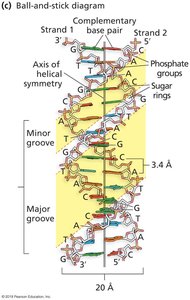
Major and Minor Grooves
Base-pair stacking creates major (12 Å) and minor (6 Å) grooves, which are binding sites for DNA-binding proteins.
Forms of DNA
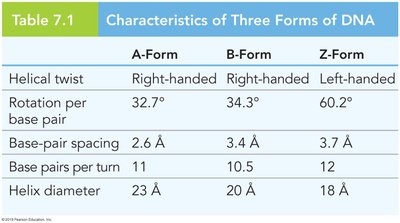
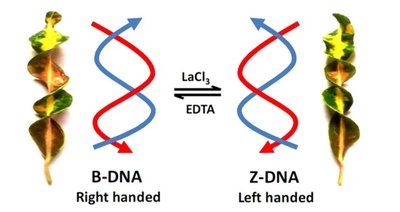
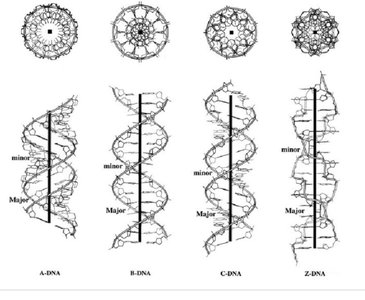
B-form: Most common, right-handed helix, 10.5 base pairs per turn, 20 Å diameter.
A-form: Right-handed, 11 base pairs per turn, 23 Å diameter, found in some DNA-protein complexes and bacteriophage.
Z-form: Left-handed, 12 base pairs per turn, 18 Å diameter, found near transcription start sites.
Form | Helical Twist | Base Pairs/Turn | Diameter (Å) |
|---|---|---|---|
A-form | Right-handed | 11 | 23 |
B-form | Right-handed | 10.5 | 20 |
Z-form | Left-handed | 12 | 18 |
DNA Replication Mechanisms
Semiconservative Replication
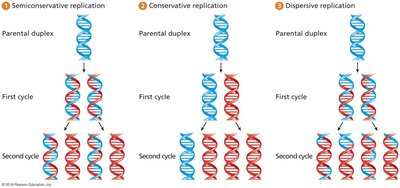
Each parental DNA strand serves as a template for a new strand, resulting in two daughter duplexes, each with one parental and one new strand.
Alternative models: Conservative (parental strands stay together) and dispersive (segments of parental and daughter strands interspersed).
Meselson-Stahl Experiment
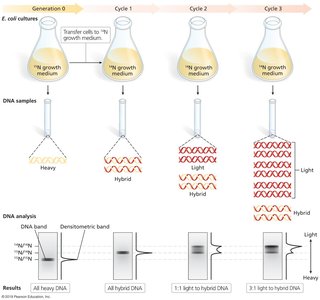
Used isotopic labeling (15N and 14N) and density gradient centrifugation to demonstrate semiconservative replication in E. coli.
After one replication cycle, DNA was hybrid density; after two, both hybrid and light DNA were present, supporting the semiconservative model.
Origins and Directionality of Replication
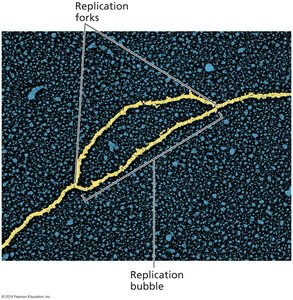
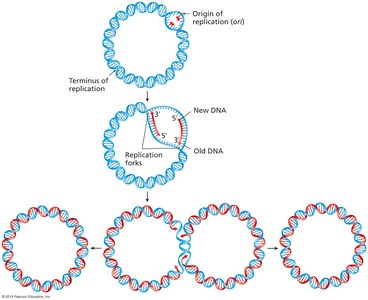
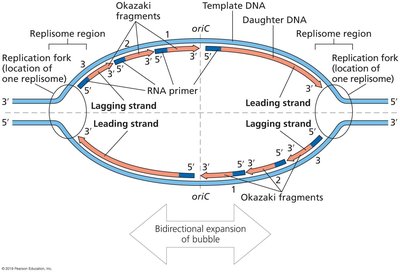
Replication is bidirectional from origins of replication.
Bacterial chromosomes typically have a single origin; eukaryotic chromosomes have multiple origins.
Replication bubbles and forks form as DNA unwinds and synthesis proceeds.
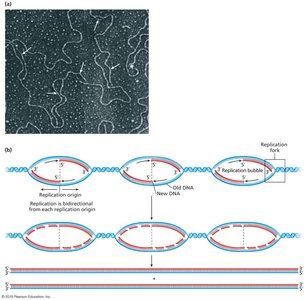
Replication Origins: Sequence and Recognition
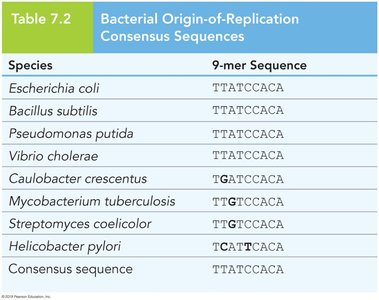
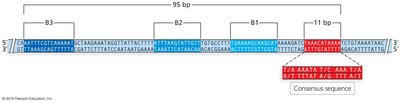
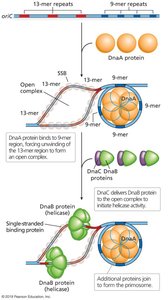
Bacterial origins (e.g., oriC in E. coli) contain conserved 13-mer and 9-mer sequences that recruit replication machinery.
Archaeal origins are called ORBs (origin recognition bases); eukaryotic origins in yeast are called ARS (autonomously replicating sequences).
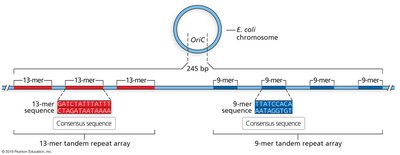
Species | 9-mer Sequence |
|---|---|
Escherichia coli | TTATCCACA |
Bacillus subtilis | TTATCCACA |
Pseudomonas putida | TTATCCACA |
Vibrio cholerae | TTATCCACA |
Caulobacter crescentus | TGATCCACA |
Mycobacterium tuberculosis | TTGTCCACA |
Streptomyces coelicolor | TTGTCCACA |
Helicobacter pylori | TCATTCCACA |
Consensus sequence | TTATCCACA |
Initiation of Replication in Bacteria
Key proteins: DnaA (binds 9-mer, bends DNA, opens 13-mer), DnaB (helicase, unwinds DNA), DnaC (delivers DnaB).
Single-stranded binding proteins (SSB) stabilize unwound DNA.
Elongation: Leading and Lagging Strands
DNA polymerase III synthesizes new DNA in the 5' to 3' direction.
Leading strand: synthesized continuously toward the replication fork.
Lagging strand: synthesized discontinuously away from the fork in short Okazaki fragments, each initiated by an RNA primer.
Primer Removal and Ligation
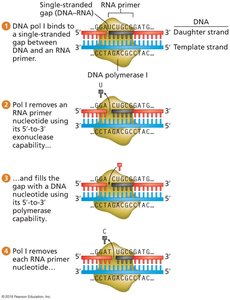
DNA polymerase I removes RNA primers (5' to 3' exonuclease) and fills gaps with DNA.
DNA ligase seals nicks between Okazaki fragments, forming a continuous strand.
Proofreading and Fidelity
DNA polymerases possess 3' to 5' exonuclease activity for proofreading, correcting mismatched bases during replication.
This ensures high fidelity, with errors occurring about once per billion nucleotides in E. coli.
Supercoiling and Topoisomerases
Unwinding DNA during replication introduces supercoiling.
Topoisomerases relieve torsional stress by cutting and rejoining DNA strands.
Telomeres and Telomerase
Linear chromosomes lose DNA at their ends (telomeres) with each replication cycle in most somatic cells.
Telomerase, a ribonucleoprotein, extends telomeres in germ cells and some other cell types, using an RNA template to add DNA repeats.
Telomere length is linked to chromosome stability, aging, and cancer.
Summary Table: Key Enzymes and Proteins in DNA Replication
Enzyme/Protein | Function |
|---|---|
DNA polymerase III | Main DNA synthesis (elongation) |
DNA polymerase I | Removes RNA primers, fills gaps |
Primase | Synthesizes RNA primers |
Helicase (DnaB) | Unwinds DNA helix |
SSB protein | Stabilizes single-stranded DNA |
DNA ligase | Seals nicks in DNA backbone |
Topoisomerase | Relieves supercoiling |
Telomerase | Extends telomeres |
Conclusion
DNA structure and replication are central to the continuity of genetic information. The semiconservative mechanism ensures faithful transmission, while specialized enzymes and sequences coordinate the complex process of chromosome duplication. Understanding these molecular details is foundational for advanced studies in genetics, molecular biology, and biotechnology.
