 Indietro
DNA Structure and Replication: Molecular Basis and Mechanisms
Guida di studio - Note intelligenti
 Appunti personalizzati basati sui tuoi materiali, ampliati con definizioni chiave, esempi e contesto.
DNA Structure and Replication
DNA as the Hereditary Molecule
The identification of DNA as the hereditary material was a pivotal moment in genetics. Early studies established five essential characteristics for hereditary material:
Localization: Found in the nucleus and chromosomes.
Stability: Present in a stable form within cells.
Complexity: Contains sufficient information for organismal structure, function, development, and reproduction.
Replication: Able to accurately replicate itself for inheritance.
Mutability: Undergoes rare mutations, providing genetic variation for evolution.
Historical Discoveries
Friedrich Miescher (1869): Isolated DNA, termed "nuclein."
Edmund Wilson (1895): Linked DNA to heredity via chromosome studies.
Rediscovery of Mendel (1900): Connected chromosome behavior to gene inheritance.
Griffith's Transformation Experiment
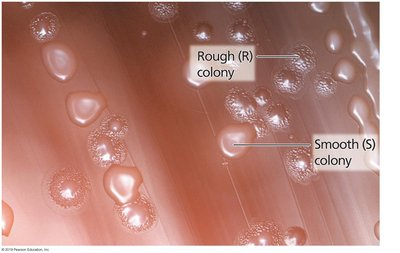
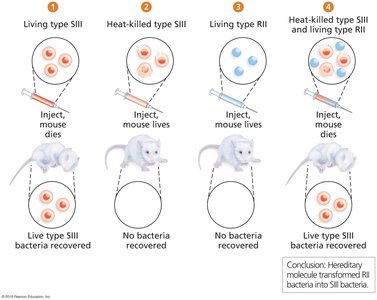
Frederick Griffith demonstrated that a "transformation factor" could transfer hereditary information between bacterial strains, suggesting DNA's role in heredity.
S (smooth) strain: Causes fatal pneumonia in mice.
R (rough) strain: Non-lethal.
Mixing heat-killed SIII with live RII resulted in live SIII bacteria, indicating transformation.
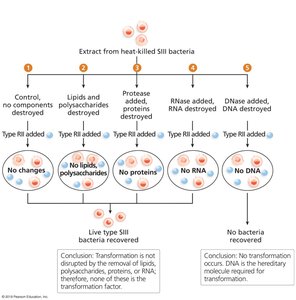
Avery, MacLeod, and McCarty's Experiment
They showed that only destruction of DNA prevented transformation, confirming DNA as the hereditary molecule.
Hershey-Chase Experiment
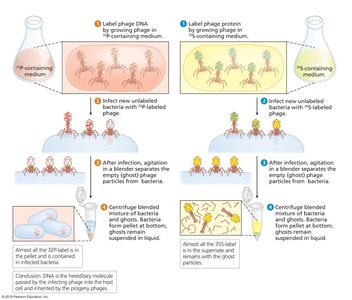
Using radioactive labeling, Hershey and Chase demonstrated that DNA, not protein, is responsible for bacteriophage infection of bacteria.
The DNA Double Helix: Structure and Properties
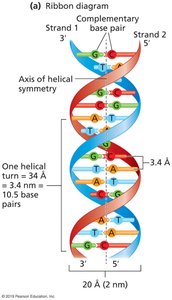
DNA's secondary structure, identified by Franklin and modeled by Watson and Crick, consists of two complementary and antiparallel strands forming a double helix.
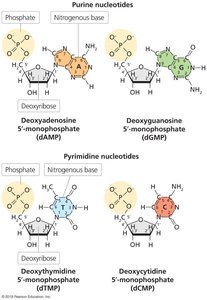
Nucleotides: Each consists of a deoxyribose sugar, a nitrogenous base (A, T, C, G), and phosphate groups.
Base Types: Purines (adenine, guanine) have double rings; pyrimidines (thymine, cytosine) have single rings.
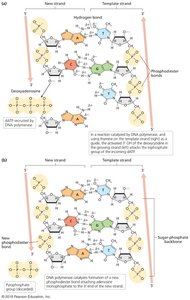
Polynucleotide Assembly: DNA polymerase catalyzes phosphodiester bonds between nucleotides.
Complementary and Antiparallel Strands
Complementarity: A pairs with T (2 H bonds), G pairs with C (3 H bonds).
Antiparallel: Strands run in opposite 5' to 3' directions.
B-Form DNA Structure
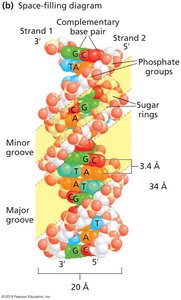
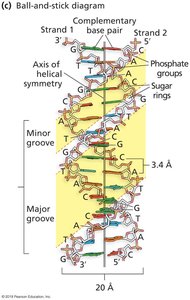
B-form DNA is the most common, with a right-handed helix, uniform diameter, and major/minor grooves for protein binding.
DNA Forms: A, B, and Z
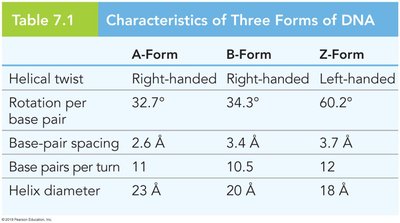
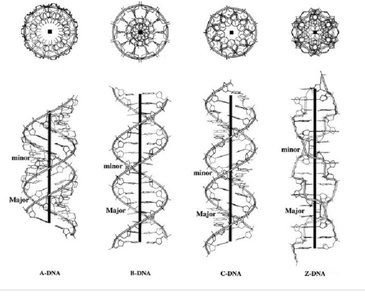
DNA can adopt different forms:
A-form: Right-handed, found in some cellular contexts.
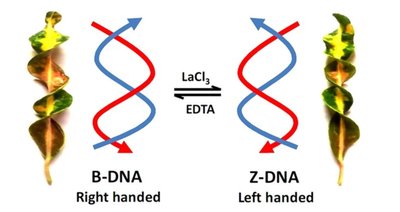
B-form: Right-handed, most common in cells.
Z-form: Left-handed, found near transcription start sites.
Form | Helical Twist | Base-Pair Spacing | Base Pairs/Turn | Helix Diameter |
|---|---|---|---|---|
A-form | Right-handed | 2.6 Å | 11 | 23 Å |
B-form | Right-handed | 3.4 Å | 10.5 | 20 Å |
Z-form | Left-handed | 3.7 Å | 12 | 18 Å |
DNA Replication: Mechanisms and Models
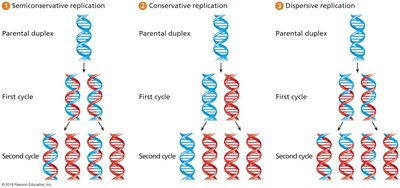
DNA replication is essential for genetic continuity. It is semiconservative and bidirectional in most organisms.
Semiconservative: Each daughter duplex contains one parental and one daughter strand.
Conservative: One duplex has both parental strands, the other both daughter strands.
Dispersive: Each duplex contains interspersed parental and daughter segments.
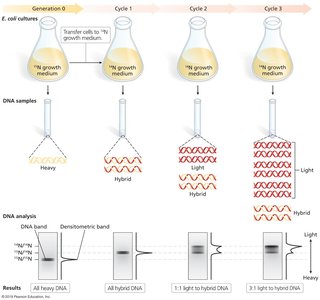
Meselson-Stahl Experiment
This experiment used isotopic labeling to confirm semiconservative replication in E. coli.
Origins and Directionality of Replication
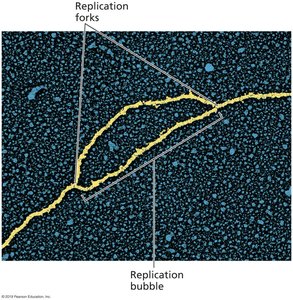
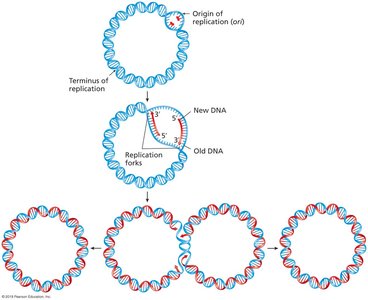
Replication initiates at specific origins and proceeds bidirectionally.
Bacterial chromosomes: Single origin of replication.
Eukaryotic chromosomes: Multiple origins.
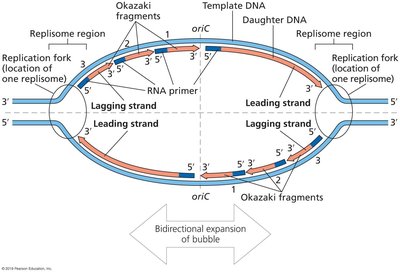
Replication bubble: Expansion around the origin forms a bubble with two replication forks.
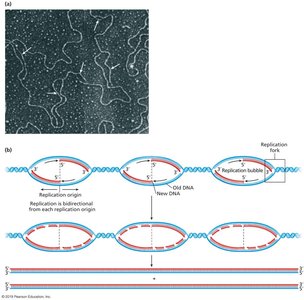
Replication Origins: Sequence and Conservation
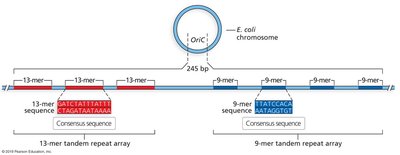
Replication origins contain conserved sequences that attract replication enzymes.
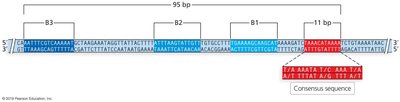
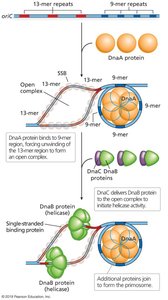
E. coli oriC: Contains 13-mer and 9-mer repeats, A-T rich.
Consensus sequences: Most common nucleotides at each position in conserved regions.
Archaeal origins: ORBs (origin recognition bases), long and miniORBs.
Eukaryotic origins: ARS (autonomously replicating sequences) in yeast.
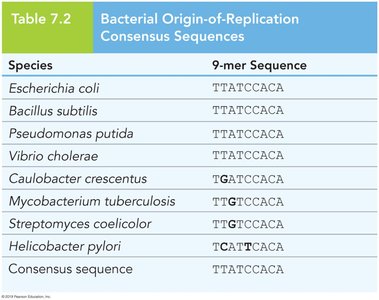
Species | 9-mer Sequence |
|---|---|
Escherichia coli | TTATCCACA |
Bacillus subtilis | TTATCCACA |
Pseudomonas putida | TTATCCACA |
Vibrio cholerae | TTATCCACA |
Caulobacter crescentus | TGATCCACA |
Mycobacterium tuberculosis | TGGTCCACA |
Streptomyces coelicolor | TGGTCCACA |
Helicobacter pylori | TCATTCCACA |
Consensus sequence | TTATCCACA |
Molecular Biology of Replication Initiation
Replication initiation in E. coli involves DnaA, DnaB, and DnaC proteins binding to oriC, unwinding DNA, and stabilizing single strands.
DnaA: Binds 9-mer, bends DNA, breaks H bonds in 13-mer.
DnaB: Helicase, unwinds DNA.
SSB: Single-stranded binding protein prevents reannealing.
DNA Replication: Enzymes and Strand Synthesis
DNA polymerase requires an RNA primer to initiate synthesis. Replication is continuous on the leading strand and discontinuous on the lagging strand (Okazaki fragments).
DNA polymerase III: Main enzyme for strand elongation.
Replisome: Protein complex at replication fork.
Primase: Synthesizes RNA primers.
RNA Primer Removal and Okazaki Fragment Ligation
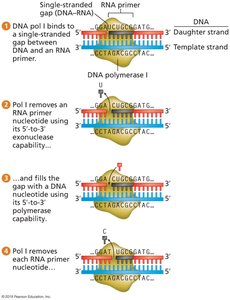
DNA polymerase I: Removes RNA primers (5'-3' exonuclease) and replaces with DNA (5'-3' polymerase).
DNA ligase: Seals gaps between DNA fragments.
DNA Proofreading and Error Correction
DNA polymerases possess proofreading activity, ensuring high fidelity during replication.
3'-5' exonuclease activity: Removes mismatched nucleotides.
Error rate: Approximately one error per billion nucleotides in E. coli.
Supercoiling and Topoisomerases
DNA unwinding during replication induces supercoiling, which is relieved by topoisomerases.
Topoisomerases: Enzymes that cut and rejoin DNA to relieve torsional stress.
Telomeres and Telomerase
Telomeres protect chromosome ends and are maintained by telomerase in germ line and certain other cells.
Telomerase: Ribonucleoprotein enzyme that extends telomeres using an RNA template.
Telomere length: Important for chromosome stability, cell longevity, and reproductive success.
Telomerase activation: Associated with cancer cell immortality.
