 Indietro
DNA Structure and Replication: Study Notes for Genetics Students 7
Guida di studio - Note intelligenti
 Appunti personalizzati basati sui tuoi materiali, ampliati con definizioni chiave, esempi e contesto.
DNA as the Hereditary Molecule
Essential Characteristics of Hereditary Material
The hereditary material must possess several key features to fulfill its biological role:
Localization: Found in the nucleus and as a component of chromosomes.
Stability: Present in a stable form within cells.
Complexity: Sufficiently complex to encode information for structure, function, development, and reproduction.
Replication: Capable of accurate self-replication, ensuring daughter cells inherit identical information.
Mutability: Able to undergo mutations at a low rate, providing genetic variation for evolution.
Discovery and Early Evidence
Friedrich Miescher (1869): Isolated DNA from nuclei, termed it "nuclein."
Edmund Wilson (1895): Linked DNA to hereditary material, noting equal chromosome contribution from sperm and egg.
Mendel’s Principles (1900): Rediscovered, leading to the chromosomal theory of inheritance.
DNA Chemistry (1920): Identified as a polynucleotide with four bases: adenine (A), thymine (T), cytosine (C), guanine (G).
Experimental Evidence for DNA as Hereditary Material
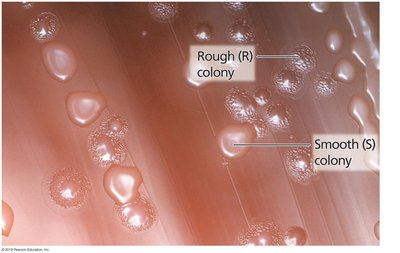
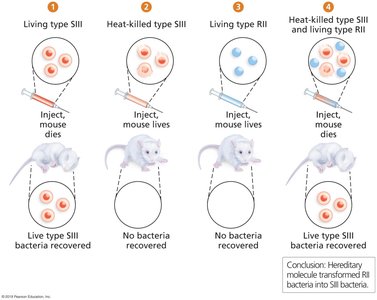
Griffith’s Transformation Experiment: Demonstrated that a "transformation factor" could transfer hereditary information between bacterial strains.
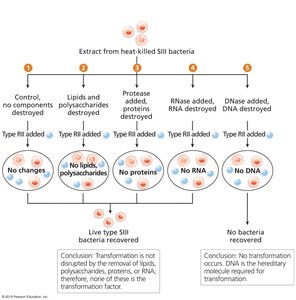
Avery, MacLeod, and McCarty: Identified DNA as the transformation factor by selectively destroying DNA, RNA, proteins, or lipids and observing effects on transformation.
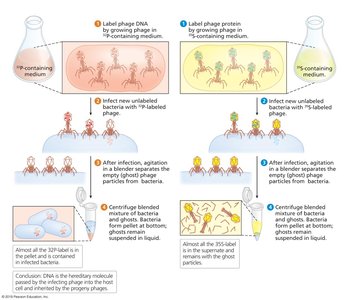
Hershey-Chase Experiment (1952): Used radioactive labeling to show that DNA, not protein, is responsible for bacteriophage infection of bacteria.
DNA Structure
Nucleotides and Their Components
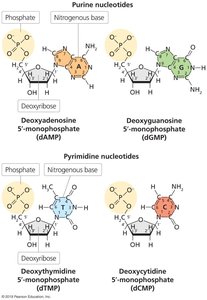
DNA is composed of nucleotides, each consisting of:
Deoxyribose sugar (five carbons: 1', 2', 3', 4', 5')
Phosphate group(s) (attached to 5' carbon)
Nitrogenous base (attached to 1' carbon)
Types of DNA Bases
Pyrimidines: Single ring (thymine, cytosine)
Purines: Double ring (adenine, guanine)
Polynucleotide Chain Assembly
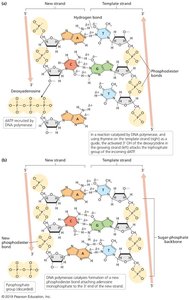
DNA polymerase catalyzes the formation of phosphodiester bonds between the 3' hydroxyl group of one nucleotide and the 5' phosphate of another, creating a sugar-phosphate backbone.
Double Helix Structure
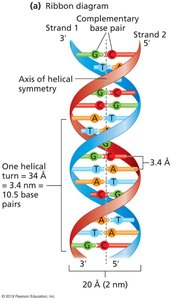
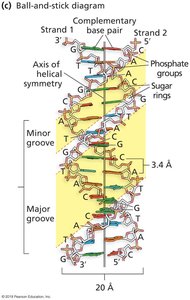
Complementary Base Pairing: A pairs with T (2 H bonds), G pairs with C (3 H bonds).
Antiparallel Strands: One strand runs 5' to 3', the other 3' to 5'.
B-Form DNA
Most common form in cells
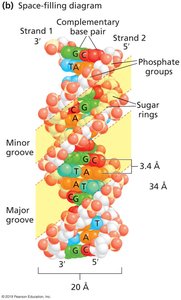
Diameter: 20 Å
Base pairs spaced at 3.4 Å intervals
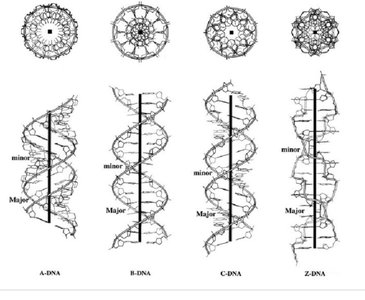
Major and minor grooves alternate, providing binding sites for proteins
Forms of DNA
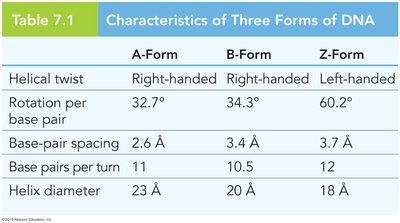
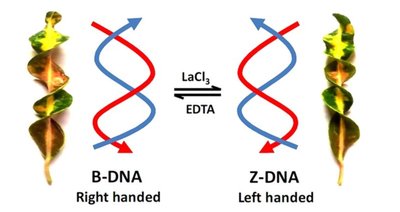
DNA can exist in several structural forms:
Form | Helical Twist | Base-pair Spacing | Base Pairs/Turn | Helix Diameter |
|---|---|---|---|---|
A-Form | Right-handed | 2.6 Å | 11 | 23 Å |
B-Form | Right-handed | 3.4 Å | 10.5 | 20 Å |
Z-Form | Left-handed | 3.7 Å | 12 | 18 Å |
DNA Replication
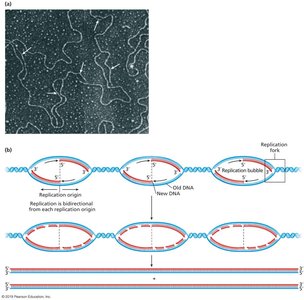
Semiconservative and Bidirectional Replication
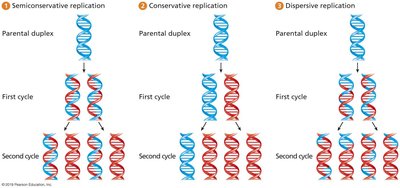
DNA replication ensures the integrity of genetic information. The process is semiconservative and bidirectional in most organisms.
Semiconservative: Each daughter duplex contains one parental and one newly synthesized strand.
Conservative: One duplex contains both parental strands, the other both daughter strands.
Dispersive: Each duplex contains interspersed parental and daughter segments.
Meselson-Stahl Experiment
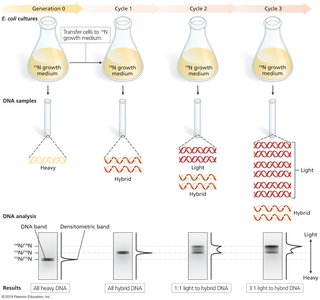
This experiment used isotopic labeling and density gradient centrifugation to demonstrate semiconservative replication in E. coli.
After one replication cycle in 14N medium, DNA was hybrid (14N/15N).
After two cycles, half was hybrid, half was light (14N/14N).
Origins of Replication
Bacterial DNA
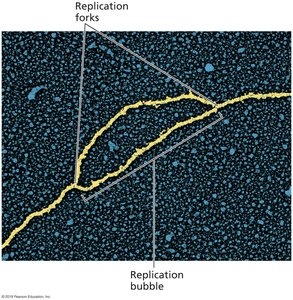
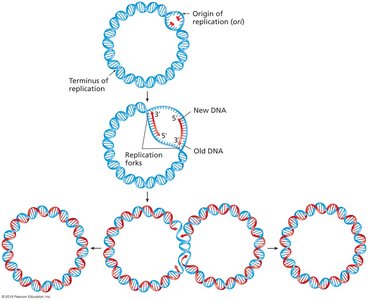
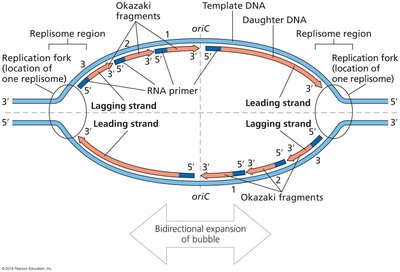
Replication is bidirectional from a single origin (oriC).
Replication bubble forms, with forks at each end.
Eukaryotic DNA
Multiple origins of replication per chromosome.
Example: Drosophila melanogaster chromosomes.
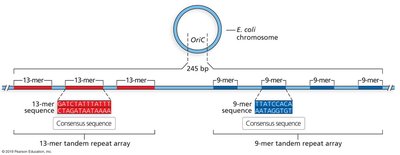
Replication Origins and Consensus Sequences
oriC in E. coli: Contains 245 bp, with three 13-mer and four 9-mer repeats.
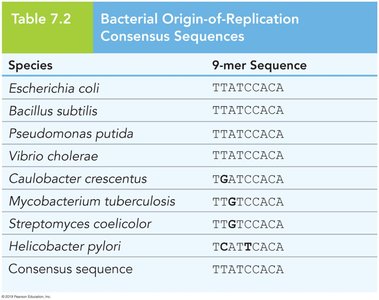
Consensus sequences: Conserved among related bacterial species.
Species | 9-mer Sequence |
|---|---|
Escherichia coli | TTATCCACA |
Bacillus subtilis | TTATCCACA |
Pseudomonas putida | TTATCCACA |
Vibrio cholerae | TTATCCACA |
Caulobacter crescentus | TGATCCACA |
Mycobacterium tuberculosis | TGGTCCACA |
Streptomyces coelicolor | TGGTCCACA |
Helicobacter pylori | TCATTCCACA |
Consensus sequence | TTATCCACA |
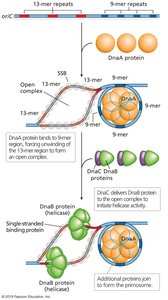
Replication Initiation in E. coli
DnaA: Binds 9-mer sequences, bends DNA, breaks H bonds in 13-mer region.
DnaB: Helicase, unwinds DNA.
DnaC: Delivers DnaB to the origin.
SSB: Single-stranded binding protein, prevents reannealing.
DNA Replication Mechanism
Primase: Synthesizes RNA primers required for DNA polymerase to initiate synthesis.
DNA Polymerase III: Main enzyme for strand elongation.
Replisome: Protein complex at replication fork, contains two pol III enzymes.
Leading and Lagging Strands
Leading strand: Synthesized continuously in direction of fork movement.
Lagging strand: Synthesized discontinuously as Okazaki fragments, opposite to fork movement.
RNA Primer Removal and Okazaki Fragment Ligation
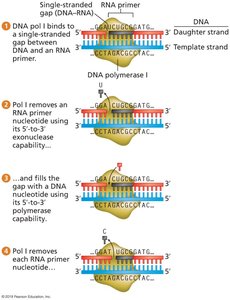
DNA Polymerase I: Removes RNA primers (5'-3' exonuclease) and replaces with DNA (5'-3' polymerase).
DNA Ligase: Seals gaps between DNA fragments.
DNA Proofreading and Error Correction
Proofreading Activity
Most DNA polymerases possess 3'-5' exonuclease activity for proofreading.
Replication errors are rare (about 1 in a billion nucleotides in E. coli).
Incorrect nucleotides are removed and replaced, ensuring high fidelity.
Supercoiling and Topoisomerases
DNA Supercoiling
Unwinding during replication causes torsional stress and supercoiling.
Topoisomerases: Enzymes that relieve supercoiling by controlled cleavage and rejoining of DNA.
Telomeres and Telomerase
Telomere Function and Replication
Telomeres are repetitive DNA sequences at chromosome ends, important for stability and longevity.
Telomerase is a ribonucleoprotein that extends telomeres in germ line and certain other cells.
Telomerase uses its RNA template to add DNA repeats to chromosome ends.
Telomeres, Aging, and Cancer
Telomere length affects cell longevity and reproductive success.
Activation of telomerase in somatic cells may promote longevity, but is also associated with cancer cell proliferation.
Summary Table: Key Enzymes and Proteins in DNA Replication
Enzyme/Protein | Function |
|---|---|
DnaA | Binds origin, initiates unwinding |
DnaB (Helicase) | Unwinds DNA |
DnaC | Delivers DnaB to origin |
SSB | Stabilizes single-stranded DNA |
Primase | Synthesizes RNA primers |
DNA Polymerase III | Main DNA synthesis |
DNA Polymerase I | Removes RNA primers, replaces with DNA |
DNA Ligase | Seals nicks between DNA fragments |
Topoisomerase | Relieves supercoiling |
Telomerase | Extends telomeres |
Additional info: These notes expand on the original slides and text, providing definitions, examples, and context for Genetics students. All included images directly reinforce the explanations and are referenced in the relevant paragraphs.
