 Indietro
Exceptions to Mendelian Genetics: Extensions and Non-Mendelian Inheritance
Guida di studio - Note intelligenti
 Appunti personalizzati basati sui tuoi materiali, ampliati con definizioni chiave, esempi e contesto.
Exceptions to Mendelian Genetics
Overview of Mendelian and Non-Mendelian Genetics
Mendelian genetics, also known as transmission genetics, describes inheritance patterns with clear-cut dominant and recessive alleles. However, many traits do not follow these simple patterns due to incomplete dominance, codominance, multiple alleles, gene interactions, and environmental effects. Understanding these exceptions is crucial for accurately predicting genotypes and phenotypes.
Alleles and Mutation Types
Wild type allele: The most common form of a gene in a population, often denoted as “+”.
Mutations: Changes in the DNA sequence that create new alleles. Types include:
Loss-of-function mutations: Reduce or eliminate gene function; null alleles have no function.
Gain-of-function mutations: Often dominant; can convert proto-oncogenes to oncogenes.
Neutral mutations: Do not affect phenotype.
Gene Notation Conventions
Wild type: +/+
Dominant to wild type: Capital letter (e.g., Wr)
Recessive to wild type: Lowercase (e.g., ap)
No dominance: Use different symbols (e.g., i, IA, IB for blood types)
Genes are italicized; proteins are not.
Non-Mendelian Forms of Inheritance
Incomplete (Partial) Dominance
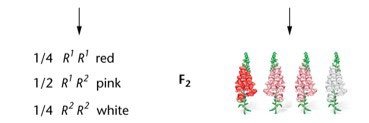
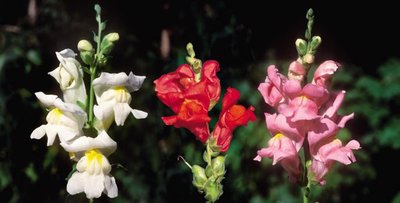
Incomplete dominance occurs when neither allele is completely dominant, resulting in an intermediate phenotype. The classic example is flower color in snapdragons or petunias, where crossing red and white yields pink offspring.
Genotype ratio: 1:2:1
Phenotype ratio: 1:2:1
Example: Tay-Sachs disease shows a threshold effect, where heterozygotes have reduced enzyme activity but normal function.
Codominance
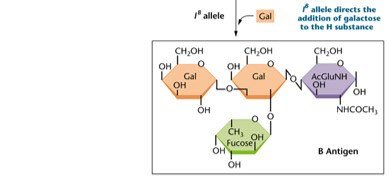
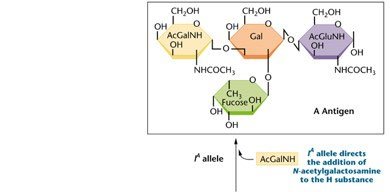
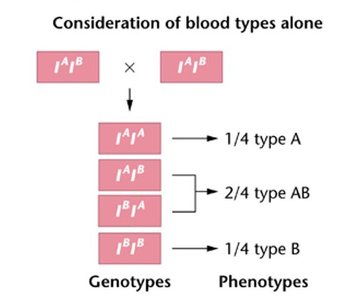
Codominance occurs when both alleles are fully expressed in the heterozygote. An example is the MN blood group, where both M and N glycoproteins are present on red blood cells.
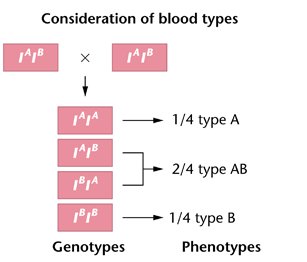
Example: ABO blood types, where IA and IB alleles are codominant.
Multiple Alleles
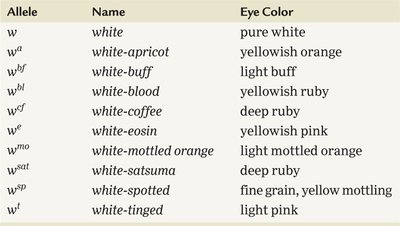
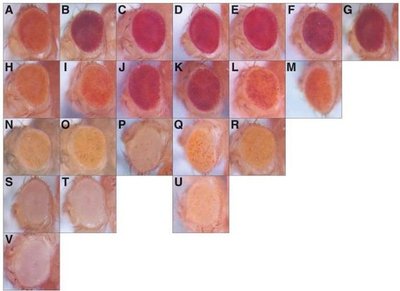
Some loci have more than two alleles in a population, increasing phenotypic diversity. For example, eye color in Drosophila has over 100 alleles, resulting in various shades.
Example: ABO blood types (IA, IB, i)
Lethal Alleles
Recessive Lethal Alleles
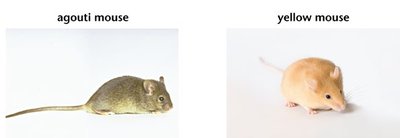
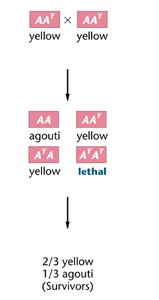
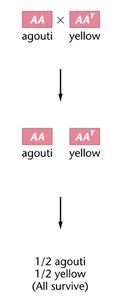
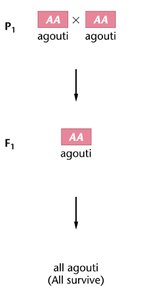
Some alleles are lethal when homozygous. For example, in mice, the yellow allele is dominant for color but recessive lethal, resulting in altered offspring ratios.
Agouti x agouti: All agouti
Agouti x yellow: ½ agouti, ½ yellow
Yellow x yellow: ⅓ agouti, ⅔ yellow (due to lethality)
Dominant Lethal Alleles
Dominant lethal alleles are fatal with only one copy, but persist if they have late onset. Huntington’s disease is a classic example.
HH: Early death
Hh: Middle age onset
hh: Normal
Probability in Non-Mendelian Genetics
Calculating Genotypes and Phenotypes
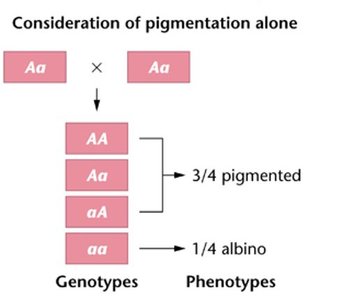
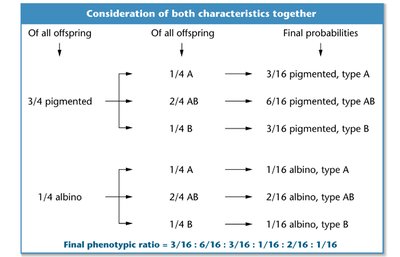
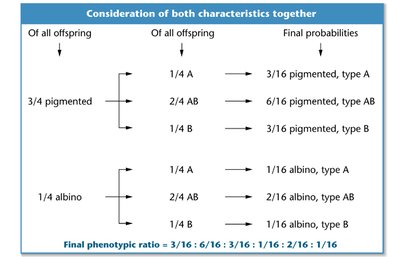
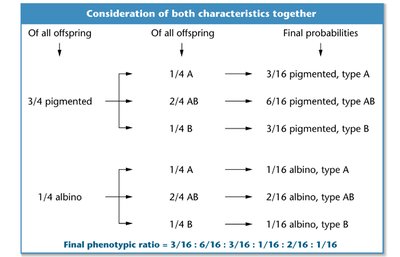
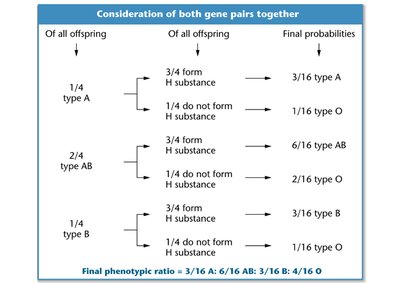
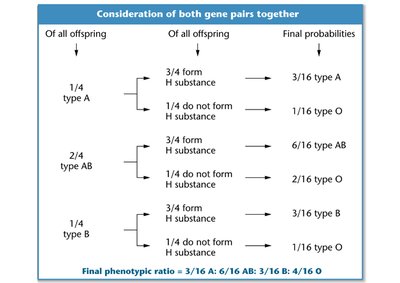
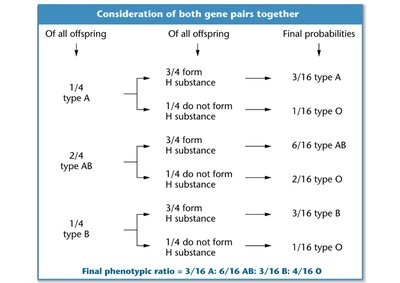
Probability rules are used to calculate outcomes in crosses involving multiple genes and inheritance modes. For example, a dihybrid cross involving a typical dominant/recessive gene and ABO blood type (codominant alleles) can be analyzed using probability.
Epistasis
Gene Interaction and the Bombay Phenotype
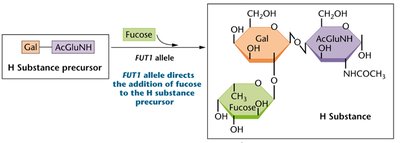
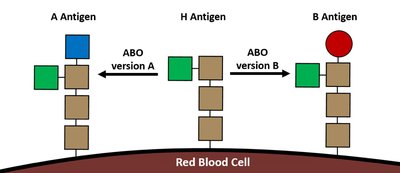
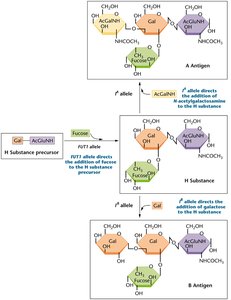
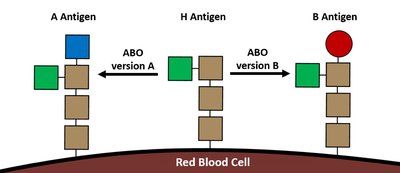
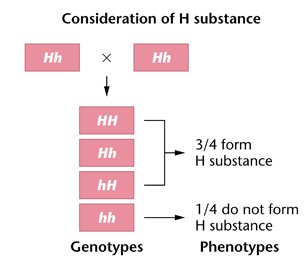
Epistasis occurs when one gene masks or modifies the expression of another gene. The Bombay phenotype is an example, where the FUT1 gene is necessary for the expression of A, B, or AB blood types. Homozygous recessive (hh) individuals cannot express these phenotypes, regardless of their ABO genotype.
FUT1 gene: Required for H substance formation
Bombay phenotype: hh genotype results in type O blood, even if A or B alleles are present
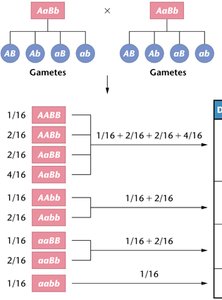
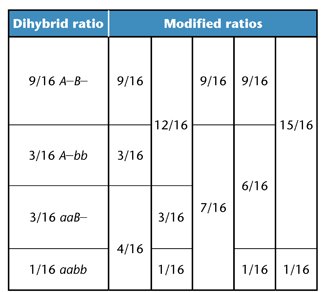
Epistatic Ratios and Dihybrid Crosses
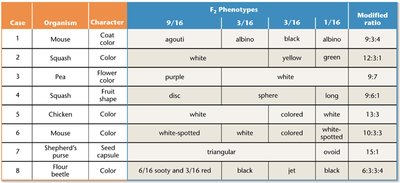
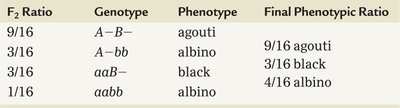
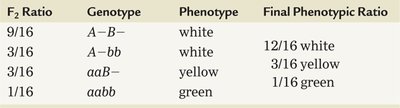
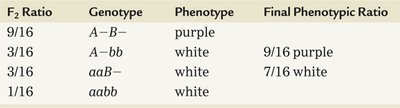
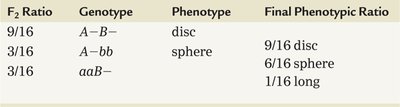
Epistasis can modify the expected dihybrid ratios. Different types of epistatic interactions yield distinct phenotypic ratios.
Recessive epistasis: Coat color in mice; albino phenotype masks agouti/black
Dominant epistasis: Color in squash; white phenotype masks yellow/green
Complementary gene interaction: Both dominant alleles required for purple pea flowers
Novel interactions: Fruit shape in squash; disc, sphere, or long shapes
Complementation Analysis and Pleiotropy
Complementation Analysis
Complementation analysis determines whether mutations causing similar phenotypes are in the same or different genes. Crossing two strains with the same mutation can reveal if the F1 offspring are wild type (different genes) or mutant (same gene).
Pleiotropy
Pleiotropy occurs when one gene affects multiple traits. Examples include Marfan syndrome (affecting connective tissue, eye lens, bones, and aorta) and porphyria variegata (affecting muscle, vision, and nervous system).
Sex-Linked and Sex-Influenced Inheritance
X-Linkage
Genes located on the X chromosome exhibit unique inheritance patterns, as males have only one X. Many X-linked alleles are dominant in males due to the absence of a second allele.
Example: Tortoiseshell and calico cats, where X-inactivation leads to patchy coloration in females.
Sex-Limited and Sex-Influenced Traits
Sex-limited: Traits expressed only in one sex, regardless of gene location.
Sex-influenced: Traits expressed differently in the sexes; heterozygotes may show different phenotypes depending on sex.
Environmental Effects on Gene Expression
Penetrance and Expressivity
Penetrance: The proportion of individuals with a genotype that show the expected phenotype.
Expressivity: The degree or range of phenotype expression among individuals with the same genotype.
Environmental Influences
Position effects: Gene location on chromosome can affect expression.
Temperature effects: Phenotype may change with temperature (e.g., temperature-dependent sex determination in reptiles).
Nutritional effects: Diet can influence phenotype, especially if a synthesis gene is missing.
Timing effects: Developmental timing can affect gene expression.
Summary Table: Types of Non-Mendelian Inheritance
Type | Definition | Example |
|---|---|---|
Incomplete Dominance | Intermediate phenotype in heterozygotes | Pink flowers from red and white parents |
Codominance | Both alleles fully expressed | AB blood type |
Multiple Alleles | More than two alleles at a locus | ABO blood types, Drosophila eye color |
Epistasis | One gene masks/modifies another | Bombay phenotype, coat color in mice |
Pleiotropy | One gene affects multiple traits | Marfan syndrome |
Sex-linked | Gene on sex chromosome | Tortoiseshell cats |
Sex-limited | Trait expressed only in one sex | Milk production in mammals |
Sex-influenced | Trait expressed differently in sexes | Pattern baldness in humans |
Environmental Effects | Phenotype influenced by environment | Temperature-dependent sex determination |
Additional info: These notes expand on brief points from the original material, providing definitions, examples, and context for each concept. All included images directly reinforce the adjacent explanations and are strictly relevant to the described genetic phenomena.
