 Indietro
Gene Interaction and Allelic Variation: Mechanisms and Examples
Guida di studio - Note intelligenti
 Appunti personalizzati basati sui tuoi materiali, ampliati con definizioni chiave, esempi e contesto.
Gene Interaction
Overview of Gene Interaction
Gene interaction refers to the phenomenon where multiple genes influence a single trait, often resulting in complex phenotypic outcomes. These interactions can involve both anabolic and catabolic pathways, as well as signal transduction and developmental pathways.
Protein Function: Proteins encoded by genes are responsible for the expression of traits.
Wild Type Gene: Produces an active enzyme, typically considered the standard or reference phenotype.
Complementation: Occurs when two mutant alleles from different genes produce a normal phenotype in offspring.
Haploinsufficiency: A single functional copy of a gene is insufficient for normal function.
Mutant Alleles and Their Effects
Mutant alleles can be dominant or recessive and are classified based on their effect on gene function.
Loss of Function Mutations: Reduce or eliminate gene product activity.
Null (Amorphic) Mutations: No functional gene product; often recessive and can be lethal in homozygotes.
Leaky (Hypomorphic) Mutations: Partial loss of function.
Dominant Negative (Antimorphic) Mutations: Spoil the function of multimeric proteins (e.g., osteogenesis imperfecta).
Gain of Function Mutations: Increase or alter gene product activity; usually dominant.
Hypermorphic: Increased gene activity.
Neomorphic: Novel gene activity.
Allelic Variation and Dominance Relationships
Incomplete Dominance
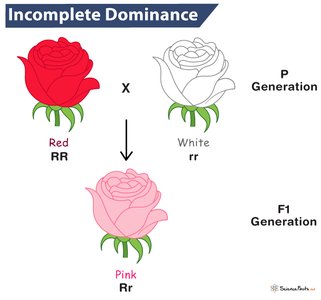
Incomplete dominance occurs when the heterozygote displays an intermediate phenotype between the two homozygotes. For example, crossing a red (RR) and white (rr) rose produces pink (Rr) offspring.
Phenotypic Ratio: The F1 generation shows a blend of parental traits.
Example: Pink roses from red and white parents.
Codominance
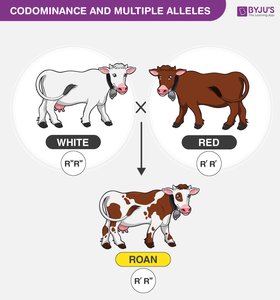
Codominance occurs when both alleles are fully expressed in the heterozygote, resulting in a phenotype that displays characteristics of both parents. For example, crossing a white and red cow produces a roan cow with both red and white patches.
Phenotypic Ratio: Both traits are visible in the offspring.
Example: Roan cattle from red and white parents.
Allelic Series
An allelic series is a hierarchy of dominance among multiple alleles of a gene, determining which traits are expressed.
C Gene in Mammals: Controls coat color via tyrosinase enzyme.
Alleles: C (full color) > cch (chinchilla) > ch (himalayan, temperature sensitive) > c (albino).
Example: Only homozygous recessive (cc) results in albino phenotype.
Lethal Alleles and Their Effects
Lethal Alleles
Lethal alleles cause death when present in certain genotypes, often hiding in heterozygotes.
Embryonic Lethals (Plants): Homozygous lethals do not produce viable offspring; observed as a 3:1 ratio of living to dead seeds.
Gametophytic Lethals (Plants): Lethal alleles prevent formation of lethal allele-carrying offspring; observed as a 1:1 ratio.
Animal Example: Agouti mice require the raly gene for embryonic development; homozygous recessive mice do not survive.
Delayed Age of Onset: Dominant lethal alleles may not manifest until reproductive age (e.g., Huntington disease).
Penetrance and Expressivity
Penetrance and Expressivity
Penetrance and expressivity describe the relationship between genotype and phenotype.
Complete Penetrance: Genotype always produces the expected phenotype.
Incomplete Penetrance: Genotype does not always result in phenotype (e.g., polydactyly).
Variable Expressivity: Individuals with the same genotype show phenotypes to varying degrees (e.g., Waardenburg syndrome).
Sex-Limited and Sex-Influenced Traits
Sex-Limited Traits: Genes present in both sexes but expressed only in one due to hormonal differences (e.g., milk production in mammals).
Sex-Influenced Traits: Expression depends on the sex of the organism (e.g., beard in male goats).
Gene-Environment Interaction and Pleiotropy
Gene-Environment Interaction
The phenotype can be influenced by environmental conditions, modifying the expression of genetic traits.
Pleiotropy
Pleiotropic genes affect multiple traits, often leading to complex phenotypic outcomes.
Genetic Pathways and Complementation
One Gene-One Enzyme Hypothesis
George Beadle and Edward Tatum proposed that each gene encodes a specific enzyme, which in turn affects a particular step in a biosynthetic pathway. Mutations in these genes result in loss or malfunction of the corresponding enzyme.
Prototroph: Wild type organism capable of synthesizing all compounds needed for growth.
Auxotroph: Mutant organism unable to synthesize a specific compound.
Genetic Dissection: Used to investigate steps in biosynthetic pathways.
Horowitz Experiment
Horowitz used mutant Neurospora crassa to determine the steps in methionine synthesis and the order of mutations.
Key Finding: Mutants cannot grow if provided with a compound that precedes the mutated step; growth is restored if the compound is downstream of the mutation.
Epistasis and Gene Interaction Ratios
Epistasis
Epistasis occurs when one gene masks or modifies the expression of another gene, resulting in altered phenotypic ratios. There are several types:
No Interaction: Standard 9:3:3:1 ratio.
Complementary Gene Interaction: 9:7 ratio; two genes work together for a trait.
Duplicate Gene Action: 15:1 ratio; either dominant allele produces wild type.
Dominant Gene Interaction: 9:6:1 ratio; phenotype depends on number of dominant alleles.
Recessive Epistasis: 9:3:4 ratio; recessive homozygote at one locus masks the second locus.
Dominant Epistasis: 12:3:1 ratio; dominant allele at one locus masks the second locus.
Dominant Suppression: 13:3 ratio; dominant allele at one locus suppresses the other.
Genetic Complementation and Heterogeneity
Genetic Complementation Analysis
Complementation analysis involves mating two pure-breeding mutants to determine if mutations are in the same or different genes.
Complementation: Wild type phenotype in offspring indicates mutations are in different genes.
No Complementation: Mutant phenotype in offspring indicates mutations are in the same gene (complementation group).
Genetic Heterogeneity
Mutations in different genes can produce the same or similar mutant phenotype.
Genetic Linkage and Mapping
Linked Genes and Genetic Linkage
Linked genes are located close together on the same chromosome and tend to be inherited together. Genetic linkage mapping determines the relative positions of genes based on recombination frequency.
Recombinant Chromosomes: Result from crossing over during meiosis.
Parental (Nonrecombinant) Chromosomes: Maintain original allele combinations.
Complete Linkage: No recombination between genes.
Incomplete Linkage: Some recombination occurs.
Recombination Frequency Formula:
Morgan's Crosses: Demonstrated the principle of genetic linkage and recombination.
Key Figures in Genetics
Thomas Hunt Morgan: Pioneered genetic linkage studies.
William Bateson: Early geneticist, discovered gene interaction.
Reginald Punnett: Developed Punnett squares for predicting genetic crosses.
