 Indietro
Genetic Analysis and Mapping in Bacteria and Bacteriophages
Guida di studio - Note intelligenti
 Appunti personalizzati basati sui tuoi materiali, ampliati con definizioni chiave, esempi e contesto.
Bacterial Genetics: Structure and DNA Organization
Overview of Bacterial Genetic Material
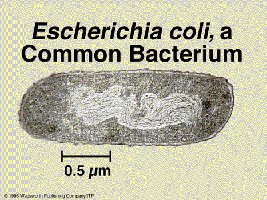
Bacteria are prokaryotic organisms that typically possess a single, large, circular chromosome containing their genetic material. Unlike eukaryotes, bacteria do not undergo sexual reproduction but can exchange genetic information through several mechanisms, contributing to genetic diversity and adaptability.
Single Circular Chromosome: Most bacteria have one main chromosome, though some may carry additional small DNA molecules called plasmids.
Plasmids: These are extrachromosomal, circular DNA molecules that often carry genes beneficial for survival, such as antibiotic resistance.
Genetic Exchange: Bacteria can acquire new genetic material through conjugation, transduction, and transformation.
Mechanisms of Genetic Exchange in Bacteria
Conjugation
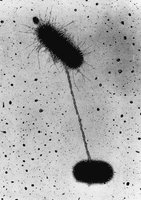
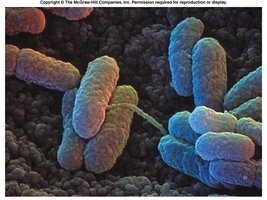
Conjugation is a process where genetic material is transferred from one bacterial cell (donor) to another (recipient) through direct cell-to-cell contact. This mechanism is a major contributor to the spread of genetic traits such as antibiotic resistance.
F Factor (F Plasmid): The donor cell (F+) contains the F plasmid, which encodes the machinery for DNA transfer, including the formation of a sex pilus.
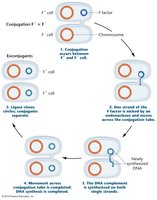
One-way Transfer: DNA is transferred from the F+ (donor) to the F- (recipient) cell. The F- cell can become F+ if it receives the entire F plasmid.
Hfr Cells: Sometimes, the F plasmid integrates into the bacterial chromosome, creating a high-frequency recombination (Hfr) cell. Hfr cells can transfer chromosomal genes to F- cells during conjugation.
Steps in Bacterial Conjugation
Formation of Conjugation Bridge: The sex pilus forms a bridge between donor and recipient cells.
Transfer of DNA: The F plasmid is nicked at the origin of transfer (oriT), and a single DNA strand is transferred to the recipient.
Replication: Both cells synthesize complementary DNA strands, resulting in two F+ cells.
Hfr Conjugation and Chromosome Mapping
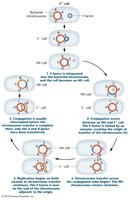
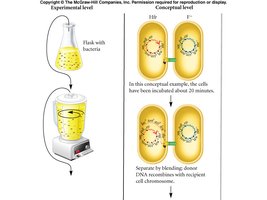
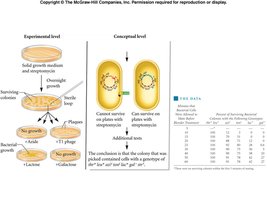
When the F factor integrates into the bacterial chromosome, the cell becomes Hfr. During conjugation, chromosomal genes are transferred in a linear sequence, allowing for gene mapping based on the order and timing of gene transfer.
Gene Mapping: The order of gene transfer reflects their position on the chromosome. Genes transferred earlier are closer to the origin of transfer.
Recombination: Only a portion of the chromosome is usually transferred before the cells separate, resulting in recombinant F- cells.
Hfr Strain | Order of Transfer (Earliest to Latest) |
|---|---|
H | thr, leu, azi, ton, lac, gal |
1 | pro, azi, ton, lac, gal, thi |
2 | pro, azi, ton, lac, gal, thi |
7 | ton, lac, gal, thi, pro, azi |
F' (F-prime) Plasmids and Merozygotes
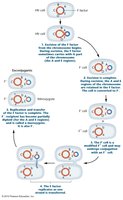
F' plasmids are formed when the F plasmid excises from the chromosome, sometimes carrying additional bacterial genes. Transfer of an F' plasmid to an F- cell creates a merozygote, a partially diploid cell for the genes carried on the F' plasmid.
Transduction
General and Specialized Transduction
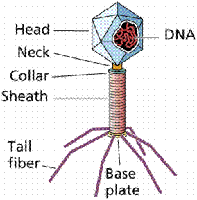
Transduction is the process by which bacterial DNA is transferred from one cell to another by a bacteriophage (virus that infects bacteria). There are two main types: general and specialized transduction.
General Transduction: Any bacterial gene can be transferred. Occurs when a phage accidentally packages bacterial DNA during the lytic cycle.
Specialized Transduction: Only specific bacterial genes near the prophage integration site are transferred. Occurs during the lysogenic cycle when prophage excises incorrectly.
Lytic and Lysogenic Cycles
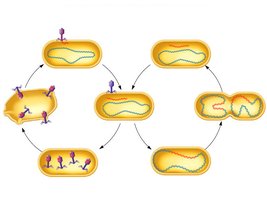
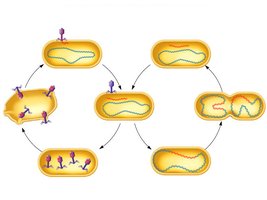
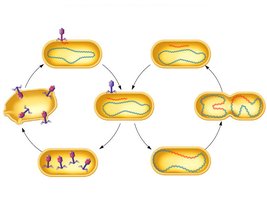
Lytic Cycle: The phage infects the bacterium, replicates, and causes cell lysis, releasing new phages.
Lysogenic Cycle: The phage DNA integrates into the bacterial chromosome as a prophage and is replicated with the host genome. It can later enter the lytic cycle.
Transformation
Mechanism of Bacterial Transformation
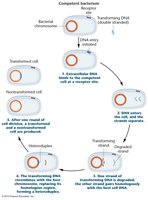
Transformation is the uptake of naked DNA from the environment by a competent bacterial cell. The DNA can recombine with the host chromosome, resulting in a genetically altered cell.
Competence: Only certain bacteria can naturally take up DNA; others can be made competent in the laboratory.
Genetic Recombination: The incorporated DNA may confer new traits, such as antibiotic resistance.
Importance of Bacterial Genetics
Applications and Relevance
Bacterial genetics is crucial for understanding gene transfer, antibiotic resistance, and the evolution of microbial populations. Many resistance genes are spread through conjugation, transduction, and transformation, posing significant challenges in medicine and biotechnology.
Antibiotic Resistance: The spread of resistance genes among bacteria is a major public health concern.
Genetic Engineering: Bacterial transformation and plasmid transfer are foundational techniques in molecular biology and biotechnology.
Summary Table: Mechanisms of Bacterial DNA Transfer
Mechanism | Description | Key Features |
|---|---|---|
Conjugation | Direct transfer of DNA via cell-to-cell contact | Involves F factor, sex pilus, one-way transfer |
Transduction | Transfer of DNA by bacteriophage | General or specialized, accidental packaging of bacterial DNA |
Transformation | Uptake of free DNA from environment | Requires competence, leads to genetic recombination |
