 Indietro
Genetic Analysis and Mapping in Bacteria and Quantitative Genetics in Plants
Guida di studio - Note intelligenti
 Appunti personalizzati basati sui tuoi materiali, ampliati con definizioni chiave, esempi e contesto.
Quantitative Genetics: Inheritance of Stem Length in Mountain Roses
Polygenic Inheritance and Phenotypic Variation
Quantitative traits, such as stem length in mountain roses, are controlled by multiple genes and exhibit continuous variation. The inheritance patterns observed in the crosses described indicate polygenic inheritance, where several genes contribute additively to the phenotype.
Polygenic Inheritance: Multiple genes (polygenes) influence a single trait, resulting in a range of phenotypes rather than discrete categories.
F1 Generation: Crossing a true-breeding 2 cm rose with a true-breeding 14 cm rose yields all 8 cm progeny, indicating intermediate inheritance.
F2 Generation: Crossing F1 progeny produces a range of stem lengths from 2 to 14 cm, with the tallest (14 cm) appearing at a frequency of 1/64, suggesting three genes are involved ( phenotypic extremes, where is the number of genes).
Phenotypic Classes: The number of phenotypic classes is calculated as , where is the number of genes. For three genes, phenotypic classes, but with intervals of 2 cm, there are 7 classes (2, 4, 6, 8, 10, 12, 14 cm).
Genotypes: The genotypes of the 6 cm and 14 cm roses in the B cross can be inferred based on their parental origin and the additive effect of alleles.
Example: If three genes (A, B, C) each have two alleles (dominant for tall, recessive for short), the 14 cm rose is homozygous dominant (AABBCC), the 2 cm rose is homozygous recessive (aabbcc), and the F1 is heterozygous (AaBbCc).
Equation:
Additional info: This is a classic example of quantitative genetics and multifactorial traits (Ch. 25).
Genetic Analysis and Mapping in Bacteria and Bacteriophages
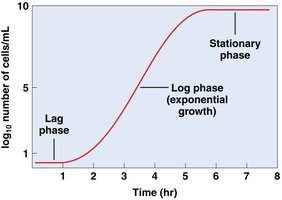
Bacterial Growth Curve
Bacterial populations grow in distinct phases when cultured in a laboratory setting. Understanding these phases is essential for genetic experiments involving bacteria.
Lag Phase: Cells adapt to new environment; little cell division occurs.
Log Phase (Exponential Growth): Cells divide rapidly; population increases exponentially.
Stationary Phase: Growth ceases as nutrients are depleted and waste accumulates.
Prototrophs vs Auxotrophs
Bacteria can be classified based on their nutritional requirements:
Prototroph: Can grow on minimal media; synthesizes all essential compounds.
Auxotroph: Requires additional nutrients; cannot synthesize certain compounds due to mutations.
Luria-Delbrück Fluctuation Assay
This experiment demonstrated that mutations in bacteria occur spontaneously rather than as a response to environmental stimuli.
Spontaneous Mutation Hypothesis: Mutations arise randomly and are inherited.
Adaptation Hypothesis: Mutations occur in response to environmental challenges (disproven by the assay).
Genetic Recombination in Bacteria
Bacteria can exchange genetic material through several mechanisms, leading to genetic diversity.
Vertical Gene Transfer: Transmission of genetic material from parent to offspring.
Horizontal Gene Transfer: Transfer of genetic material between unrelated cells.
Early Experiments in Bacterial Recombination
Classic experiments demonstrated that bacteria could undergo recombination, leading to new genotypes.
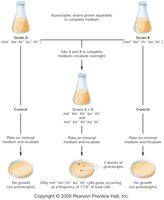
Mixing Auxotrophic Strains: When two auxotrophic strains are mixed, prototrophic recombinants can arise, indicating gene transfer.
Bacterial Conjugation
Conjugation is a process where genetic material is transferred from one bacterium to another via direct contact.
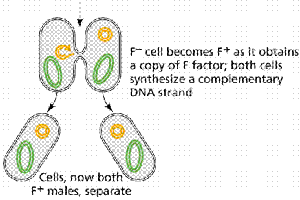
F Factor: A plasmid that enables conjugation; cells with F factor are F+ (donors), those without are F- (recipients).
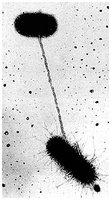
Pilus Formation: A pilus forms between cells, allowing DNA transfer.
F Factor Transmission and Cell-Cell Contact
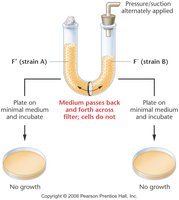
The F factor is not transmitted extracellularly; direct cell-cell contact is required for conjugation.
Bacterial Conjugation: Mechanism
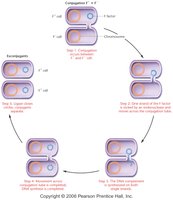
The process of conjugation involves the transfer of the F factor and sometimes chromosomal genes from donor to recipient.
Steps: 1. Pilus formation, 2. DNA transfer, 3. Synthesis of complementary DNA strands, 4. Separation of cells.
Transformation in Bacteria
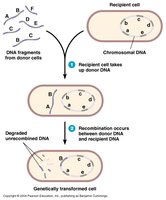
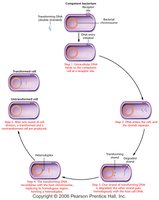
Transformation is the uptake of free DNA from the environment by a bacterial cell, leading to genetic change.
Natural Transformation: Occurs in nature; some bacteria are naturally competent.
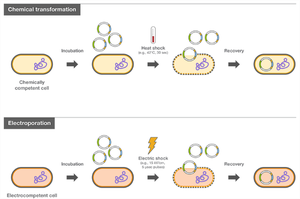
Laboratory Transformation (Transfection): DNA is introduced into cells using chemical or physical methods.
Lipofection in Eukaryotic Cells
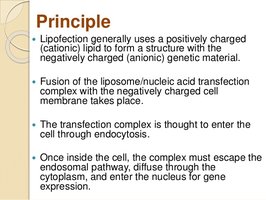
Lipofection is a method used to introduce genetic material into eukaryotic cells by forming complexes with lipids.
Principle: Positively charged lipids form complexes with negatively charged DNA, facilitating entry into cells via endocytosis.
Applications: Used in gene expression studies and genetic engineering.
Bacteriophages and Viral Genetics
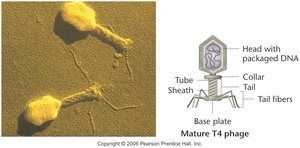
Bacteriophages are viruses that infect bacteria, playing a crucial role in genetic studies and gene transfer.
Structure: Consists of a head (containing DNA), tail, and fibers for attachment.
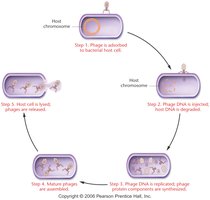
Infection Cycle: Phage attaches to host, injects DNA, and can follow lytic or lysogenic pathways.
Lytic vs Lysogenic Cycles
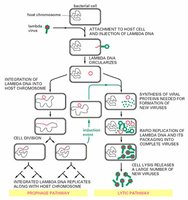
Bacteriophages can reproduce via two distinct cycles:
Lytic Cycle: Phage replicates, lyses host cell, and releases new phages.
Lysogenic Cycle: Phage DNA integrates into host genome and replicates passively until induced to enter lytic cycle.
Transduction
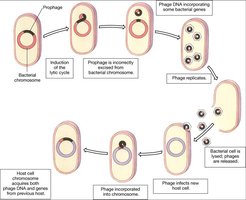
Transduction is the process by which bacterial DNA is transferred from one cell to another via a bacteriophage.
Generalized Transduction: Any bacterial gene can be transferred.
Specialized Transduction: Only specific genes near the prophage insertion site are transferred.
Summary Table: Modes of Bacterial Gene Transfer
Mode | Mechanism | Key Features |
|---|---|---|
Conjugation | Direct cell-cell contact | F factor, pilus formation, plasmid transfer |
Transformation | Uptake of free DNA | Competent cells, recombination |
Transduction | Bacteriophage-mediated | Generalized/specialized, viral infection |
Additional info: These mechanisms are central to genetic analysis and mapping in bacteria and bacteriophages (Ch. 6).
