 Indietro
Lecture 13: Genetic Basis and Molecular Mechanisms of Cancer
Guida di studio - Note intelligenti
 Appunti personalizzati basati sui tuoi materiali, ampliati con definizioni chiave, esempi e contesto.
Cancer as a Genetic Disease
Genetic Nature of Cancer
Cancer is fundamentally a genetic disease of somatic cells, characterized by the accumulation of mutations in specific genes that regulate cell growth, division, and survival. These mutations disrupt normal cellular processes, leading to uncontrolled proliferation and tumor formation. - Somatic mutations occur in body cells and are not inherited, while germline mutations can be passed to offspring and predispose individuals to cancer. - Key genes involved: Oncogenes, tumor suppressor genes, and DNA repair genes. - Multiple mutations are required for a cell to become cancerous, supporting the "multi-hit" model of tumorigenesis. 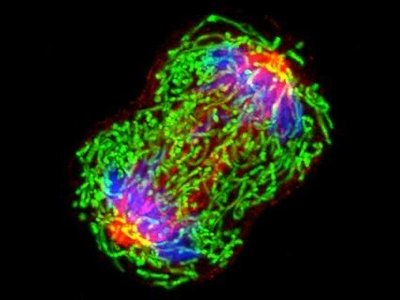
Incidence and Relevance
The risk of developing cancer is significant, with approximately 50% of men and 33% of women affected during their lifetime. Cancer is not a single disease but a collection of related diseases, each defined by the specific genes mutated and the cell type of origin. 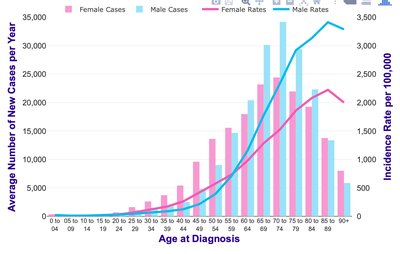
Cell Division and Tumorigenesis
Normal vs. Cancer Cell Division
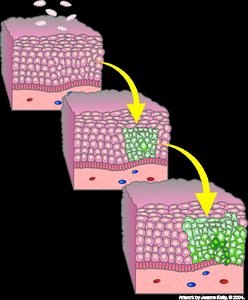
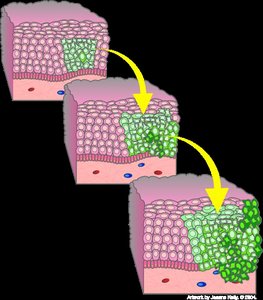
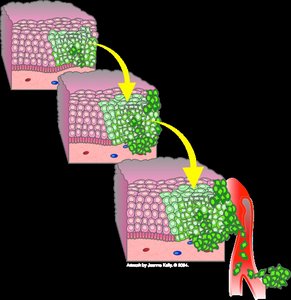
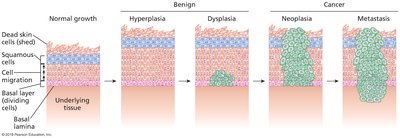
Normal cell division is tightly regulated by checkpoints and signaling pathways, ensuring proper growth and repair. In cancer, these controls are lost, resulting in unchecked cell division and accumulation of mutations. - Normal cells undergo apoptosis (programmed cell death) or are targeted by the immune system when damaged. - Cancer cells evade these mechanisms, continue dividing, and may undergo metastasis, spreading to other parts of the body. 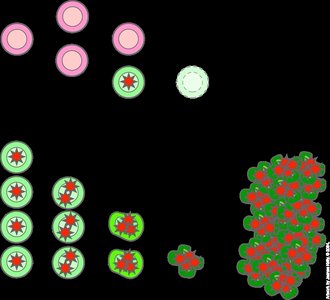
Cellular Pathways Mutated in Cancer
Growth Regulation and Cell Cycle
The cell cycle is regulated by checkpoints that ensure DNA integrity and proper division. Genes that block cell cycle progression are tumor suppressors (brakes), while genes that promote division are proto-oncogenes (accelerators). - Oncogenes arise from gain-of-function mutations in proto-oncogenes, leading to constant activation. - Tumor suppressor genes are inactivated by loss-of-function mutations, removing growth inhibition. 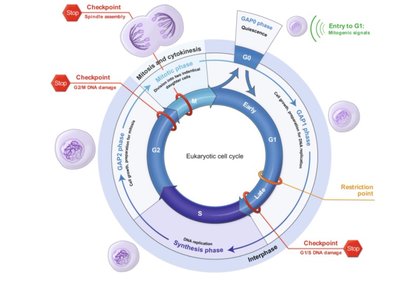
Phenotypic Consequences of Cancer Mutations
Loss of Growth Control and Metastasis
Cancer cells exhibit several phenotypic changes due to accumulated mutations: - Loss of growth regulation - Evasion of apoptosis - Increased migration and invasion - Ability to metastasize and colonize distant tissues 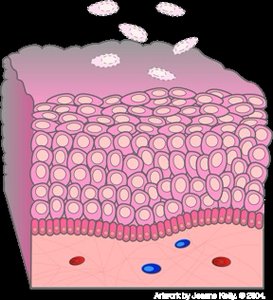
Types of Cancer Genes
Oncogenes vs. Tumor Suppressor Genes
Oncogenes: - Proto-oncogenes normally drive cell cycle progression. - Gain-of-function mutations convert them to oncogenes, causing constant cell division. - Usually dominant mutations. Tumor Suppressor Genes: - Normally block cell cycle progression, repair DNA, or promote apoptosis. - Loss-of-function mutations remove these brakes, allowing uncontrolled growth. - Usually recessive mutations.
Genomic Alterations in Cancer
Karyotype Abnormalities
Cancer cells often display structural abnormalities in their chromosomes, such as deletions, translocations, and duplications, which contribute to tumorigenesis. 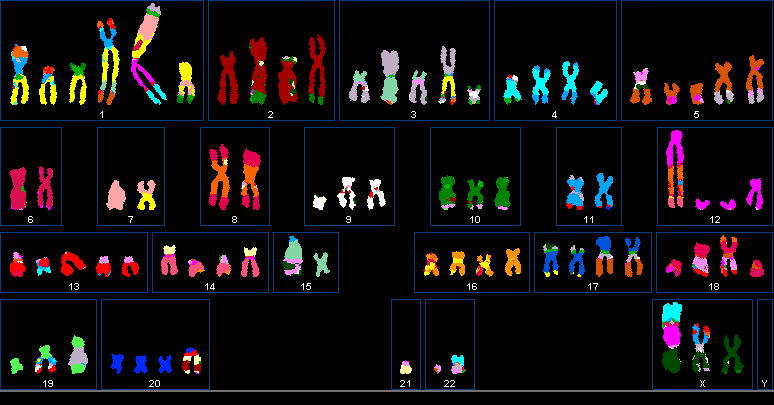
Multi-Step Model of Cancer Development
Tumorigenesis is a multi-step process, requiring mutations in several genes over time. Each cancer arises from a single cell (clonal origin), and its progeny gain a growth advantage. 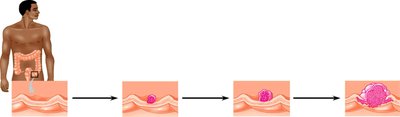
Hallmarks of Cancer
Key Steps in Malignant Transformation
Hanahan and Weinberg (2011) identified ten hallmarks required for a normal cell to become a malignant tumor: - Activation of oncogenes - Inactivation of tumor suppressor genes - Altered metabolism (Warburg effect) - Genome instability - Evasion of apoptosis - Avoidance of immune destruction - Immortality - Inflammation - Vascularization (angiogenesis) - Metastasis
Inherited vs. Sporadic Cancer
Inherited Cancer Predisposition
A subset of cancers are inherited, typically due to autosomal dominant mutations in oncogenes or tumor suppressor genes. Individuals inherit one mutant allele and acquire additional mutations somatically. 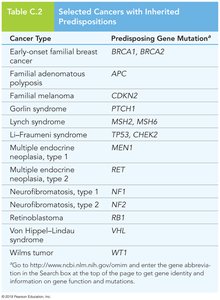
Sporadic Cancer
Most cancers are caused by spontaneous or environmental mutations, with only about 5% attributable to inherited alleles.
Types of Mutations Causing Cancer
Mutation Classes
Cancer can result from various types of mutations: - Missense mutations: Change a single amino acid. - Nonsense mutations: Introduce a premature stop codon. - Frameshift mutations: Alter the reading frame. - Deletions: Remove part or all of a gene. - Chromosome rearrangements: Translocations, exchanges of large DNA segments.
Translocations and Cancer
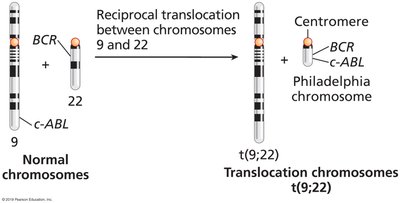
Philadelphia Chromosome (Chronic Myeloid Leukemia): - Reciprocal translocation between chromosomes 9 and 22 creates a BCR-ABL fusion gene, producing a constitutively active kinase. 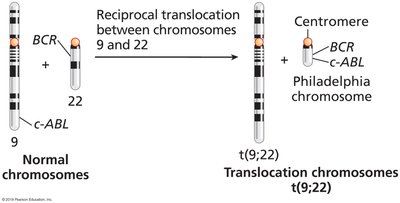
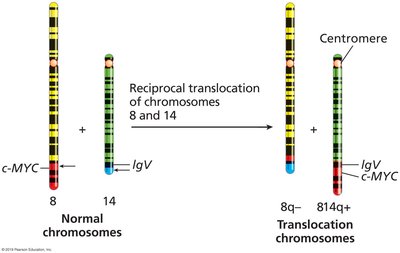
 Burkitt's Lymphoma: - Translocation of c-MYC from chromosome 8 to the IgV region on chromosome 14 results in overproduction of c-MYC protein, promoting cell growth.
Cancer Therapy
Mechanistic Basis of Therapies
Cancer treatments exploit the molecular basis of the disease: - Surgery: Removal of tumors when feasible. - Radiation: Damages DNA in dividing cells. - Chemotherapy: Targets rapidly dividing cells, often by inducing DNA damage (e.g., cisplatin). - Immunotherapy: Uses antibodies against proteins expressed by cancer cells (e.g., Herceptin, Keytruda). - Targeted therapies: Drugs like Gleevec block specific proteins (e.g., ABL kinase in CML) to inhibit growth and survival signals.
Summary Table: Selected Cancers with Inherited Predispositions
Cancer Type | Predisposing Gene Mutation |
|---|---|
Early-onset familial breast cancer | BRCA1, BRCA2 |
Familial adenomatous polyposis | APC |
Familial melanoma | CDKN2 |
Gorlin syndrome | PTCH1 |
Lynch syndrome | MSH2, MSH6 |
Li-Fraumeni syndrome | TP53, CHEK2 |
Multiple endocrine neoplasia, type 1 | MEN1 |
Multiple endocrine neoplasia, type 2 | RET |
Neurofibromatosis, type 1 | NF1 |
Neurofibromatosis, type 2 | NF2 |
Retinoblastoma | RB1 |
Von Hippel-Lindau syndrome | VHL |
Wilms tumor | WT1 |
Key Equations and Concepts
Multi-Hit Model of Cancer
The probability of cancer increases with the number of mutations required: where is the probability of a mutation per cell division and is the number of required mutations.
Dominant vs. Recessive Mutations
- Oncogenes: Dominant gain-of-function mutations. - Tumor suppressor genes: Recessive loss-of-function mutations (both alleles must be inactivated).
Conclusion
Cancer is a complex genetic disease involving multiple mutations in key regulatory genes. Understanding the molecular basis of cancer has enabled the development of targeted therapies and improved diagnostic strategies. Additional info: The notes expand on the mechanistic basis of cancer therapies and the multi-step model of tumorigenesis for completeness.
