 Indietro
Genetics Exam 1 Study Guide: Chromosomes, Cell Cycle, Meiosis, Mendelian Genetics, Pedigrees, and Chromosomal Mutations
Guida di studio - Note intelligenti
 Appunti personalizzati basati sui tuoi materiali, ampliati con definizioni chiave, esempi e contesto.
Q1. Which event occurs during the G₁ phase of the cell cycle? Select all that are true.
Background
Topic: Cell Cycle Phases
This question tests your understanding of the G₁ phase, which is the first gap phase after cell division and before DNA replication. It is important to distinguish what cellular activities occur in G₁ compared to other phases like S, G₂, and M.
Key Terms:
G₁ phase: The period of cell growth and preparation for DNA replication.
Gene expression: The process by which information from a gene is used to synthesize proteins.
DNA replication: The process of copying DNA, which occurs in the S phase.
Chromosome condensation: Occurs during mitosis/meiosis, not G₁.
Separation of sister chromatids: Occurs during mitosis/meiosis, not G₁.
Step-by-Step Guidance
Review the main events of the G₁ phase: cell growth, gene expression, and preparation for DNA replication.
Recall that DNA replication occurs in the S phase, not G₁.
Chromosome condensation and separation of sister chromatids occur during mitosis/meiosis, not G₁.
Identify which options are specific to G₁ and which belong to other phases.
Try solving on your own before revealing the answer!
Final Answer:
Gene expression and growth occur during the G₁ phase. DNA replication, chromosome condensation, and separation of sister chromatids do not occur in G₁.
Q2. If a cell bypassed the G₁/S checkpoint despite extensive DNA damage, what would most likely result?
Background
Topic: Cell Cycle Checkpoints
This question tests your understanding of the importance of cell cycle checkpoints, especially the G₁/S checkpoint, which prevents cells with damaged DNA from replicating.
Key Terms:
G₁/S checkpoint: Ensures DNA integrity before replication.
DNA damage: Can lead to mutations if not repaired.
Cell division: The process of creating daughter cells.
Step-by-Step Guidance
Recall the function of the G₁/S checkpoint: to prevent cells with damaged DNA from entering S phase.
Consider what happens if this checkpoint is ignored: damaged DNA is replicated.
Think about the consequences for daughter cells if DNA damage is not repaired.
Evaluate the options for the most likely outcome.
Try solving on your own before revealing the answer!
Final Answer:
The damaged DNA would be passed to both daughter cells. Bypassing the checkpoint allows replication and division despite DNA damage.
Q3. A cell with 2n = 8 undergoes meiosis but experiences nondisjunction of one homologous pair in meiosis I. How many chromosomes will each gamete contain after meiosis II?
Background
Topic: Meiosis and Chromosome Number
This question tests your understanding of nondisjunction, which is the failure of homologous chromosomes to separate properly during meiosis I, resulting in abnormal chromosome numbers in gametes.
Key Terms:
2n: Diploid chromosome number.
Nondisjunction: Failure of chromosome separation.
Meiosis I and II: Two rounds of division in meiosis.
Step-by-Step Guidance
Recall that normal meiosis produces gametes with n chromosomes.
Understand that nondisjunction in meiosis I results in two gametes with an extra chromosome and two with one less.
Calculate the possible chromosome numbers in the resulting gametes.
Set up the calculation for the chromosome distribution after meiosis II.
Try solving on your own before revealing the answer!
Final Answer:
Gametes will contain 3 and 5 chromosomes. Nondisjunction causes two gametes to have one extra and two to have one fewer chromosome.
Q4. Which event occurs in meiosis II but not in meiosis I?
Background
Topic: Meiosis I vs. Meiosis II
This question tests your ability to distinguish between the events of meiosis I and meiosis II.
Key Terms:
Meiosis I: Homologous chromosomes separate.
Meiosis II: Sister chromatids separate.
Crossing over: Occurs in meiosis I.
Synapsis: Occurs in meiosis I.
Reduction of chromosome number: Occurs in meiosis I.
Step-by-Step Guidance
List the events unique to meiosis I: crossing over, synapsis, reduction of chromosome number.
List the events unique to meiosis II: separation of sister chromatids.
Compare the options to determine which event is exclusive to meiosis II.
Set up your answer based on the differences between the two divisions.
Try solving on your own before revealing the answer!
Final Answer:
Separation of sister chromatids occurs in meiosis II but not in meiosis I.
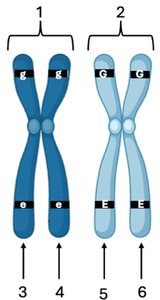
Q5. Based on the image below, which labels represent sister chromatids?
Background
Topic: Chromosome Structure
This question tests your ability to identify sister chromatids, which are identical copies of a chromosome connected by a centromere.
Key Terms:
Sister chromatids: Two identical DNA molecules joined at the centromere.
Homologous chromosomes: Chromosomes from each parent with the same genes but possibly different alleles.
Step-by-Step Guidance
Identify the two arms of each X-shaped chromosome; these are the sister chromatids.
Look for labels pointing to the two halves of each chromosome structure.
Recall that sister chromatids are within the same chromosome, not between homologs.
Determine which labels correspond to the two chromatids of a single chromosome.
Try solving on your own before revealing the answer!
Final Answer:
Labels 3 and 4 (for structure 1) and 5 and 6 (for structure 2) represent sister chromatids. Each pair is part of the same chromosome.
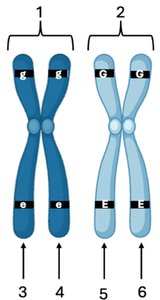
Q6. Based on the image below, the structure labeled “5” is a chromatid. True or False?
Background
Topic: Chromosome Structure
This question tests your ability to identify chromatids in a chromosome diagram.
Key Terms:
Chromatid: One of two identical halves of a replicated chromosome.
Step-by-Step Guidance
Locate label “5” in the diagram and determine if it points to one half of the X-shaped chromosome.
Recall that each half of the X is a chromatid.
Check if label “5” is pointing to a single chromatid or another structure.
Set up your answer based on the definition of a chromatid.
Try solving on your own before revealing the answer!
Final Answer:
True. The structure labeled “5” is a chromatid, as it is one half of the X-shaped chromosome.
