 Indietro
Genetics Exam 1 Study Guide: Core Concepts and Applications
Guida di studio - Note intelligenti
 Appunti personalizzati basati sui tuoi materiali, ampliati con definizioni chiave, esempi e contesto.
DNA & Chromosomes
Complementary Base Pairing Rules
DNA structure is stabilized by specific pairing between nitrogenous bases, following Chargaff's rules:
Adenine (A) pairs with Thymine (T) via 2 hydrogen bonds.
Guanine (G) pairs with Cytosine (C) via 3 hydrogen bonds.
In RNA, Uracil (U) replaces Thymine.
Example: For a DNA strand 5'-ATGCCG-3', the complementary strand is 3'-TACGGC-5'.
Diploid and Haploid Chromosome Numbers
Diploid (2n): Full chromosome set, found in somatic cells (e.g., humans 2n = 46).
Haploid (n): Half the chromosome set, found in game\
es (n = 23 in humans).
Each chromosome pair consists of one chromosome from each parent.
Model Organisms in Genetics
Drosophila melanogaster (fruit fly), Mus musculus (mouse), Caenorhabditis elegans (roundworm), Arabidopsis thaliana (plant) are common model organisms.
Large mammals and humans are less commonly used due to ethical and practical reasons.
Cell Division: Mitosis & Meiosis
Cell Cycle & Chromosome Doubling
G1: Cell growth and protein synthesis.
S Phase: DNA replication (chromosome doubling occurs here).
G2: Preparation for cell division.
M Phase: Mitosis or meiosis occurs.
Chromosome doubling occurs during S phase, not during mitosis itself.
Mitosis
Interphase (S Phase): Chromosomes replicate, each consisting of two sister chromatids.
Prophase: Chromatin condenses, spindle fibers form.
Metaphase: Chromosomes align at the metaphase plate.
Anaphase: Sister chromatids separate to opposite poles.
Telophase: Nuclear envelope reforms.
Cytokinesis: Cell splits into two diploid daughter cells.
Meiosis
Reduces chromosome number from diploid (2n) to haploid (n).
Consists of two divisions: Meiosis I and Meiosis II.
Results in four genetically unique haploid gametes.
Mendelian Genetics
Mendel's Laws
Law | Definition |
|---|---|
Law of Segregation | Two alleles for each gene separate during gamete formation. |
Law of Independent Assortment | Genes on different chromosomes are inherited independently. |
Independent assortment applies to genes on different (non-homologous) chromosomes.
Genotypes & Phenotypes
Homozygous dominant: AA
Homozygous recessive: aa
Heterozygous (Carrier): Aa
Wild type: Most common phenotype in a population.
Proband: First affected individual identified in a pedigree.
Test Cross
Cross an unknown dominant phenotype with a homozygous recessive (aa) to determine genotype.
Unknown Genotype | Offspring Ratio |
|---|---|
AA × aa | 100% dominant phenotype |
Aa × aa | 50% dominant : 50% recessive |
Dihybrid Cross Example
Cross: AaBb × Aabb
Gametes for AaBb: AB, Ab, aB, ab
Gametes for Aabb: Ab, Ab, ab, ab
Ab | Ab | ab | ab | |
|---|---|---|---|---|
AB | AABb | AABb | AaBb | AaBb |
Ab | AAbb | AAbb | Aabb | Aabb |
aB | AaBb | AaBb | aaBb | aaBb |
ab | Aabb | Aabb | aabb | aabb |
Phenotype Ratio: A_B_ : 3, A_bb : 3, aaB_ : 1, aabb : 1 (3:3:1:1)
Number of Gamete Types
Formula: where n = number of heterozygous gene pairs
For AaBbCcDd: n = 4, so gamete types
Forked-Line Method (Probability)
Used to calculate probability of offspring genotypes across multiple genes.
Example: Probability of aa offspring from Aa × Aa for each gene:
Inheritance Patterns
Term | Definition | Example |
|---|---|---|
Codominance | Both alleles are fully expressed | ABO blood type (AB) |
Incomplete Dominance | Heterozygote shows a blend | Red × White → Pink flowers |
Epistasis | One gene masks another | Coat color in Labradors |
Pleiotropy | One gene affects multiple traits | Sickle cell anemia |
Gain of Function Mutation: Creates new/enhanced protein function, usually autosomal dominant.
Pedigree Analysis
Pattern | Clues in Pedigree |
|---|---|
Autosomal Dominant | Trait appears every generation, affects both sexes equally |
Autosomal Recessive | Skips generations, carrier parents can have affected child |
X-linked Dominant | Affected fathers pass to all daughters; more females affected |
X-linked Recessive | More males affected; carrier mothers pass to sons |
Y-linked | Only males; passed from father to all sons |
X-linked Dominant: Affected fathers pass trait to all daughters, not sons; affected mothers (heterozygous) pass to 50% of sons and daughters.
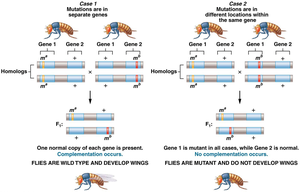
Complementation Test (Fruit Flies)
The complementation test distinguishes whether mutations causing the same phenotype are in the same or different genes. If two mutants are crossed and the offspring are wild type, the mutations are in different genes (complementation occurs). If the offspring are mutant, the mutations are in the same gene (no complementation).
Sex Determination & X-Inactivation
Sex Chromosome Abnormalities & Nondisjunction
Nondisjunction: Failure of chromosomes to separate properly during meiosis, leading to abnormal chromosome numbers.
Syndrome | Genotype | Features |
|---|---|---|
Klinefelter Syndrome | 47, XXY | Male, infertile, tall, gynecomastia |
Turner Syndrome | 45, X | Female, short, infertile, webbed neck |
Triple X | 47, XXX | Female, usually fertile, mild learning difficulties |
Jacob's Syndrome | 47, XYY | Male, tall, usually fertile |
Lyon Hypothesis / X-Inactivation / Barr Bodies
In mammals, one X chromosome is randomly inactivated in each somatic cell, forming a Barr body.
Formula:
Genotype | # of X chromosomes | # of Barr bodies |
|---|---|---|
XX (female) | 2 | 1 |
XY (male) | 1 | 0 |
XXY (Klinefelter) | 2 | 1 |
XXX | 3 | 2 |
X (Turner) | 1 | 0 |
This process is called dosage compensation, ensuring equal expression of X-linked genes in both sexes.
Calico cats (XX) display orange/black patches due to random X-inactivation.
Pseudoautosomal Region (PAR)
PAR is a region on the Y chromosome that pairs with the X chromosome during meiosis.
It behaves like an autosomal region and is located at the tips of X and Y chromosomes.
Metabolic & Chromosomal Disorders
Inborn Errors of Metabolism
Disease | Cause | Treatment Strategy |
|---|---|---|
PKU (Phenylketonuria) | Cannot metabolize phenylalanine | Dietary restriction of phenylalanine |
Galactosemia | Cannot metabolize galactose | Dietary restriction of galactose/lactose |
Gout | Excess uric acid accumulation | Dietary changes + medications (allopurinol) |
Albinism: Autosomal recessive, absence of melanin pigment.
Lethal Alleles
Some alleles are lethal when homozygous dominant (AA).
Example cross (Aa × Aa, AA lethal): Expected 1 AA : 2 Aa : 1 aa, but AA dies, so surviving ratio is 2 Aa : 1 aa.
Karyotype Analysis
A karyotype shows chromosome number, size, and structure.
It cannot reveal specific gene mutations, gene expression levels, epigenetic modifications, or behavioral traits.
Study Tip: Focus on understanding the reasoning behind each concept, not just memorization. Practice drawing mitosis, meiosis, and Punnett squares, and apply the product law for probability calculations.
