 Indietro
Genetics Exam Study Guide: Pedigree Analysis, Mendelian Genetics, Probability, and Cell Division
Guida di studio - Note intelligenti
 Appunti personalizzati basati sui tuoi materiali, ampliati con definizioni chiave, esempi e contesto.
Q1. The cross AaBb x aaBb is called a:
Background
Topic: Types of genetic crosses
This question tests your understanding of terminology used in classical Mendelian genetics to describe crosses involving two genes.
Key Terms:
Dihybrid cross: A cross between two individuals that are both heterozygous for two genes.
Backcross: A cross between an F1 individual and one of the parental genotypes.
Reciprocal cross: A cross in which the sexes of the parents are reversed.
Testcross: A cross between an individual of unknown genotype and a homozygous recessive individual.
Monohybrid cross: A cross involving only one gene.
Step-by-Step Guidance
Identify the genotypes involved: AaBb (heterozygous for both genes) and aaBb (homozygous recessive for one gene, heterozygous for the other).
Determine which type of cross this represents based on the definitions above.
Consider whether this cross is testing for one or two genes, and whether one parent is homozygous recessive for either gene.
Try solving on your own before revealing the answer!
Final Answer: b. backcross
This cross is a backcross because one parent (aaBb) is homozygous recessive for one gene and heterozygous for the other, which is typical of a backcross in dihybrid genetics.
Q2. Assuming codominance for both genes, what is the phenotypic ratio of the offspring of the cross AaBb x aaBb?
Background
Topic: Codominance and dihybrid crosses
This question tests your ability to predict phenotypic ratios when both genes exhibit codominance, rather than simple dominance.
Key Terms and Formulas:
Codominance: Both alleles in a heterozygote are fully expressed.
Dihybrid cross: A cross involving two genes.
Phenotypic ratio: The ratio of different observable traits among offspring.
Step-by-Step Guidance
List all possible genotypes for each gene from the cross AaBb x aaBb.
Determine the phenotypes for each genotype, considering codominance.
Calculate the expected frequency of each phenotype using Punnett squares or probability rules.
Try solving on your own before revealing the answer!
Final Answer: a. 1:2:1:2:2:1
With codominance, the phenotypic ratio reflects the expression of all alleles, resulting in a 1:2:1:2:2:1 ratio for the offspring.
Q5. Corn has a color gene and a height gene with the following phenotypes: CC and Cc, purple; cc, white; TT, tall; Tt, medium; tt, dwarf. If a dihybrid is self-fertilized, what is the resulting phenotypic ratio?
Background
Topic: Dihybrid cross and phenotypic ratios
This question tests your ability to calculate the phenotypic ratio from a self-fertilized dihybrid (heterozygous for both genes).
Key Terms and Formulas:
Dihybrid cross: Cross between individuals heterozygous for two genes.
Phenotypic ratio: Ratio of observable traits in offspring.
Self-fertilization: Crossing an individual with itself.
Use the formula for independent assortment: for two genes with simple dominance.
Step-by-Step Guidance
Identify the genotypes of the dihybrid: CcTt.
Set up Punnett squares for each gene separately to determine the ratios for color and height.
Combine the ratios for both genes to get the overall phenotypic ratio.
Try solving on your own before revealing the answer!
Final Answer: a. 9:3:3:1
The classic dihybrid self-cross produces a 9:3:3:1 phenotypic ratio for two genes with simple dominance.
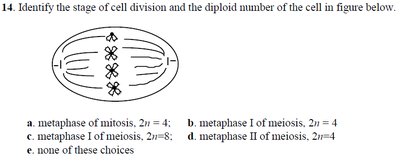
Q14. Identify the stage of cell division and the diploid number of the cell in the figure below.
Background
Topic: Cell division stages and chromosome number
This question tests your ability to recognize the stage of mitosis or meiosis and determine the diploid number from a diagram.
Key Terms:
Metaphase: Chromosomes align at the cell's equator.
Diploid number (): Total number of chromosomes in a somatic cell.
Mitosis vs. Meiosis: Mitosis produces identical cells; meiosis produces gametes with half the chromosome number.
Step-by-Step Guidance
Examine the diagram for chromosome arrangement and number.
Determine if the chromosomes are paired (homologous pairs) or single (sister chromatids).
Count the chromosomes and relate to the possible diploid number.
Decide whether the stage is metaphase of mitosis or meiosis based on arrangement.
Try solving on your own before revealing the answer!
Final Answer: b. metaphase I of meiosis, 2n = 4
The diagram shows homologous chromosomes aligned, characteristic of metaphase I of meiosis with a diploid number of 4.
Q21. A dihybrid plant was crossed; the F2 generation consisted of 860 tall plants with purple flowers, 285 dwarf, purple plants, 340 tall, pink plants, and 115 dwarf, pink plants. The data remind you of a 9:3:3:1 ratio. The critical chi-square for two degrees of freedom (df) = 5.991. Therefore, you should:
Background
Topic: Chi-square test in genetics
This question tests your ability to use the chi-square test to evaluate whether observed data fit expected Mendelian ratios.
Key Terms and Formulas:
Chi-square () test: Statistical test to compare observed and expected frequencies.
Degrees of freedom (): Number of categories minus one.
Formula:
Step-by-Step Guidance
Calculate the expected numbers for each phenotype based on the total and the 9:3:3:1 ratio.
Compute the chi-square value using the formula above.
Compare your calculated value to the critical value for (or 2, as stated).
Decide whether to accept or reject the hypothesis based on whether is less than or greater than the critical value.
Try solving on your own before revealing the answer!
Final Answer: b. accept your hypothesis
If the calculated is less than the critical value, the observed data fit the expected ratio and you accept the hypothesis.
Q33. Barring new mutation, and assuming complete penetrance and single-locus inheritance, what are possible modes of inheritance of the trait shown in figure below?
Background
Topic: Pedigree analysis and modes of inheritance
This question tests your ability to interpret pedigrees and determine possible modes of inheritance (autosomal dominant, autosomal recessive, X-linked dominant, X-linked recessive).
Key Terms:
Autosomal dominant/recessive: Traits inherited via non-sex chromosomes.
X-linked dominant/recessive: Traits inherited via the X chromosome.
Penetrance: Proportion of individuals with a genotype who show the phenotype.
Step-by-Step Guidance
Examine the pedigree for affected and unaffected individuals across generations.
Determine if the trait appears in every generation (suggests dominant) or skips generations (suggests recessive).
Check for sex bias in affected individuals (suggests X-linked inheritance).
Consider whether more than one mode of inheritance could explain the pattern.
Try solving on your own before revealing the answer!
Final Answer: e. more than one of these
The pedigree could fit more than one mode of inheritance, depending on penetrance and the pattern of affected individuals.
