 Indietro
Genetics Exam Study Guide: Pedigree Analysis, Mendelian Inheritance, and Probability
Guida di studio - Note intelligenti
 Appunti personalizzati basati sui tuoi materiali, ampliati con definizioni chiave, esempi e contesto.
Q1. The cross AaBb x aaBb is called:
Background
Topic: Types of genetic crosses
This question tests your understanding of terminology used in genetics to describe crosses involving two genes, such as dihybrid, backcross, reciprocal cross, testcross, and monohybrid cross.
Key Terms:
Dihybrid cross: Cross between individuals with different alleles at two loci.
Backcross: Cross between an F1 individual and one of the parental genotypes.
Reciprocal cross: Cross in which the sexes of the parents are reversed.
Testcross: Cross between an individual and a homozygous recessive individual.
Monohybrid cross: Cross involving one gene.
Step-by-Step Guidance
Examine the genotypes: AaBb (heterozygous for both genes) and aaBb (homozygous recessive for one gene, heterozygous for the other).
Determine which type of cross this represents based on the definitions above.
Consider whether this is a testcross, backcross, or another type.
Review the options and match the cross to the correct terminology.
Try solving on your own before revealing the answer!
Final Answer: b. backcross
This cross is a backcross because one parent (aaBb) is homozygous for one gene and heterozygous for the other, matching the definition of a backcross.
Q2. Assuming codominance for both genes, what is the phenotypic ratio of the offspring of the cross AaBb x aaBb?
Background
Topic: Mendelian ratios and codominance
This question tests your ability to calculate phenotypic ratios when both genes exhibit codominance, meaning both alleles are expressed in the heterozygote.
Key Terms and Formulas:
Codominance: Both alleles are fully expressed in the heterozygote.
Phenotypic ratio: The proportion of different phenotypes among the offspring.
Punnett square: Tool for predicting genotypes and phenotypes.
Step-by-Step Guidance
Set up the Punnett square for each gene separately: Aa x aa and Bb x Bb.
Determine the possible genotypes for each gene.
Combine the genotypes to get the overall phenotypes, considering codominance.
Count the number of each phenotype and set up the ratio.
Try solving on your own before revealing the answer!
Final Answer: c. 3:6:3:1:2:1
With codominance, the phenotypic ratio is more complex than simple dominance, resulting in 6 distinct phenotypes.
Q3. The cross AaBb x aabb is called:
Background
Topic: Types of genetic crosses
This question tests your understanding of genetic cross terminology, specifically when one parent is homozygous recessive for both genes.
Key Terms:
Testcross: Cross between an individual and a homozygous recessive individual.
Backcross: Cross between an F1 individual and a parental genotype.
Step-by-Step Guidance
Identify the genotypes: AaBb (heterozygous for both genes) and aabb (homozygous recessive for both genes).
Recall the definition of a testcross.
Determine if this cross fits the definition of a testcross.
Review the answer choices and select the correct term.
Try solving on your own before revealing the answer!
Final Answer: d. testcross
This cross is a testcross because one parent is homozygous recessive for both genes.
Q4. Assuming complete dominance, what is the phenotypic ratio of the offspring of the cross AaBb x aabb?
Background
Topic: Mendelian ratios and complete dominance
This question tests your ability to calculate phenotypic ratios when both genes exhibit complete dominance.
Key Terms and Formulas:
Complete dominance: Only the dominant allele is expressed in the heterozygote.
Punnett square: Tool for predicting genotypes and phenotypes.
Step-by-Step Guidance
Set up the Punnett square for each gene: Aa x aa and Bb x bb.
Determine the possible genotypes for each gene.
Combine the genotypes to get the overall phenotypes, considering complete dominance.
Count the number of each phenotype and set up the ratio.
Try solving on your own before revealing the answer!
Final Answer: b. 1:1:1:1
With complete dominance, the testcross produces a 1:1:1:1 phenotypic ratio.
Q5. Corn has a color gene and a height gene with the following phenotypes: CC and Cc, purple; cc, white; TT, tall; Tt, medium; tt, dwarf. If a dihybrid is self-fertilized, what is the resulting phenotypic ratio?
Background
Topic: Dihybrid cross and phenotypic ratios
This question tests your ability to calculate the phenotypic ratio for a dihybrid self-cross involving two genes with complete dominance.
Key Terms and Formulas:
Dihybrid cross: Cross between individuals heterozygous for two genes.
Phenotypic ratio: The proportion of different phenotypes among the offspring.
Punnett square: Tool for predicting genotypes and phenotypes.
Step-by-Step Guidance
Set up the Punnett square for both genes: Cc x Cc and Tt x Tt.
Determine the phenotypic ratios for each gene separately.
Multiply the ratios to get the combined phenotypic ratio for both traits.
List the possible phenotypes and their expected proportions.
Try solving on your own before revealing the answer!
Final Answer: a. 12:2:4:2:1:2:1
The combined phenotypic ratio reflects the interaction of two genes with three phenotypes each.
Q6. Mendel's work on the rules of inherited traits was not appreciated until it was rediscovered in 1900 because:
Background
Topic: History of genetics
This question tests your understanding of why Mendel's discoveries were not immediately recognized by the scientific community.
Key Terms:
Mendelian genetics: Principles of inheritance discovered by Gregor Mendel.
Scientific controls: Methods to ensure reliable results.
Gene concept: The idea of discrete units of inheritance.
Step-by-Step Guidance
Review the historical context of Mendel's work.
Consider the reasons listed and their relevance to the scientific community's acceptance of Mendel's findings.
Identify which reason best explains the delay in recognition.
Eliminate options that are not historically accurate.
Try solving on your own before revealing the answer!
Final Answer: c. there was no known physical basis for Mendel's "gene" concept at the time.
Mendel's concept of genes was not understood because the physical nature of genes was unknown in the 19th century.
Q7. Full pod shape (F) is dominant to constricted pod shape (f), and yellow pod color (Y) is dominant to green pod color (y) in pea plants. A pure-breeding green plant with full pods is crossed with a pure-breeding yellow plant with constricted pods. The offspring are then testcrossed. What is the expected phenotypic ratio of the offspring?
Background
Topic: Dihybrid testcross and Mendelian ratios
This question tests your ability to predict phenotypic ratios from a dihybrid testcross involving two traits with complete dominance.
Key Terms and Formulas:
Testcross: Cross between an individual and a homozygous recessive individual.
Dihybrid cross: Cross involving two genes.
Punnett square: Tool for predicting genotypes and phenotypes.
Step-by-Step Guidance
Identify the genotypes of the parents and the testcross offspring.
Set up the Punnett square for the testcross.
Determine the possible phenotypes and their expected ratios.
Match the calculated ratio to the answer choices.
Try solving on your own before revealing the answer!
Final Answer: c. 1:1:1:1
A dihybrid testcross produces a 1:1:1:1 phenotypic ratio.
Q8. Full pod shape (F) is dominant to constricted pod shape (f), and yellow pod color (Y) is dominant to green pod color (y) in pea plants. What is the genotype of a yellow plant with a constricted pod?
Background
Topic: Genotype and phenotype relationships
This question tests your ability to deduce the genotype from the phenotype, given dominance relationships.
Key Terms:
Dominant allele: Expressed in the phenotype when present.
Recessive allele: Only expressed when homozygous.
Genotype: Genetic makeup of an organism.
Phenotype: Observable traits.
Step-by-Step Guidance
Yellow color means at least one Y allele; constricted pod means ff genotype.
Combine the information to deduce the possible genotypes.
Review the answer choices and select those that fit the phenotype.
Consider if more than one genotype is possible.
Try solving on your own before revealing the answer!
Final Answer: e. two of these choices
Both FfYy and ffYY genotypes can produce a yellow plant with a constricted pod.
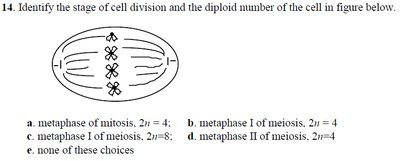
Q14. Identify the stage of cell division and the diploid number of the cell in figure below.
Background
Topic: Cell division stages and chromosome number
This question tests your ability to recognize stages of mitosis and meiosis and determine the diploid number from a diagram.
Key Terms:
Metaphase: Stage where chromosomes align at the cell's equator.
Diploid number (2n): Total number of chromosomes in a somatic cell.
Mitosis vs. meiosis: Types of cell division.
Step-by-Step Guidance
Count the number of chromosomes shown in the diagram.
Determine if the cell is in mitosis or meiosis based on chromosome arrangement.
Match the stage and chromosome number to the answer choices.
Review the options and select the most accurate description.
Try solving on your own before revealing the answer!
Final Answer: b. metaphase I of meiosis, 2n = 4
The diagram shows homologous chromosomes aligned, characteristic of metaphase I of meiosis with a diploid number of 4.
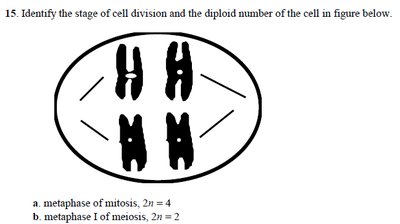
Q15. Identify the stage of cell division and the diploid number of the cell in figure below.
Background
Topic: Cell division stages and chromosome number
This question tests your ability to recognize stages of mitosis and meiosis and determine the diploid number from a diagram.
Key Terms:
Metaphase: Stage where chromosomes align at the cell's equator.
Diploid number (2n): Total number of chromosomes in a somatic cell.
Mitosis vs. meiosis: Types of cell division.
Step-by-Step Guidance
Count the number of chromosomes shown in the diagram.
Determine if the cell is in mitosis or meiosis based on chromosome arrangement.
Match the stage and chromosome number to the answer choices.
Review the options and select the most accurate description.
Try solving on your own before revealing the answer!
Final Answer: a. metaphase of mitosis, 2n = 4
The diagram shows chromosomes aligned in metaphase of mitosis with a diploid number of 4.
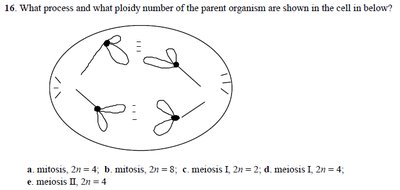
Q16. What process and what ploidy number of the parent organism are shown in the cell below?
Background
Topic: Cell division and ploidy
This question tests your ability to identify the process (mitosis or meiosis) and the ploidy number from a cell diagram.
Key Terms:
Ploidy: Number of sets of chromosomes in a cell.
Mitosis: Division of somatic cells.
Meiosis: Division to produce gametes.
Step-by-Step Guidance
Examine the chromosome number and arrangement in the diagram.
Determine if the cell is undergoing mitosis or meiosis.
Identify the ploidy number based on the chromosome count.
Match your findings to the answer choices.
Try solving on your own before revealing the answer!
Final Answer: d. meiosis I, 2n = 4
The diagram shows meiosis I with a diploid number of 4 chromosomes.
Q21. A dihybrid plant was crossed; the F2 generation consisted of 860 tall plants with purple flowers; 285 dwarf, purple plants; 340 tall, pink plants; and 115 dwarf, pink plants. The data remind you of a 9:3:3:1 ratio. The critical chi-square for two degrees of freedom (df) = 5.991; three df = 7.815; four df = 9.488; nine df = 16.919. Therefore, you should:
Background
Topic: Chi-square test in genetics
This question tests your ability to interpret chi-square values and degrees of freedom to accept or reject a genetic hypothesis.
Key Terms and Formulas:
Chi-square test (): Statistical test to compare observed and expected values.
Degrees of freedom (df): Number of categories minus one.
Critical value: Threshold for accepting or rejecting the hypothesis.
Step-by-Step Guidance
Calculate the expected values for each phenotype based on the total and the 9:3:3:1 ratio.
Compute the chi-square value using .
Determine the degrees of freedom (number of phenotypic categories minus one).
Compare your calculated chi-square value to the critical value for the appropriate degrees of freedom.
Try solving on your own before revealing the answer!
Final Answer: b. accept your hypothesis
If the calculated chi-square is less than the critical value, you accept the hypothesis that the observed ratio fits the expected 9:3:3:1 ratio.
Q22. A dihybrid (AaBb) lab mouse is testcrossed. What is the probability that the first three offspring are dihybrid females?
Background
Topic: Probability in genetics
This question tests your ability to calculate the probability of a specific outcome in a genetic cross using the multiplication rule.
Key Terms and Formulas:
Probability: Likelihood of a specific outcome.
Multiplication rule: Probability of independent events occurring together.
Dihybrid: Heterozygous for two genes.
Step-by-Step Guidance
Determine the probability of producing a dihybrid female in a single cross.
Multiply the probability for three consecutive offspring.
Set up the calculation using the multiplication rule.
Review the answer choices and match your calculation.
Try solving on your own before revealing the answer!
Final Answer: a. 3(1/8) = 0.375
The probability is calculated by multiplying the chance for each offspring and considering the number of ways to get three dihybrid females.
Q24. A male fruit fly and a female fruit fly are heterozygous for detached wings (det). What is the probability that of their first ten offspring, any five will be females with detached wings?
Background
Topic: Probability and binomial distribution in genetics
This question tests your ability to use the binomial formula to calculate the probability of a specific number of offspring with a given phenotype.
Key Terms and Formulas:
Binomial probability:
Detached wings: Specific phenotype.
Heterozygous: Having two different alleles.
Step-by-Step Guidance
Determine the probability of a single offspring being a female with detached wings.
Use the binomial formula to calculate the probability for five out of ten offspring.
Set up the calculation and review the answer choices.
Match your setup to the options provided.
Try solving on your own before revealing the answer!
Final Answer: c. (10!/(5!5!))(1/8)^5(3/8)^5
The binomial formula is used to calculate the probability of five females with detached wings out of ten offspring.
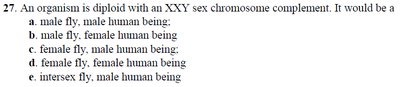
Q27. An organism is diploid with an XXY sex chromosome complement. It would be a:
Background
Topic: Sex chromosome complements and their effects
This question tests your understanding of how different sex chromosome combinations affect the phenotype in flies and humans.
Key Terms:
Diploid: Two sets of chromosomes.
XXY: Sex chromosome complement.
Klinefelter syndrome: XXY in humans.
Sex determination: Mechanisms in flies and humans.
Step-by-Step Guidance
Recall how sex is determined in humans (XX = female, XY = male, XXY = male with Klinefelter syndrome).
Recall how sex is determined in flies (ratio of X chromosomes to autosomes).
Match the XXY complement to the expected phenotype in both species.
Review the answer choices and select the correct combination.
Try solving on your own before revealing the answer!
Final Answer: b. male fly, female human being
XXY produces a male fly and a female human (Klinefelter syndrome).
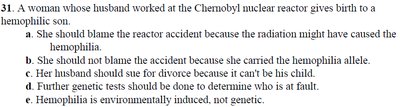
Q31. A woman whose husband worked at the Chernobyl nuclear reactor gives birth to a hemophilic son. What is the most likely explanation?
Background
Topic: X-linked inheritance and environmental effects
This question tests your understanding of the genetic basis of hemophilia and whether environmental factors like radiation can cause it.
Key Terms:
Hemophilia: X-linked recessive disorder.
X-linked inheritance: Trait carried on the X chromosome.
Environmental effects: Influence of external factors on genetics.
Step-by-Step Guidance
Recall the inheritance pattern of hemophilia (X-linked recessive).
Consider whether radiation exposure can cause hemophilia.
Determine the most likely explanation for the son's condition.
Review the answer choices and select the most accurate explanation.
Try solving on your own before revealing the answer!
Final Answer: b. She should not blame the accident because she carried the hemophilia allele.
Hemophilia is inherited, not caused by environmental factors like radiation.
Q33. Barring new mutation, and assuming complete penetrance and single-locus inheritance, what are possible modes of inheritance of the trait shown in figure below?
Background
Topic: Pedigree analysis and modes of inheritance
This question tests your ability to analyze a pedigree and determine possible modes of inheritance for a trait.
Key Terms:
Autosomal recessive: Trait appears only when both alleles are recessive.
Autosomal dominant: Trait appears when at least one dominant allele is present.
X-linked recessive/dominant: Trait carried on the X chromosome.
Penetrance: Proportion of individuals with a genotype who show the phenotype.
Step-by-Step Guidance
Examine the pedigree for affected and unaffected individuals.
Determine if the trait skips generations or is present in every generation.
Assess whether the trait is equally distributed among sexes.
Match the pattern to possible modes of inheritance.
Try solving on your own before revealing the answer!
Final Answer: e. more than one of these
The pedigree could fit more than one mode of inheritance, depending on the pattern observed.
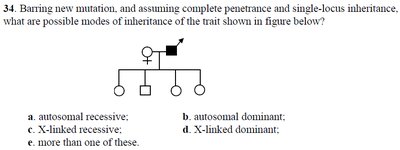
Q34. Barring new mutation, and assuming complete penetrance and single-locus inheritance, what are possible modes of inheritance of the trait shown in figure below?
Background
Topic: Pedigree analysis and modes of inheritance
This question tests your ability to analyze a pedigree and determine possible modes of inheritance for a trait.
Key Terms:
Autosomal recessive: Trait appears only when both alleles are recessive.
Autosomal dominant: Trait appears when at least one dominant allele is present.
X-linked recessive/dominant: Trait carried on the X chromosome.
Penetrance: Proportion of individuals with a genotype who show the phenotype.
Step-by-Step Guidance
Examine the pedigree for affected and unaffected individuals.
Determine if the trait skips generations or is present in every generation.
Assess whether the trait is equally distributed among sexes.
Match the pattern to possible modes of inheritance.
Try solving on your own before revealing the answer!
Final Answer: a. autosomal recessive
The pedigree pattern is consistent with autosomal recessive inheritance.
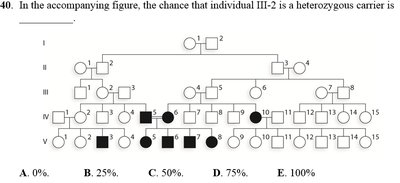
Q40. In the accompanying figure, the chance that individual III-2 is a heterozygous carrier is:
Background
Topic: Probability and pedigree analysis
This question tests your ability to calculate the probability that an individual is a carrier based on pedigree information.
Key Terms:
Carrier: Individual who has one copy of a recessive allele.
Pedigree: Diagram showing family relationships and inheritance.
Probability: Likelihood of a specific genotype.
Step-by-Step Guidance
Examine the pedigree and identify the inheritance pattern.
Determine the genotypes of the parents and the probability for III-2.
Calculate the chance based on Mendelian inheritance.
Review the answer choices and match your calculation.
Try solving on your own before revealing the answer!
Final Answer: C. 50%
Based on the pedigree, III-2 has a 50% chance of being a heterozygous carrier.
Q41. What is the genotype of III-1?
Background
Topic: Genotype determination from pedigree
This question tests your ability to deduce the genotype of an individual based on pedigree information.
Key Terms:
Genotype: Genetic makeup of an individual.
Pedigree: Diagram showing family relationships and inheritance.
Homozygous: Two identical alleles.
Heterozygous: Two different alleles.
Step-by-Step Guidance
Examine the pedigree and identify the inheritance pattern.
Determine the genotypes of the parents and the possible genotypes for III-1.
Review the answer choices and match your deduction.
Consider if more than one genotype is possible.

Try solving on your own before revealing the answer!
Final Answer: D. heterozygous or homozygous recessive
Based on the pedigree, III-1 could be either heterozygous or homozygous recessive.
Q42. Huntington's disease is an autosomal dominant trait. Given the pedigree below, if individual IV-2 has three children with a normal man, what is the probability that exactly two of the three children would have the disorder?
Background
Topic: Probability and autosomal dominant inheritance
This question tests your ability to use probability and binomial distribution to calculate the likelihood of a specific number of affected children.
Key Terms and Formulas:
Autosomal dominant: Trait appears when at least one dominant allele is present.
Binomial probability:
Probability: Likelihood of a specific outcome.
Step-by-Step Guidance
Determine the probability that a child inherits the disorder from an affected parent.
Use the binomial formula to calculate the probability for exactly two out of three children.
Set up the calculation and review the answer choices.
Match your setup to the options provided.
Try solving on your own before revealing the answer!
Final Answer: D. 3/8
The binomial formula gives the probability that exactly two of three children inherit the autosomal dominant disorder.
