 Indietro
Genetics Homework Review: DNA Structure and Replication Study Guide
Guida di studio - Note intelligenti
 Appunti personalizzati basati sui tuoi materiali, ampliati con definizioni chiave, esempi e contesto.
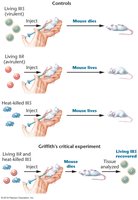
Q1. In Griffith’s transformation experiment, which strains of Streptococcus (called Diplococcus in his day) caused disease in mice?
Background
Topic: Bacterial Transformation and DNA as Genetic Material
This question tests your understanding of Griffith's classic experiment, which demonstrated that genetic material could be transferred between bacterial strains, leading to the concept of transformation.
Key Terms:
Transformation: Uptake of genetic material from the environment by a cell.
Virulent (IIS): Disease-causing strain.
Non-virulent (IIR): Non-disease-causing strain.
Heat-killed: Bacteria that have been killed by heat, unable to cause disease on their own.
Step-by-Step Guidance
Review the different strains used in Griffith's experiment: Living IIR (non-virulent), Living IIS (virulent), Heat-killed IIS, and mixtures.
Recall the outcome for each strain when injected into mice: Which caused disease and which did not?
Focus on the critical experiment: What happened when Living IIR was mixed with heat-killed IIS?
Think about the concept of transformation: Which strain was able to acquire virulence from another?
Try solving on your own before revealing the answer!
Final Answer:
Both Living IIS and Living IIR mixed with heat-killed IIS caused disease in mice. Living IIS is virulent and causes disease. Living IIR mixed with heat-killed IIS also caused disease due to transformation, where IIR acquired genetic material from IIS.
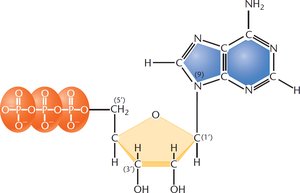
Q2. This molecule is most likely found in ________. It has a(n) _________ ring.
Background
Topic: Nucleotide Structure and DNA/RNA Identification
This question tests your ability to identify nucleotide components and distinguish between DNA and RNA, as well as purine and pyrimidine bases.
Key Terms:
Nucleotide: Basic unit of DNA/RNA, consisting of a sugar, phosphate, and nitrogenous base.
Purine: Double-ring structure (adenine, guanine).
Pyrimidine: Single-ring structure (cytosine, thymine, uracil).
DNA vs RNA: DNA contains deoxyribose; RNA contains ribose.
Step-by-Step Guidance
Examine the sugar: Does it have an OH group at the 2' carbon (ribose) or an H (deoxyribose)?
Identify the nitrogenous base: Is it a purine (double ring) or pyrimidine (single ring)?
Determine if the molecule is from DNA or RNA based on the sugar and base.
Match the ring type to purine or pyrimidine.
Try solving on your own before revealing the answer!
Final Answer:
This molecule is most likely found in RNA; it has a purine ring. The presence of the OH group at the 2' position indicates ribose (RNA), and the double-ring structure is characteristic of purines.
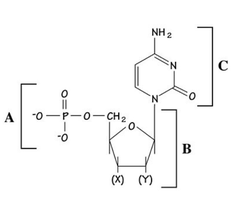
Q3. If this molecule was found in a DNA chain, the chemical group labeled (X) would be ________ and the chemical group labeled (Y) would be ________.
Background
Topic: DNA Nucleotide Structure
This question tests your knowledge of the chemical groups present in DNA nucleotides, specifically the sugar component (deoxyribose).
Key Terms:
Deoxyribose: Sugar in DNA, lacks an OH group at the 2' carbon.
Phosphate group: Attached to the 5' carbon.
OH group: Hydroxyl group, present at the 3' carbon.
Step-by-Step Guidance
Identify the sugar: Is it deoxyribose (DNA) or ribose (RNA)?
Locate the positions labeled (X) and (Y) on the sugar ring.
Recall that in DNA, the 2' carbon has an H (not OH), and the 3' carbon has an OH group.
Assign the correct chemical groups to (X) and (Y) based on their positions.
Try solving on your own before revealing the answer!
Final Answer:
If this molecule was found in a DNA chain, the chemical group labeled (X) would be H and the chemical group labeled (Y) would be OH. This is characteristic of deoxyribose in DNA.
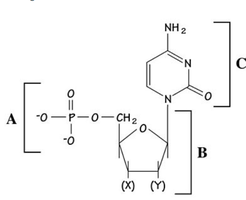
Q4. If this molecule were found in an RNA chain, the chemical group labeled (X) would be ___ and the chemical group labeled (Y) would be ________.
Background
Topic: RNA Nucleotide Structure
This question tests your understanding of the chemical groups present in RNA nucleotides, specifically the sugar component (ribose).
Key Terms:
Ribose: Sugar in RNA, has an OH group at the 2' carbon.
OH group: Hydroxyl group, present at both 2' and 3' carbons in ribose.
Step-by-Step Guidance
Identify the sugar: Is it ribose (RNA) or deoxyribose (DNA)?
Locate the positions labeled (X) and (Y) on the sugar ring.
Recall that in RNA, both the 2' and 3' carbons have OH groups.
Assign the correct chemical groups to (X) and (Y) based on their positions.
Try solving on your own before revealing the answer!
Final Answer:
If this molecule were found in an RNA chain, the chemical group labeled (X) would be OH and the chemical group labeled (Y) would be OH. This is characteristic of ribose in RNA.
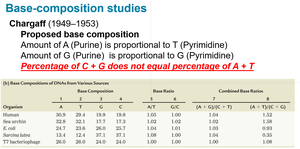
Q5. Which of the following is not consistent with Erwin Chargaff’s findings?
Background
Topic: Chargaff's Rules and DNA Base Composition
This question tests your understanding of Chargaff's rules, which describe the relationships between the amounts of different bases in DNA.
Key Terms:
Chargaff's Rules: In DNA, A = T and G = C; the total purines equal total pyrimidines.
Base ratios: Relationships between A, T, G, and C.
Step-by-Step Guidance
Review Chargaff's rules: A = T, G = C, (A + G) = (C + T).
Examine each option and compare it to the rules.
Identify any option that violates the relationships described by Chargaff.
Focus on the ratios and sums of bases to spot inconsistencies.
Try solving on your own before revealing the answer!
Final Answer:
(C + G) = (A + T) is not consistent with Chargaff’s findings. Chargaff found that A = T and G = C, but the sum of C + G does not necessarily equal the sum of A + T.
Q6. What does the term "melting temperature" mean in applied genetics?
Background
Topic: DNA Denaturation and Melting Temperature
This question tests your understanding of the concept of melting temperature (Tm) in DNA, which is important for techniques like PCR and DNA hybridization.
Key Terms:
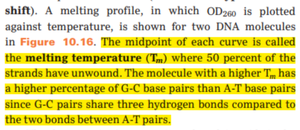
Melting temperature (Tm): The temperature at which 50% of DNA strands are denatured (unwound).
Denaturation: Separation of DNA strands due to breaking of hydrogen bonds.
GC content: DNA with higher GC content has higher Tm due to more hydrogen bonds.
Step-by-Step Guidance
Recall what happens to DNA when heated: hydrogen bonds break, strands separate.
Understand that Tm is the midpoint where half the DNA is denatured.
Consider the effect of base composition (GC vs AT) on Tm.
Identify the correct definition among the options provided.
Try solving on your own before revealing the answer!
Final Answer:
The melting temperature is the temperature at which 50% of the DNA strands denature. This is the point where half of the hydrogen bonds between strands are broken, and it is influenced by the GC content of the DNA.
