 Indietro
Genetics of Bacteria: Mechanisms, Mapping, and Model Systems
Guida di studio - Note intelligenti
 Appunti personalizzati basati sui tuoi materiali, ampliati con definizioni chiave, esempi e contesto.
Genetics of Bacteria
Introduction to Bacterial Genetics
Bacteria are powerful model organisms in genetics due to their rapid growth, simple genome structure, and ease of manipulation. Their genetic simplicity allows for clear observation of mutations and gene transfer events.
Small genome: E. coli has a genome of approximately 5 million base pairs (Mbp).
Rapid growth: Generation time is typically less than 30 minutes.
Haploid: Bacteria possess a single chromosome, so recessive mutations are not masked.
Markers: Many strains have antibiotic resistance or prototrophy markers.
Growing Bacteria and Colony Formation
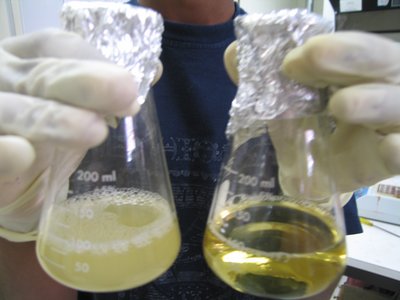
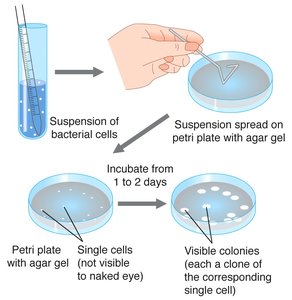
Bacteria are grown in liquid or solid media, allowing for the isolation and study of individual colonies derived from single cells.
Suspension: Bacterial cells are suspended in liquid medium.
Plating: Cells are spread on agar plates to isolate single cells.
Colony formation: After incubation, visible colonies form, each representing a clone of the original cell.
E. coli Genetics and Plasmids
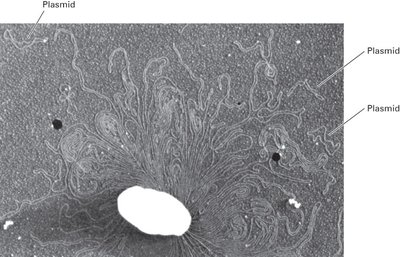
E. coli is a key model organism in molecular biology. Its genome is circular, and it often carries plasmids—extrachromosomal DNA elements.
Plasmids: Small, circular DNA molecules separate from the chromosome.
Functions: Plasmids may confer antibiotic resistance, metabolic capabilities, or act as genetic parasites.
Selection: Strong selection occurs if plasmids provide essential functions for survival.
Useful Bacterial Phenotypes for Selection
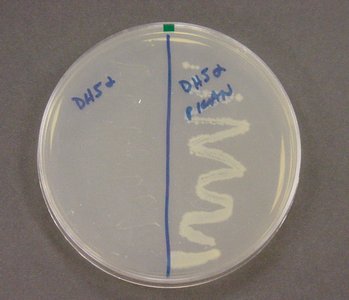
Selection for phenotypes is more efficient than screening. Useful phenotypes include antibiotic resistance, prototrophy, and the ability to utilize specific substrates.
Antibiotic resistance: Enables growth in the presence of antibiotics.
Prototrophy: Ability to synthesize essential growth components.
Substrate utilization: Growth on specific sugars or compounds.
Gene Transfer Mechanisms in Bacteria
Overview of Gene Transfer
Genes can be transferred between bacteria via three main mechanisms: conjugation, transduction, and transformation. These processes are essential for genetic mapping and understanding antibiotic resistance.
Conjugation: Direct transfer of DNA between cells.
Transduction: Transfer of DNA via bacteriophages (viruses).
Transformation: Uptake of free DNA from the environment.
Conjugation: Bacterial "Sex"
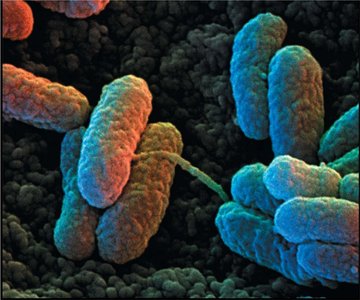
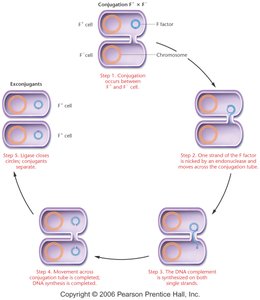
Conjugation is a unidirectional process where DNA is transferred from a donor (F+) to a recipient (F-) cell. Physical contact is required, and the process is used for chromosome mapping.
F factor: Fertility plasmid that enables conjugation.
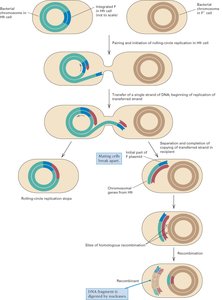
Hfr strains: F factor integrated into the chromosome, allowing transfer of chromosomal genes.
Classic Conjugation Experiments
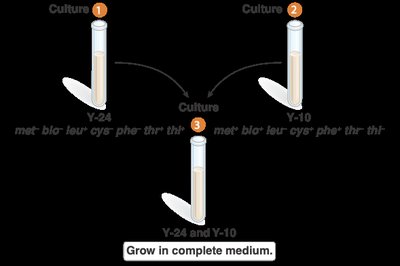
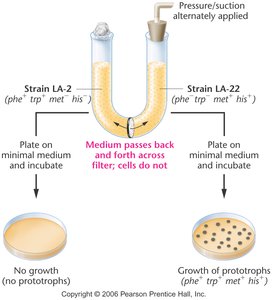
Lederberg and Tatum (1946) demonstrated gene transfer via conjugation using auxotrophic strains. Selection for prototrophic recombinants was achieved by growing on minimal media. 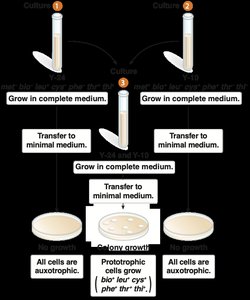
Mechanism of Conjugation
Only F+ strains can transmit genetic material. Physical contact is necessary, as shown by experiments using filters that block cell contact. 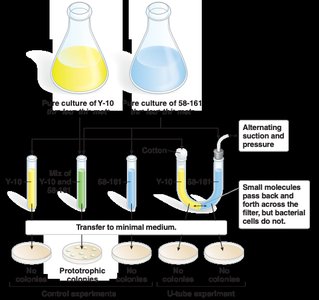
Transduction: Gene Transfer via Phages
Transduction involves the transfer of bacterial DNA by bacteriophages. There are two main cycles:
Lytic cycle: Phage infects, replicates, and lyses the host cell.
Lysogenic cycle: Phage integrates into the host genome and replicates with it.
Transformation: Uptake of DNA from the Environment
Some bacteria can naturally or artificially take up DNA from their surroundings, a process called transformation. This is a routine technique in molecular biology for introducing engineered DNA.
Mapping the Bacterial Genome
Conjugation-Based Mapping
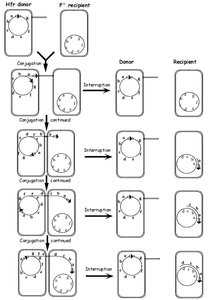
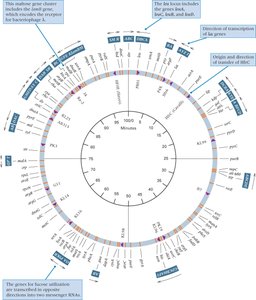
Mapping genes by conjugation involves tracking the order and timing of gene transfer from Hfr strains.
F plasmid: Encodes transfer genes; transfer coincides with replication.
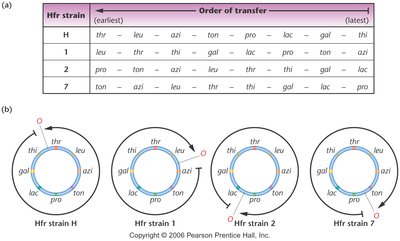
Hfr strains: Transfer starts from a specific position and proceeds in a defined direction.
Interrupted mating: Mating is stopped at intervals to determine the order of gene transfer.

Assembling Genetic Maps
Data from interrupted mating experiments are used to build genetic maps, showing the order and timing of gene transfer. 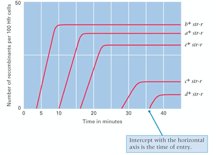
Transduction-Based Mapping
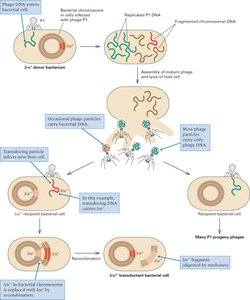
Generalized transducing phages can package bacterial DNA and transfer it to other cells. Cotransduction frequency is used to map genes that are close together.
Generalized transduction: Phage packages bacterial DNA instead of its own.
Cotransduction: Genes close together are more likely to be transferred together.
Mapping Close Genes by Cotransduction
The frequency of cotransduction is inversely proportional to the distance between genes.
Formula: Cotransduction frequency can be used to estimate gene distance.
Example: If two genes are cotransduced at a high frequency, they are likely close together on the chromosome.
Summary Table: Bacterial Gene Transfer Mechanisms
Mechanism | Key Features | Applications |
|---|---|---|
Conjugation | Requires cell contact, F factor, unidirectional transfer | Chromosome mapping, gene transfer studies |
Transduction | Phage-mediated, can transfer close genes together | Mapping gene proximity, studying phage biology |
Transformation | Uptake of free DNA, can be induced chemically | Genetic engineering, gene function studies |
Additional info: Mapping by conjugation and transduction is fundamental for understanding bacterial genetics and the spread of antibiotic resistance.
