 Indietro
Genetics Study Guide: DNA, Chromosomes, and Nucleic Acid Structure
Guida di studio - Note intelligenti
 Appunti personalizzati basati sui tuoi materiali, ampliati con definizioni chiave, esempi e contesto.
Q1. What is a gene? How is it related to phenotype?
Background
Topic: Gene Definition and Phenotype Relationship
This question tests your understanding of what a gene is and how it influences observable traits (phenotype).
Key Terms:
Gene: A segment of DNA that codes for a functional product (usually a protein).
Phenotype: The observable characteristics or traits of an organism, resulting from the interaction of its genotype with the environment.
Step-by-Step Guidance
Start by defining what a gene is in molecular terms.
Explain how genes are expressed (transcription and translation) to produce proteins.
Describe how proteins (or other gene products) contribute to the development of traits.
Discuss the relationship between genotype (genetic makeup) and phenotype (observable traits).
Try solving on your own before revealing the answer!
Final Answer:
A gene is a segment of DNA that encodes a functional product, typically a protein. The expression of genes determines the phenotype by producing proteins that influence the organism's traits.
Q2. How many molecules of DNA make up one chromosome in a nondividing cell? How many molecules of DNA make up one chromosome with two sister chromatids at the start of M phase?
Background
Topic: Chromosome Structure and DNA Content
This question tests your understanding of chromosome structure during different cell cycle phases.
Key Terms:
Chromosome: A DNA molecule with associated proteins, carrying genetic information.
Sister Chromatids: Two identical DNA molecules joined at the centromere, formed after DNA replication.
M Phase: The mitotic phase of the cell cycle, where chromosomes are visible and paired as sister chromatids.
Step-by-Step Guidance
Recall that a chromosome in a nondividing (interphase) cell consists of a single DNA molecule.
During DNA replication, each chromosome is duplicated, resulting in two sister chromatids.
Each sister chromatid contains its own DNA molecule.
At the start of M phase, consider how many DNA molecules are present per chromosome.
Try solving on your own before revealing the answer!
Final Answer:
In a nondividing cell, one chromosome contains one DNA molecule. At the start of M phase, each chromosome consists of two sister chromatids, so there are two DNA molecules per chromosome.
Q3. What is the chromosomal theory of inheritance?
Background
Topic: Chromosomal Theory of Inheritance
This question tests your understanding of how chromosomes carry genetic information and are responsible for inheritance.
Key Terms:
Chromosomal Theory of Inheritance: The theory that genes are located on chromosomes and that the behavior of chromosomes during meiosis explains inheritance patterns.
Meiosis: The process by which gametes are formed, involving chromosome segregation.
Step-by-Step Guidance
Recall the main points of the chromosomal theory: genes are found on chromosomes.
Explain how chromosomes are inherited from parents to offspring.
Describe how the movement of chromosomes during meiosis accounts for Mendelian inheritance patterns.
Try solving on your own before revealing the answer!
Final Answer:
The chromosomal theory of inheritance states that genes are located on chromosomes, and the behavior of chromosomes during meiosis explains how traits are inherited according to Mendel's laws.
Q4. State the 5 subdisciplines of genetics and give an example of each.
Background
Topic: Subdisciplines of Genetics
This question tests your knowledge of the major areas within genetics and their applications.
Key Terms:
Subdiscipline: A specialized area within a broader field.
Step-by-Step Guidance
List the five main subdisciplines of genetics.
For each, think of a real-world or research example.
Write a brief description for each example.
Try solving on your own before revealing the answer!
Final Answer:
1. Transmission Genetics (e.g., Mendelian inheritance studies) 2. Molecular Genetics (e.g., gene cloning) 3. Population Genetics (e.g., allele frequency studies) 4. Quantitative Genetics (e.g., trait heritability analysis) 5. Genomics (e.g., whole genome sequencing)
Q5. Define gene. Define genome.
Background
Topic: Definitions in Genetics
This question tests your ability to distinguish between a gene and a genome.
Key Terms:
Gene: A segment of DNA coding for a functional product.
Genome: The complete set of genetic material in an organism.
Step-by-Step Guidance
Define gene in terms of structure and function.
Define genome as the total genetic content.
Compare and contrast the two terms.
Try solving on your own before revealing the answer!
Final Answer:
A gene is a segment of DNA that codes for a functional product. The genome is the entire collection of genetic material in an organism.
Q6. What is the purpose of DNA? What must it be able to do?
Background
Topic: DNA Function
This question tests your understanding of the roles and requirements of DNA in living organisms.
Key Terms:
DNA: Deoxyribonucleic acid, the molecule that stores genetic information.
Step-by-Step Guidance
List the main functions of DNA (information storage, replication, expression).
Explain why DNA must be stable yet able to change (mutate).
Discuss the importance of accurate replication and expression.
Try solving on your own before revealing the answer!
Final Answer:
The purpose of DNA is to store genetic information, replicate accurately, and direct the synthesis of proteins. It must be stable, able to replicate, and capable of mutation for evolution.
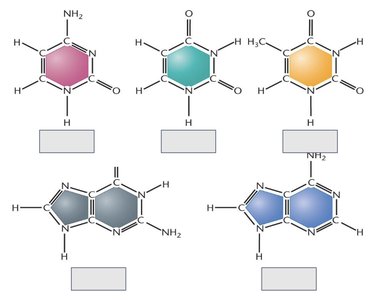
Q7. Be able to recognize the bases and determine which ones are purines and pyrimidines.
Background
Topic: DNA and RNA Bases
This question tests your ability to identify the nitrogenous bases and classify them as purines or pyrimidines.
Key Terms:
Pyrimidines: Single-ring structures (cytosine, thymine, uracil).
Purines: Double-ring structures (adenine, guanine).
Step-by-Step Guidance
Examine the structure of each base. Single-ring bases are pyrimidines; double-ring bases are purines.
Identify cytosine, thymine, and uracil as pyrimidines.
Identify adenine and guanine as purines.
Practice labeling each base in diagrams or images.
Try solving on your own before revealing the answer!
Final Answer:
Pyrimidines: Cytosine, Thymine, Uracil (single-ring). Purines: Adenine, Guanine (double-ring).
The image shows the chemical structures of the five bases. The top row (single ring) are pyrimidines; the bottom row (double ring) are purines.
