 Indietro
Guidelines for Human Gene Nomenclature: HGNC Standards and Practices
Guida di studio - Note intelligenti
 Appunti personalizzati basati sui tuoi materiali, ampliati con definizioni chiave, esempi e contesto.
Gene Nomenclature in Human Genetics
Introduction to Gene Nomenclature
Standardized gene naming is essential for clear communication in genetics and genomics, especially as these fields become increasingly important in healthcare and research. The HUGO Gene Nomenclature Committee (HGNC) is responsible for assigning unique symbols and names to human genes, including protein-coding genes, RNA genes, and pseudogenes. The HGNC guidelines ensure consistency, stability, and clarity in gene nomenclature, facilitating data retrieval and scientific collaboration.
HGNC: Human Gene Nomenclature Committee, established to standardize gene names and symbols.
Gene Symbol: A short, memorable, and pronounceable code assigned to each gene.
Gene Name: A descriptive long-form name reflecting the gene's function or characteristics.
HGNC ID: Unique identifier for each gene entry in the HGNC database.
Philosophy and Evolution of HGNC Guidelines
The HGNC philosophy emphasizes the stability of gene symbols, especially those associated with disease, to minimize confusion and disruption in clinical and research settings. While gene names may be updated to reflect new functional information, the gene symbol is rarely changed unless necessary. Symbols are also transferred to homologous genes in other vertebrates, avoiding human-specific references.
Stability: Priority is given to maintaining stable gene symbols.
Collaboration: Researchers are encouraged to consult HGNC when naming or renaming genes.
Case-by-case Review: Each gene is considered individually, allowing exceptions when beneficial for communication.
Gene Naming Principles and Practices
General Guidelines for Gene Naming
Gene symbols and names must adhere to specific rules to ensure uniqueness and clarity. Table 1 summarizes the main requirements for gene symbols and names.
Uniqueness: Each gene symbol must be unique within the genome.
Format: Symbols use only uppercase Latin letters and Arabic numerals; names are brief and specific.
Prohibited Elements: No superscripts, subscripts, punctuation (except for clarity), or references to species, gene, or human.
Language: Names are written in American English.
Non-offensive: Symbols and names must not be offensive or pejorative.
Root Symbols: Related genes are grouped by a common root symbol, with modifiers for specificity.
Symbols | Names |
|---|---|
Must be unique within a genome | Should be brief and specific |
Must not be offensive or pejorative | Must not use superscripts/subscripts/punctuation* |
Must only contain uppercase Latin letters and Arabic numerals | Must be written in American English |
Must start with a letter | Must start with a lowercase letter (unless eponymous/capitalized abbreviation) |
Should not include "G" for gene, "H" for human, Roman numerals, or Greek letters | Should not include "gene" or "human" |
Should avoid duplicating symbols in other species (unless orthologous) | Should start with the same letter as the symbol |
Should not reference species, taxa, tissue specificity, molecular weight, chromosomal location, human-specific features, phenotypes, familial terms | Descriptive modifiers follow the main part of the name |
*Exceptions for enzyme names and C#orfs
Gene Naming by Biotype
Gene naming varies depending on the biotype: protein-coding genes, pseudogenes, and non-coding RNA genes each have specific conventions.
Protein-coding genes: Named based on function, structure, homology, or chromosome location. Related genes use a common root symbol with numeric or letter suffixes (e.g., KLF1, KLF2).
Pseudogenes: Named based on homology to parent genes, with processed pseudogenes using parent gene symbols plus a "P" suffix (e.g., DPP3P1).
Non-coding RNA genes: Named according to RNA type, function, or genomic context. Systematic nomenclature is applied when function is unknown.
HGNC Process for Naming Long Non-coding RNA (lncRNA) Genes
The HGNC uses a systematic process for naming lncRNA genes, based on published information and genomic context. The process involves evaluating function, microRNA content, promoter sharing, genomic location, and relationship to protein-coding genes.
Host Gene (HG): lncRNA contains a microRNA gene.
Divergent Transcript (DT): lncRNA shares a promoter with a protein-coding gene.
Intronic Transcript (IT): lncRNA resides entirely within an intron of a protein-coding gene.
Overlapping Transcript (OT): lncRNA overlaps a protein-coding gene on the same strand.
Antisense RNA (AS): lncRNA is transcribed in the opposite direction to a protein-coding gene.
LINC: Long intergenic non-protein coding RNA, not associated with protein-coding genes.
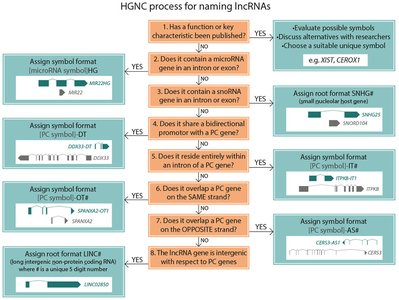
Abbreviations: HG (host gene), PC (protein-coding), DT (divergent transcript), IT (intronic transcript), OT (overlapping transcript), AS (antisense RNA), LINC (long intergenic non-protein coding RNA).
Special Cases and Exceptions
Gene Segments, Genomic Regions, and Structural Variants
HGNC assigns symbols to gene segments in complex loci (e.g., immunoglobulins, T-cell receptors) and occasionally to genomic regions or structural variants, especially when referenced in literature or incorporated into the reference genome.
Gene Segments: Assigned based on community request for complex loci.
Genomic Regions: Symbols for regions (e.g., XIC) or clusters (e.g., HOXA@) are rarely assigned now, but some legacy symbols are retained.
Structural Variants: Naming is restricted to variants on alternate reference loci, using underscores or hybrid symbols (e.g., GTF2H2C_2, APOBEC3A_B).
Status and Updates
HGNC gene records have a status, with most being "approved." If new evidence shows a gene is not real, the entry is "withdrawn." Symbol changes are minimized but may occur for clarity, popularity, or to avoid problematic nomenclature.
Approved: Most gene records.
Entry Withdrawn: Used for genes no longer considered real.
Symbol Updates: Placeholder symbols (FAM, C#orf, KIAA) may be updated to reflect function or structure.
Gene Nomenclature Across Species
Orthologous Genes and Vertebrate Nomenclature Committees
HGNC recommends that orthologous genes across vertebrate species use the same symbol. The Vertebrate Gene Nomenclature Committee (VGNC) coordinates naming in species lacking their own committee, ensuring consistency with human homologs.
VGNC: Assigns standardized names to vertebrate genes.
Species Designation: Use NCBI taxonomy ID and species name to distinguish homologs.
Complex Gene Families: Named with expert input (e.g., olfactory receptors, cytochrome P450).
Gene Symbol Usage and Recommendations
Formatting and Citation
HGNC endorses the use of italics for gene symbols, alleles, and RNAs to distinguish them from proteins. Authors should quote the approved gene symbol and HGNC ID in publications to avoid ambiguity.
Italics: Used for genes, alleles, and RNAs; proteins use non-italicized symbols.
HGNC ID: Unique identifier for tracking gene data.
Publication: Approved gene symbol should appear in abstracts; HGNC ID ensures clarity.
Summary of HGNC Guidelines (Box 1)
Each gene is assigned a unique symbol, HGNC ID, and descriptive name.
Symbols contain only uppercase Latin letters and Arabic numerals.
Symbols should not be the same as commonly used abbreviations.
Nomenclature should not reference any species or use "G" for gene.
Nomenclature should not be offensive or pejorative.
HGNC Exclusions (Box 2)
HGNC does not provide nomenclature for sequence variants, gene translocations/fusions, proteins, regulatory elements, transposable element insertions, or loci associated with clinical phenotypes and complex traits.
Sequence variant nomenclature is managed by the Human Genome Variation Society (HGVS).
Protein nomenclature is managed by specialist groups; gene and protein symbols should use the same abbreviation.
Scenarios for Symbol Change (Box 3)
Adoption of popular aliases (e.g., RNASEN to DROSHA).
Domain/motif-based updates (e.g., TMEM206 to PACC1).
Phenotype/disease-based updates (e.g., CASC4 to GOLM2).
Location-based updates (e.g., TWISTNB to POLR1F).
Removal of pejorative or misleading symbols.
Correction of symbols affecting data handling (e.g., SEPT1 to SEPTIN1).
References and Further Reading
HGNC Database: https://www.genenames.org/
VGNC Database: https://vertebrate.genenames.org/
HGVS Nomenclature: https://www.hgvs.org/
