 Indietro
Human Genetics and Pedigree Analysis: Patterns of Inheritance and Twin Studies
Guida di studio - Note intelligenti
 Appunti personalizzati basati sui tuoi materiali, ampliati con definizioni chiave, esempi e contesto.
Human Genetics and Pedigree Analysis
Introduction to Pedigree Analysis
Pedigree analysis is a fundamental tool in human genetics for studying the inheritance of traits and genetic disorders. Pedigrees use standardized symbols to represent individuals and their relationships, allowing geneticists to track the transmission of traits across generations.
Pedigree: A diagram that shows the occurrence and appearance of phenotypes of a particular gene or organism and its ancestors from one generation to the next.
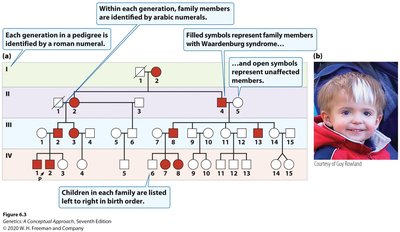
Symbols: Squares represent males, circles represent females. Filled symbols indicate affected individuals, while open symbols indicate unaffected individuals.
Generations: Identified by Roman numerals (I, II, III, etc.). Individuals within a generation are numbered with Arabic numerals (1, 2, 3, etc.).
Example: The pedigree below illustrates the inheritance of Waardenburg syndrome in a family.
Patterns of Inheritance
Autosomal Recessive Inheritance
Autosomal recessive traits require two copies of the mutant allele for an individual to be affected. These traits often skip generations and appear equally in both sexes.
Key Features:
Appears in both sexes with equal frequency.
Tends to skip generations.
Affected offspring usually have unaffected parents (carriers).
When both parents are heterozygous, about 25% of offspring are affected.
More frequent among children of consanguineous marriages.
Example: Cystic fibrosis is a classic autosomal recessive disorder.
Autosomal Dominant Inheritance
Autosomal dominant traits require only one copy of the mutant allele for an individual to be affected. These traits do not skip generations and are transmitted by both sexes.
Key Features:
Appears in both sexes with equal frequency.
Both sexes transmit the trait to offspring.
Does not skip generations.
Affected offspring must have an affected parent (unless a new mutation occurs).
When one parent is affected (heterozygous) and the other is unaffected, about 50% of offspring are affected.
Unaffected parents do not transmit the trait.
X-Linked Recessive Inheritance
X-linked recessive traits are more common in males, as they have only one X chromosome. These traits often skip generations and are not passed from father to son.
Key Features:
More males than females are affected.
Affected sons are usually born to unaffected (carrier) mothers.
Trait skips generations.
About 50% of a carrier mother’s sons are affected.
Never passed from father to son.
All daughters of affected fathers are carriers.
Example: Classic hemophilia in European royal families.
X-Linked Dominant Inheritance
X-linked dominant traits affect both sexes, but often more females than males. These traits do not skip generations.
Key Features:
Both males and females are affected; more females may be affected.
Does not skip generations.
Affected sons must have an affected mother; affected daughters must have an affected mother or father.
Affected fathers pass the trait to all daughters.
Affected mothers (if heterozygous) pass the trait to half of their sons and daughters.
Y-Linked Inheritance
Y-linked traits are only present in males and are passed from father to all sons. These traits do not skip generations.
Key Features:
Only males are affected.
Passed from father to all sons.
Does not skip generations.
Summary Table: Pedigree Characteristics of Inheritance Patterns
Inheritance Pattern | Key Pedigree Characteristics |
|---|---|
Autosomal Recessive | Equal frequency in both sexes, skips generations, affected offspring from unaffected parents, more frequent in consanguinity |
Autosomal Dominant | Equal frequency in both sexes, does not skip generations, affected offspring have affected parent, 50% risk if one parent affected |
X-Linked Recessive | More males affected, skips generations, never father to son, all daughters of affected fathers are carriers |
X-Linked Dominant | Both sexes affected (more females), does not skip generations, affected fathers pass to all daughters |
Y-Linked | Only males affected, passed father to all sons, does not skip generations |
Genetic Counseling Example: Cystic Fibrosis
Scenario: A couple, each with a sibling affected by cystic fibrosis (autosomal recessive), seeks genetic counseling.
Probability Calculation: Each parent is likely a carrier (heterozygous, Aa). The probability their child will be affected (aa) is 25%.
If their child is affected: Both parents must be carriers (genotype Aa).
Studying Twins and Adoptions
Twins: Assessing Genetic and Environmental Influence
Twin studies help distinguish the roles of genetics and environment in human traits.
Dizygotic twins: Nonidentical twins, share about 50% of their genes.
Monozygotic twins: Identical twins, share 100% of their genes.
Concordant trait: Trait shared by both twins.
Concordance: Percentage of twin pairs concordant for a trait.
Concordance Data for Selected Traits
Trait | Monozygotic Concordance (%) | Dizygotic Concordance (%) |
|---|---|---|
Heart attack (males) | 39 | 26 |
Heart attack (females) | 44 | 14 |
Bronchial asthma | 47 | 24 |
Cancer (all sites) | 12 | 15 |
Epilepsy | 59 | 19 |
Death from acute infection | 7.9 | 8.8 |
Rheumatoid arthritis | 32 | 6 |
Multiple sclerosis | 28 | 5 |
Interpretation Example: For cancer, the concordance is similar in monozygotic (12%) and dizygotic (15%) twins, suggesting environmental factors play a larger role than genetics for this trait.
Adoption Studies
Adoption studies compare adopted children to their biological and adoptive parents to assess genetic versus environmental influences.
Example: Studies show a genetic influence on body mass index (BMI) in adoptees, as BMI correlates more strongly with biological parents than adoptive parents.
Key Terms and Definitions
Pedigree: A diagram showing family relationships and the transmission of inherited traits.
Concordance: The percentage of twin pairs that both show a particular trait.
Consanguinity: Mating between individuals who are closely related.
Carrier: An individual who is heterozygous for a recessive trait and can pass the allele to offspring.
