 Indietro
Introduction to Genetics: Central Dogma, Gene Expression, and Cystic Fibrosis Case Study
Guida di studio - Note intelligenti
 Appunti personalizzati basati sui tuoi materiali, ampliati con definizioni chiave, esempi e contesto.
Introduction to Genetics
What is Genetics?
Genetics is the study of heredity and the variation of inherited characteristics. It is central to understanding biology, medicine, and the mechanisms underlying life itself. Modern genetics explores how DNA encodes instructions for building proteins, which in turn construct cells and organisms.
Genetics is foundational for careers in science, healthcare, and for informed citizenship.
It is not just about historical figures or simple traits, but about the molecular mechanisms that drive biological function.
Course Structure and Learning Objectives
This course is organized into four main units:
Unit 1: Introduction to DNA and chromosomes
Unit 2: Gene expression
Unit 3: Regulation of gene expression and recombinant DNA technology
Unit 4: Transmission genetics and genomics
Key learning objectives include understanding the central dogma, applying genetic principles to human disease, and exploring how genetic information is regulated and altered.
The Central Dogma of Molecular Biology
Overview
The central dogma describes the flow of genetic information within a biological system. It explains how DNA is transcribed into RNA, which is then translated into proteins. These proteins perform essential cellular functions.
DNA stores genetic information.
RNA acts as a messenger, carrying instructions from DNA for protein synthesis.
Proteins are the functional molecules that carry out cellular processes.
The central dogma can be summarized as:
DNA → RNA → Protein
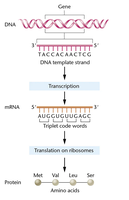
Transcription is the process of copying a segment of DNA into RNA. Translation is the process where ribosomes synthesize proteins using the mRNA template.
Example: The gene for hemoglobin is transcribed and translated to produce the hemoglobin protein, which carries oxygen in the blood.
Proteins as Cellular Machines
Structure and Function
Cells are filled with complex molecular machines, most of which are proteins. These machines perform a wide variety of tasks, from catalyzing reactions to transporting molecules across membranes.
Some cellular machines are made of RNA (e.g., ribosomes).
Proteins are encoded by genes and their function can be altered by mutations.
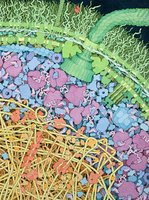
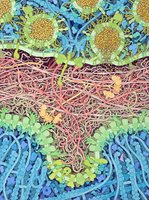
Example: The bacterial flagellum is a protein machine that enables bacterial movement. Neurotransmitter receptors are protein complexes that mediate communication between nerve cells.
Genetic Mutations and Human Disease: Cystic Fibrosis Case Study
What is Cystic Fibrosis?
Cystic fibrosis (CF) is a genetic disorder caused by mutations in the CFTR gene, which encodes a protein responsible for transporting chloride ions out of cells. When this protein is nonfunctional, mucus in the lungs becomes thick and sticky, leading to severe respiratory and digestive problems.
Nearly 1000 different mutations in the CFTR gene can cause CF.
The most common mutation is the deletion of phenylalanine (F) at position 508 (ΔF508).
To delete a single amino acid from a protein, three nucleotides (one codon) must be deleted from the mRNA.
This mutation affects protein folding, leading to degradation of the mutant protein and loss of function.
Genotype, Protein Function, and Phenotype
Humans are diploid, meaning they have two copies of each gene. The combination of alleles determines whether functional protein is produced and whether disease symptoms develop.
Heterozygous (one wildtype, one mutant): Usually enough functional protein is made, so the individual does not develop severe symptoms.
Homozygous mutant (two ΔF508 alleles): No functional protein is made, leading to disease.
These relationships are the basis of dominant and recessive inheritance:
Dominant allele: Encodes a functional protein; phenotype is observed with one copy.
Recessive allele: Encodes a nonfunctional protein; phenotype is observed only when both copies are mutant.
Genotype | Proteins Produced | Phenotype |
|---|---|---|
CFTR wildtype / CFTR wildtype | Functional protein | No disease |
CFTR wildtype / CFTR ΔF508 | Some functional protein | No disease (carrier) |
CFTR ΔF508 / CFTR ΔF508 | No functional protein | Cystic fibrosis |
Predicting Inheritance: Punnett Squares
If both parents are carriers (heterozygous), the probability of their child having cystic fibrosis can be predicted using a Punnett square.
1 in 4 chance (25%) the child will have CF (homozygous mutant)
2 in 4 chance (50%) the child will be a carrier (heterozygous)
1 in 4 chance (25%) the child will be unaffected (homozygous wildtype)
Complexity of Phenotypes
Most phenotypes are not determined by a single gene. Disease severity in cystic fibrosis can vary widely due to:
Other genetic factors (modifier genes)
Environmental influences
Understanding these complexities is essential for accurate genetic counseling and disease prediction.
Summary and Applications
Key Questions for Genetic Analysis
What event occurs at each step of gene expression?
Which protein or RNA machines carry out these steps?
How is each event regulated?
By mastering these concepts, students can apply genetic principles to predict inheritance patterns, understand disease mechanisms, and appreciate the molecular basis of life.
Additional info: The course uses the textbook "Essentials of Genetics" (Klug, 10th edition) and various online learning tools. Students are encouraged to explore the course Canvas site and participate in review sessions for success.
