 Indietro
Mendelian Genetics: Principles, Experiments, and Applications
Guida di studio - Note intelligenti
 Appunti personalizzati basati sui tuoi materiali, ampliati con definizioni chiave, esempi e contesto.
Mendel’s Laws of Genetic Inheritance
Introduction to Mendelian Genetics
Mendelian genetics forms the foundation of classical genetics, describing how traits are inherited from one generation to the next. Gregor Mendel’s experiments with pea plants led to the discovery of fundamental laws governing heredity, which remain central to our understanding of genetics today.
Genetics is the study of heredity and variation in organisms.
Traits are inherited from parents through discrete units called genes.
Species accumulate hereditary changes over evolutionary time, leading to diversity.
Gregor Mendel and His Experiments
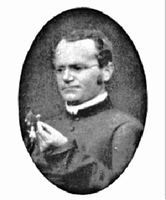
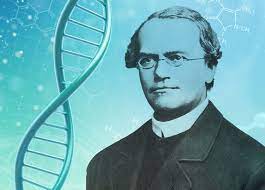
Gregor Mendel (1822–1884) was an Austrian monk whose work with pea plants established the basic principles of heredity. By analyzing the inheritance of specific traits, Mendel deduced the existence of discrete hereditary factors (now known as genes).
Mendel performed monohybrid and dihybrid crosses to study inheritance patterns.
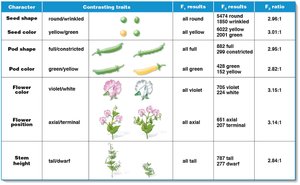
He selected seven contrasting traits in pea plants, such as seed shape, seed color, and flower color.
Key Principles of Mendelian Genetics
Unit Factors, Dominance, and Segregation
Mendel’s analysis of monohybrid crosses led to three foundational principles:
Unit Factors in Pairs: Genetic traits are controlled by unit factors (genes) that exist in pairs in individuals.
Dominance and Recessiveness: When two different unit factors are present, one may mask the expression of the other. The expressed trait is dominant, the masked trait is recessive.
Principle of Segregation: During gamete formation, the paired unit factors separate randomly, so each gamete receives one factor.
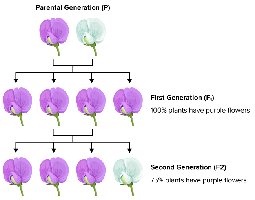
These principles explain why certain traits disappear in the F1 generation but reappear in the F2 generation.
Principle of Independent Assortment
Mendel’s Principle of Independent Assortment states that during gamete formation, segregating pairs of unit factors assort independently of each other, provided the genes are on different chromosomes.
This principle explains the inheritance of multiple traits simultaneously.
It is the basis for the genetic variation observed in offspring.
Genetic Crosses and Probability
Monohybrid Crosses
A monohybrid cross examines the inheritance of a single trait. Mendel’s classic monohybrid cross involved crossing true-breeding plants with contrasting traits (e.g., tall vs. dwarf).
F1 generation: All offspring display the dominant trait.
F2 generation: The recessive trait reappears in a 3:1 phenotypic ratio.
Genotypic ratio in F2: 1 homozygous dominant : 2 heterozygous : 1 homozygous recessive (1:2:1).

Punnett Squares
The Punnett square is a tool used to predict the genotypes and phenotypes of offspring from genetic crosses.
Rows and columns represent possible gametes from each parent.
Each box shows a possible genotype for the offspring.

Test Crosses
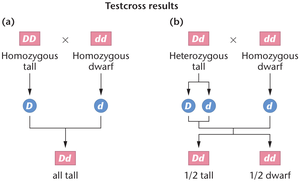
A test cross is used to determine the genotype of an individual with a dominant phenotype by crossing it with a homozygous recessive individual.
If all offspring display the dominant trait, the tested individual is homozygous dominant.
If offspring show a 1:1 ratio of dominant to recessive traits, the tested individual is heterozygous.
Dihybrid Crosses and the Product Law
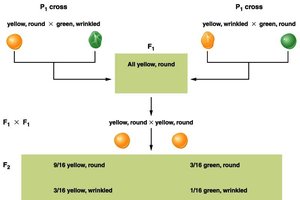
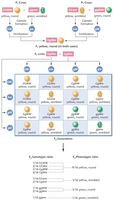
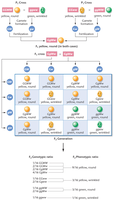
A dihybrid cross examines the inheritance of two traits simultaneously. Mendel’s dihybrid crosses revealed a 9:3:3:1 phenotypic ratio in the F2 generation, supporting the principle of independent assortment.
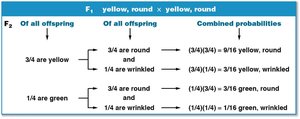
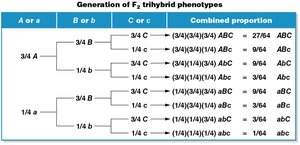
The product law of probability states that the probability of two independent events occurring together is the product of their individual probabilities.
This law is used to calculate expected ratios in dihybrid and trihybrid crosses.
Trihybrid Crosses and the Forked-Line Method
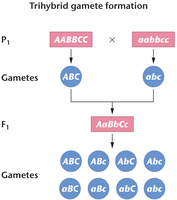
Trihybrid crosses involve three traits and result in a large number of possible genotypes and phenotypes. The forked-line method simplifies the calculation of expected ratios by breaking the problem into sequential steps.
Rediscovery and Chromosomal Basis of Mendel’s Laws
Historical Context and Chromosome Theory
Mendel’s work was not widely recognized until the early 20th century, when scientists rediscovered his principles and linked them to chromosome behavior during cell division.
Walther Flemming discovered chromosomes in 1897.
Walter Sutton and Theodor Boveri connected Mendel’s laws to the behavior of chromosomes during mitosis and meiosis.
Somatic (body) cells are diploid (2N), containing two copies of each chromosome; gametes are haploid (1N).
Pedigree Analysis and Human Genetics
Pedigree Symbols and Interpretation
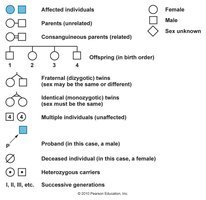
Pedigree analysis is used to study the inheritance of traits in humans and animals. Standard symbols are used to represent individuals, relationships, and affected status.
Autosomal Recessive and Dominant Inheritance
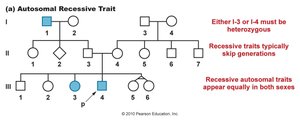
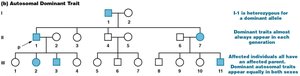
Pedigrees can reveal whether a trait is inherited in a recessive or dominant manner.
Autosomal recessive traits often skip generations; affected individuals may have unaffected parents.
Autosomal dominant traits usually appear in every generation; affected individuals have at least one affected parent.
Examples of Human Genetic Disorders
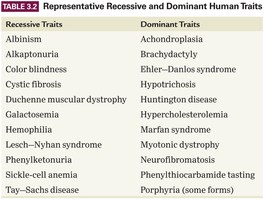
Many human diseases follow Mendelian inheritance patterns. For example, Tay-Sachs disease is a recessive disorder, while Huntington’s disease is dominant.
Recessive: Tay-Sachs disease, cystic fibrosis, sickle-cell anemia
Dominant: Huntington’s disease, Marfan syndrome, achondroplasia
Summary Table: Mendelian Ratios in Crosses
Type of Cross | Genotypic Ratio | Phenotypic Ratio |
|---|---|---|
Monohybrid (Aa x Aa) | 1 AA : 2 Aa : 1 aa | 3 dominant : 1 recessive |
Dihybrid (AaBb x AaBb) | 9 A_B_ : 3 A_bb : 3 aaB_ : 1 aabb | 9:3:3:1 |
Test Cross (Aa x aa) | 1 Aa : 1 aa | 1 dominant : 1 recessive |
Key Terms and Concepts
Allele: Alternative forms of a gene.
Homozygous: Having two identical alleles for a trait.
Heterozygous: Having two different alleles for a trait.
Genotype: Genetic makeup of an organism.
Phenotype: Observable traits of an organism.
Product Law: Probability of independent events occurring together is the product of their individual probabilities.
Practice Problems and Further Study
Practice constructing and analyzing Punnett squares for monohybrid and dihybrid crosses.
Interpret pedigrees to determine inheritance patterns.
Apply the product law to calculate probabilities in genetic crosses.
For additional practice, refer to assigned questions and online resources such as Khan Academy and Mastering Genetics assignments.
