 Indietro
Mendelian Genetics: Principles, Experiments, and Applications
Guida di studio - Note intelligenti
 Appunti personalizzati basati sui tuoi materiali, ampliati con definizioni chiave, esempi e contesto.
Chapter 3: Mendelian Genetics
Introduction to Mendelian Genetics
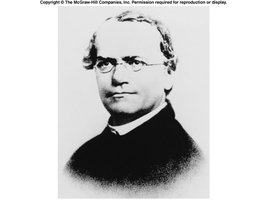
Mendelian genetics is the foundation of classical genetics, describing how traits are inherited from one generation to the next. Gregor Mendel, an Austrian monk, conducted pioneering experiments using pea plants to elucidate the basic principles of heredity.
Key Terms: Trait, Gene, Allele, Genotype, Phenotype
Example: Mendel studied traits such as flower color, seed shape, and plant height.
Experimental Design: Pea Plant Crosses
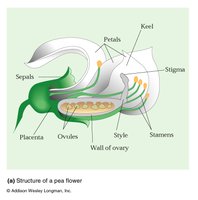
Mendel used pea plants for their distinct, easily observable traits and ability to self- or cross-fertilize. He carefully controlled pollination to study inheritance patterns.
Self-fertilization: Pollen fertilizes eggs within the same flower.
Cross-fertilization: Pollen from one plant fertilizes eggs of another plant with a different phenotype.

Traits Studied by Mendel
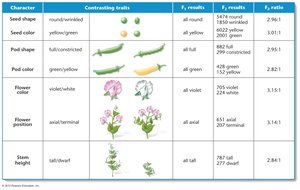
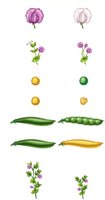
Mendel selected seven traits, each with two contrasting variants, to ensure clear inheritance patterns.
Examples: Seed shape (round/wrinkled), flower color (purple/white), stem height (tall/dwarf).
Character | Contrasting traits | F1 results | F2 results | F2 ratio |
|---|---|---|---|---|
Seed shape | round/wrinkled | all round | 5474 round, 1850 wrinkled | 2.96:1 |
Seed color | yellow/green | all yellow | 6022 yellow, 2001 green | 3.01:1 |
Pod color | green/yellow | all green | 428 green, 152 yellow | 2.82:1 |
Flower color | violet/white | all violet | 705 purple, 224 white | 3.15:1 |
Flower position | axial/terminal | all axial | 651 axial, 207 terminal | 3.14:1 |
Stem height | tall/dwarf | all tall | 787 tall, 277 dwarf | 2.84:1 |
Mendel’s Experimental Procedure
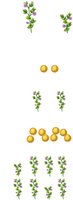
Mendel cross-fertilized true-breeding lines for each trait, observed the F1 generation, and allowed self-fertilization to produce the F2 generation. He analyzed the ratios of phenotypes in the F2 generation.
P generation: True-breeding parents
F1 generation: Offspring of P cross, all showing dominant phenotype
F2 generation: Offspring of F1 self-fertilization, showing both dominant and recessive phenotypes
Interpretation of Mendel’s Data
Mendel observed that traits did not blend but were inherited as discrete units. He proposed the concept of particulate inheritance, now known as genes.
Dominant trait: Masks the presence of a recessive trait
Recessive trait: Only expressed when two recessive alleles are present
Law of Segregation: Two copies of a gene segregate during gamete formation
Genetic Terminology
Understanding key genetic terms is essential for interpreting Mendelian crosses.
Homozygous: Two identical alleles for a gene (e.g., TT or tt)
Heterozygous: Two different alleles for a gene (e.g., Tt)
Allele: Variant form of a gene
Testcross: Cross with a homozygous recessive individual to determine genotype
Punnett Squares and Probability
Punnett Squares are used to predict the outcome of genetic crosses. Probability rules help calculate the likelihood of specific genotypes and phenotypes.
Sum Rule: Probability of mutually exclusive events is the sum of their probabilities
Product Rule: Probability of independent events occurring together is the product of their probabilities
Binomial Expansion: Used for calculating probabilities of unordered events
Example Equation:
Where n = total number of offspring, x = number of offspring of one phenotype, p = probability of phenotype x, q = probability of the other phenotype.
Mendel’s Law of Independent Assortment
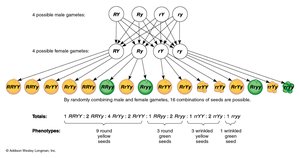
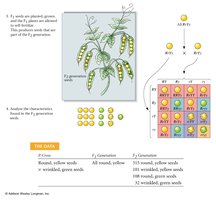
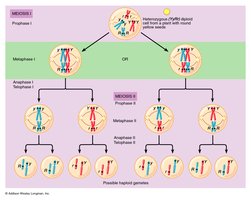
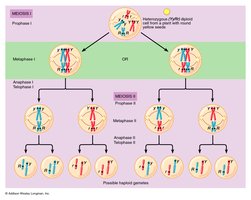
This law states that alleles of different genes assort independently during gamete formation, leading to genetic variation.
Dihybrid Cross: Cross involving two traits, resulting in a 9:3:3:1 ratio in the F2 generation
Chromosomal Theory of Inheritance
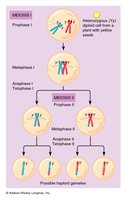
This theory connects Mendelian inheritance to the behavior of chromosomes during meiosis. Chromosomes carry genes, and their segregation and independent assortment explain Mendel’s laws.
Meiosis: Explains the law of segregation and independent assortment
Diploid: Two sets of chromosomes, one from each parent
Haploid: Gametes contain one set of chromosomes
Statistical Analysis: Chi Square Test
The Chi Square test is used to determine if observed genetic data fit expected ratios. It compares observed and expected values to test hypotheses.
Formula:
Degrees of Freedom: Number of phenotypes minus one
P value: Typically 0.05 is used for significance
Human Genetics and Pedigree Analysis
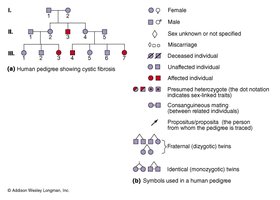
In humans, controlled crosses are not possible. Pedigree analysis is used to infer inheritance patterns by examining family histories.
Pedigree: Diagram showing inheritance of traits across generations
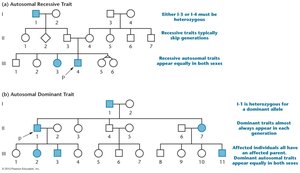
Questions: Are males and females affected equally? Does the trait skip generations?
Autosomal recessive: Trait may skip generations, affects both sexes equally
Autosomal dominant: Trait appears in every generation, affects both sexes equally
Summary of Mendelian Principles
Mendelian genetics provides the basis for understanding inheritance. Key principles include the law of segregation, law of independent assortment, and the use of probability and statistical analysis to interpret genetic data. Pedigree analysis extends these principles to human genetics.
Perform crosses and analyze ratios to determine inheritance patterns
Use Punnett Squares and probability rules for predictions
Apply Chi Square analysis to test hypotheses
Use pedigrees to study human inheritance
