 Indietro
Mendelian Genetics: Principles, Probability, and Chi-Square Analysis
Guida di studio - Note intelligenti
 Appunti personalizzati basati sui tuoi materiali, ampliati con definizioni chiave, esempi e contesto.
Introduction to Genetics
What is Genetics?
Genetics is the scientific study of heredity and variation in living organisms. It explores how traits are passed from parents to offspring and the molecular mechanisms underlying these processes. The field has evolved from early theories of inheritance to the modern understanding of genes, alleles, and chromosomes.
Heredity: The process by which living things produce offspring with similar characteristics.
Historical Theories: Early ideas included Pangenesis, Preformationism, and Blending Inheritance, which were later disproven by experimental evidence.
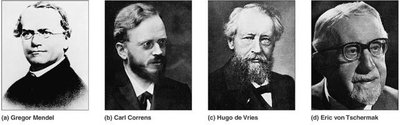
Key Figures: Gregor Mendel is recognized as the father of modern genetics. In 1900, Carl Correns, Hugo de Vries, and Erich von Tschermak rediscovered Mendel's laws, confirming their validity.
Mendel's Laws of Inheritance
Basic Principles of Heredity
Mendel's experiments with pea plants established the foundational principles of inheritance. He chose pea plants for their distinct traits and ease of cultivation, allowing him to observe patterns across generations.
Principle of Segregation: Each individual possesses two alleles for a trait, which segregate during gamete formation, so each gamete receives one allele.
Concept of Dominance: When two different alleles are present, one (the dominant) may mask the expression of the other (the recessive).
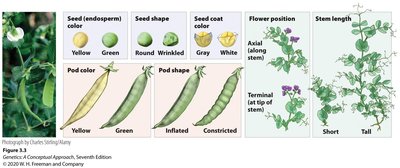
Example: Mendel studied seven characteristics in peas, each with two contrasting forms (e.g., round vs. wrinkled seeds, yellow vs. green pods).
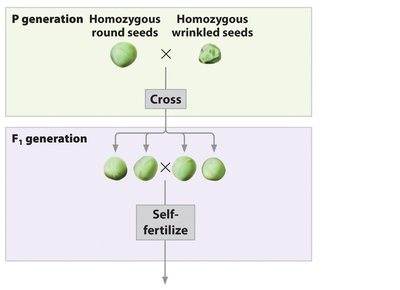
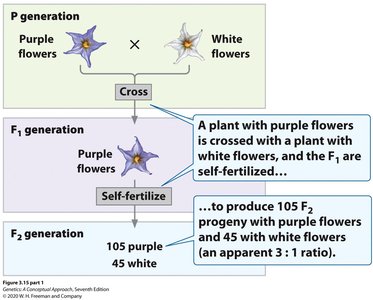
In a classic monohybrid cross, Mendel crossed homozygous round-seeded peas with homozygous wrinkled-seeded peas. All F1 offspring were round, but self-fertilization of F1 plants produced F2 progeny in a 3:1 ratio of round to wrinkled seeds.
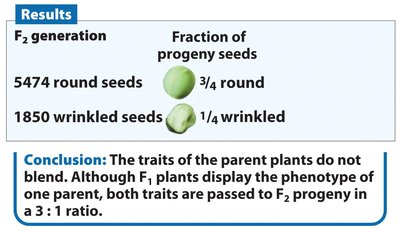
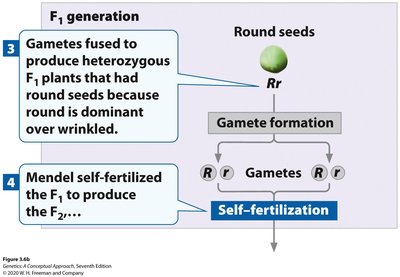
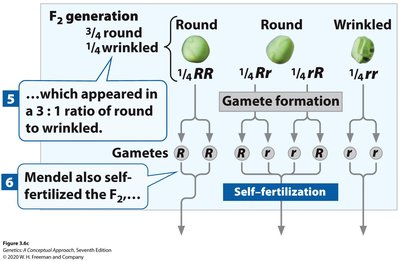
Conclusion: Traits do not blend; both parental traits are passed to the next generation, supporting the particulate nature of inheritance.
Key Genetic Terms
Term | Definition |
|---|---|
Gene | An inherited factor (encoded in DNA) that helps determine a characteristic |
Allele | One of two or more alternative forms of a gene |
Locus | Specific place on a chromosome occupied by an allele |
Genotype | Set of alleles possessed by an individual organism |
Homozygote | Individual with two of the same alleles at a locus |
Heterozygote | Individual with two different alleles at a locus |
Phenotype | The appearance or manifestation of a characteristic |
Probability in Genetics
Using Probability to Predict Genetic Outcomes
Probability is a key tool in genetics for predicting the outcomes of genetic crosses. Two main rules are used:
Multiplication Rule: The probability of two independent events both occurring is the product of their individual probabilities. (Key word: "and")
Addition Rule: The probability of either of two mutually exclusive events occurring is the sum of their individual probabilities. (Key words: "either...or")
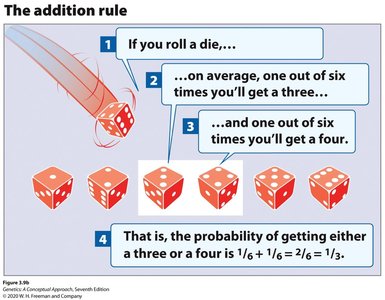
Example: The probability of rolling either a three or a four on a die is .
Conditional Probability: Used when certain outcomes are excluded based on prior information (e.g., probability of a genotype among only round-seeded progeny).
Binomial Expansion: Used to calculate probabilities for multiple offspring or events. The general formula is:
where is the total number of events, is the number of times outcome occurs, and is the number of times outcome occurs.
Principle of Independent Assortment
Dihybrid Crosses and Multiple Loci
Mendel's dihybrid crosses demonstrated that alleles of different genes assort independently during gamete formation, leading to new combinations of traits.
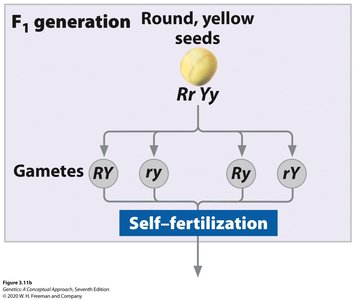
For a cross between RrYy x RrYy, the F2 generation shows a 9:3:3:1 phenotypic ratio, reflecting independent assortment.
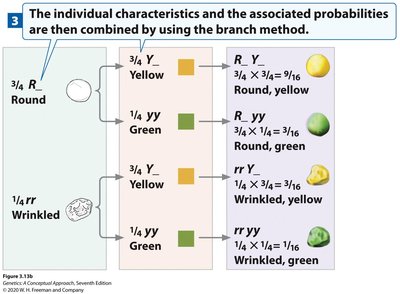
Branch Diagrams: Used to combine probabilities for multiple traits, simplifying calculations for complex crosses.
Statistical Analysis: Chi-Square Goodness-of-Fit Test
Evaluating Genetic Hypotheses
The chi-square test is used to determine whether observed genetic ratios deviate significantly from expected ratios due to chance.
State a null hypothesis (e.g., observed ratio matches expected Mendelian ratio).
Calculate expected numbers for each class.
Compute chi-square value using:
where is observed and is expected.
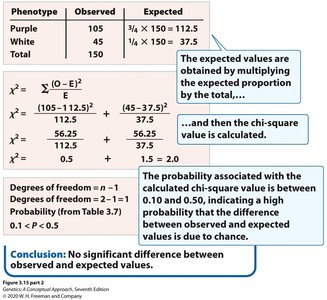
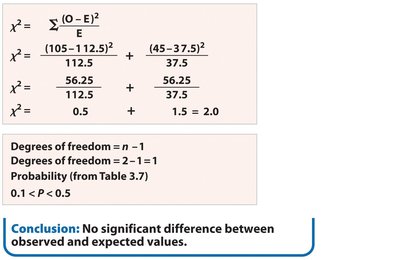
Compare the calculated value to a critical value from the chi-square distribution table, using degrees of freedom ().
If , the difference is likely due to chance, and the hypothesis is accepted.
If , the difference is significant, and the hypothesis is rejected.
Example: In a cross producing 105 purple and 45 white flowers (expected 3:1 ratio), the chi-square value is 2.0 with , , so the hypothesis is accepted.
Summary Table: Key Genetic Terms
Term | Definition |
|---|---|
Gene | Inherited factor encoded in DNA |
Allele | Alternative form of a gene |
Locus | Chromosomal location of a gene |
Genotype | Allelic composition of an individual |
Phenotype | Observable trait |
Strategies for Success in Genetics
Download and review lecture materials before class.
Read textbook sections relevant to each lecture.
Take and review notes, clarify gaps using the textbook.
Practice suggested problems to reinforce understanding.
Seek help from instructors or tutors as needed.
Additional info: The course syllabus outlines exam policies, grading, and recommended study strategies. The content above covers the foundational concepts of Mendelian genetics, probability, and statistical analysis as presented in the provided materials.
