 Indietro
Mendel's Laws of Inheritance: Structured Study Notes
Guida di studio - Note intelligenti
 Appunti personalizzati basati sui tuoi materiali, ampliati con definizioni chiave, esempi e contesto.
Mendel's Experiments and Laws
Overview of Mendel's Experiments
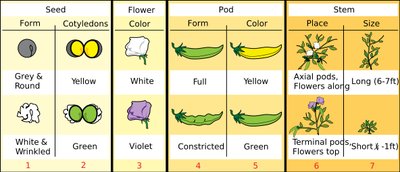
Gregor Mendel, an Austrian monk, is considered the father of genetics due to his pioneering experiments with pea plants. He used pure lines, ensuring that offspring produced by pure line mating would be identical for the trait studied. Mendel labeled generations as follows:
Parental (P) Generation: The initial mating.
First Filial (F1) Generation: Offspring from the parental mating, often self-mated or cross-fertilized.
Second Filial (F2) Generation: Offspring from F1 self-mating.
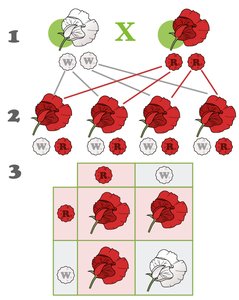
One of Mendel's classic crosses resulted in a 3:1 ratio of traits in the F2 generation, demonstrating the principles of inheritance.
Mendel's Laws
Mendel's studies led to the formulation of three fundamental laws of inheritance:
Law of Segregation: Alleles separate during meiosis, so each gamete contains a single allele for each trait.
Law of Dominance: Some alleles are dominant, while others are recessive; the dominant allele masks the expression of the recessive allele.
Law of Independent Assortment: Genes for different traits segregate independently into gametes.
These laws explain the inheritance patterns observed in Mendel's crosses, such as the classic 3:1 ratio in monohybrid crosses and the 9:3:3:1 ratio in dihybrid crosses.
Diploid and Haploid Genetics
Diploid Genetics
Diploid organisms have two alleles per gene, one on each homologous chromosome. Key concepts include:
Alleles: Variants for a particular trait; can be dominant or recessive.
Homozygous: Two identical alleles at a gene locus.
Heterozygous: Two different alleles at a gene locus.
Locus: Specific chromosomal location of a gene.
During meiosis, chromosomes are replicated and divided, resulting in four haploid gametes.
Chromosome Structure
Chromosomes have distinct structures:
Centromere: Condensed region; can be metacentric (center), submetacentric (off-center), or acrocentric (end).
p arm: Short arm.
q arm: Long arm.
Haploid Genetics
Haploid cells contain only one allele per gene. Wild type and mutant alleles are denoted differently (e.g., a+ for wild type, a for mutant). Fusion of opposite mating types creates a diploid meiocyte, which can be divided into haploid cells.
Monohybrid and Dihybrid Crosses
Monohybrid Cross
A monohybrid cross involves two organisms with different alleles at a single gene. The classic result is a 3:1 phenotypic ratio in the F2 generation when both parents are heterozygous.
Genotype notation: Dominant (A), recessive (a), wild type (+), mutant (a).
Punnett Square: Used to predict offspring genotypes and phenotypes.
Dihybrid Cross
A dihybrid cross involves two traits, such as color and shape. The common phenotypic ratio is 9:3:3:1. Two methods are used:
Punnett Square: Visual representation of all possible combinations.
Branching Diagram: Mathematical calculation of genotype probabilities.
Example starting genotypes: Mother: Yy Rr, Father: Yy Rr.
Sex-Linked Genes
Sex Chromosomes and Inheritance
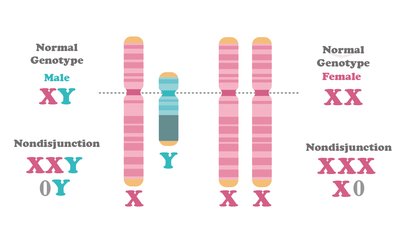
Humans have two sex chromosomes, X and Y. The Y chromosome contains few genes, including SRY for maleness, and is hemizygous. The X chromosome contains many genes. Both X and Y have pseudoautosomal regions for pairing during meiosis. Nondisjunction can result in abnormal genotypes (e.g., XXY, XO).
Sex-Linkage Patterns
X-linkage: Mutant alleles on the X chromosome.
Y-linkage: Mutant alleles on the Y chromosome.
Sex-limited inheritance: Expression limited to one sex.
Sex-influenced inheritance: Expression influenced by sex hormones.
Example: X-linkage and eye color in Drosophila shows distinct inheritance patterns in reciprocal crosses.
Probability and Genetics
Probability Laws
Geneticists use probability to predict offspring genotypes and phenotypes:
Product Law: Multiply probabilities of independent events.
Sum Law: Add probabilities of mutually exclusive events.
Binomial Theorem: Used for combinations of events.
Example equation for probability of two males and two females in a family of four children:
General binomial expansion:
Pedigrees and Inheritance Patterns
Pedigree Analysis
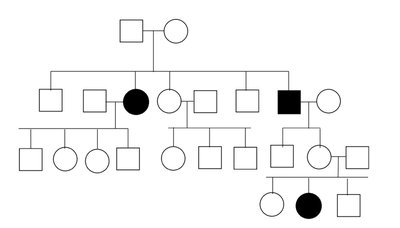
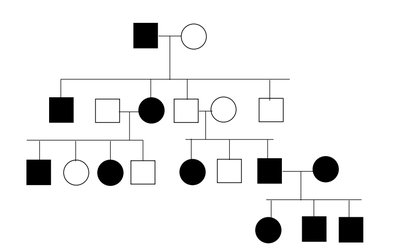
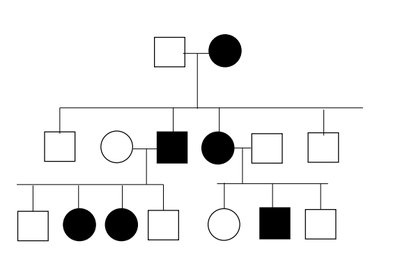
A pedigree is a map of human matings, used to identify inheritance patterns. Key symbols include male, female, affected, carrier, twins, and propositus. Pedigrees help distinguish between autosomal and sex-linked inheritance.
Autosomal and Sex-Linked Disorders
Autosomal Recessive: Affected individuals appear in offspring of unaffected parents; both sexes affected.
Autosomal Dominant: Phenotype appears in every generation; affected parents pass phenotype to children.
Autosomal Polymorphisms: Two or more common phenotypes inherited in Mendelian manner.
X-Linked Recessive: More males affected; affected males do not pass trait to offspring, daughters are carriers.
X-Linked Dominant: Affected males pass condition to all daughters, not sons; heterozygous females pass to half of offspring.
Y-Linked: Only males inherit; very rare.
Pedigree Flowchart
Pedigree flowcharts help determine inheritance patterns based on affected individuals and their parents.
Practice Problems and Applications
Sample Questions
Identify chromosome types (e.g., acrocentric).
Predict offspring genotypes and phenotypes using Punnett squares.
Calculate probabilities using product and sum laws.
Analyze pedigrees to determine inheritance patterns.
Additional info: These notes expand on brief points with academic context, definitions, and examples to ensure completeness and clarity for exam preparation.
