 Indietro
Mitochondrial Genetics: Structure, Inheritance, and Disease
Guida di studio - Note intelligenti
 Appunti personalizzati basati sui tuoi materiali, ampliati con definizioni chiave, esempi e contesto.
Mitochondrial Genetics
Introduction to the Mitochondrial Genome
The mitochondrial genome, or mitochondrial DNA (mtDNA), is a distinct genetic system found within the mitochondria of eukaryotic cells. Unlike the nuclear genome, mtDNA is inherited exclusively through the maternal line and plays a crucial role in cellular energy production.
Mitochondria are organelles responsible for generating adenosine triphosphate (ATP), the cell's main energy currency.
Each human cell contains approximately 1,000 to 2,000 mitochondria, with higher numbers in energy-demanding cells such as muscle cells.
Red blood cells lack mitochondria entirely.
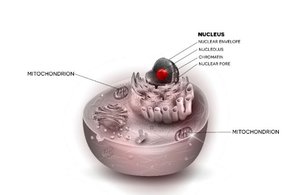
Figure 1: Depiction of nucleus and mitochondria in a typical eukaryotic cell
Structure and Content of the Mitochondrial Genome
The human mitochondrial genome is a compact, circular DNA molecule containing 16,569 base pairs. It encodes a limited number of genes essential for mitochondrial function and energy production.
Gene Content: 37 genes in total:
13 protein-coding genes (involved in oxidative phosphorylation)
22 transfer RNA (tRNA) genes
2 ribosomal RNA (rRNA) genes (12S and 16S)
One strand, called the heavy strand, encodes 28 genes; the other, the light strand, encodes 9 genes.
The mitochondrial genome lacks introns and is maternally inherited.
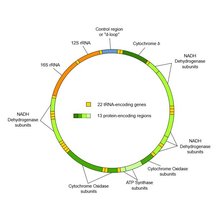
Figure 2: The mitochondrial genome
Replication, Mutation, and Evolutionary Significance
Mitochondrial DNA replicates independently of nuclear DNA and does not undergo recombination during meiosis. The mutation rate in mtDNA is significantly higher than in nuclear DNA due to limited DNA repair mechanisms and exposure to reactive oxygen species (ROS) generated during ATP production.
Heteroplasmy: The presence of multiple mitochondrial DNA variants within a single cell.
Mutations can accumulate rapidly, making mtDNA a valuable tool for tracing maternal ancestry and studying evolutionary relationships.
The endosymbiont theory proposes that mitochondria originated from free-living alpha-proteobacteria that formed a symbiotic relationship with ancestral eukaryotic cells.
Equation: The mutation rate () in mtDNA can be expressed as:
Additional info: mtDNA is often used in population genetics and forensic studies due to its high mutation rate and maternal inheritance.
Mitochondrial Inheritance
Mitochondrial inheritance (maternal inheritance) refers to the transmission of mitochondrial genes exclusively through the mother. Only eggs contribute mitochondria to the zygote, as sperm mitochondria are typically excluded during fertilization.
All children of an affected mother inherit her mitochondrial DNA and any associated mutations.
Fathers do not pass on mitochondrial DNA to their offspring.
Some mitochondrial disorders are caused by mutations in nuclear genes, which can be inherited from either parent.
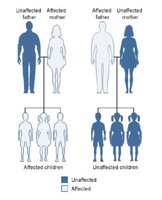
Figure 3: Mitochondrial inheritance
Mitochondrial Diseases
Mitochondrial diseases are a diverse group of disorders caused by mutations in either mitochondrial or nuclear genes affecting mitochondrial function. These diseases can be inherited maternally (if caused by mtDNA mutations) or from either parent (if caused by nuclear DNA mutations).
Symptoms vary widely and may include muscle weakness, neurological deficits, cardiac disease, and developmental disorders such as autism spectrum disorder (ASD).
Mitochondrial diseases can also arise spontaneously or due to environmental factors (e.g., exposure to toxins).
Collectively, mitochondrial diseases affect approximately 1 in 4,300 people.
Table: Comparison of Mitochondrial and Nuclear Genome Features
Feature | Mitochondrial Genome | Nuclear Genome |
|---|---|---|
Structure | Circular, double-stranded | Linear, double-stranded |
Gene Number | 37 | ~20,000-25,000 |
Inheritance | Maternally inherited | Biparental (Mendelian) |
Mutation Rate | High | Lower |
Introns | Absent | Present |
Recombination | Absent | Present (meiosis) |
Additional info: Mitochondrial diseases are often diagnosed using genetic testing of both mtDNA and nuclear DNA, and treatment options are limited, focusing mainly on symptom management.
