 Indietro
Modifications of Mendelian Inheritance: Non-Mendelian Patterns and Genetic Complexity
Guida di studio - Note intelligenti
 Appunti personalizzati basati sui tuoi materiali, ampliati con definizioni chiave, esempi e contesto.
Modifications of Mendelian Inheritance
Introduction
Mendelian inheritance describes the transmission of traits according to the laws established by Gregor Mendel. However, many traits in human populations do not follow simple Mendelian ratios due to genetic complexity, gene interactions, environmental influences, and other phenomena. Understanding these modifications is essential for interpreting genetic data and predicting phenotypic outcomes.
When Gene Expression Appears to Alter Mendelian Ratios
Although Mendel's laws still apply at the genetic level, the phenotypic expression of traits may deviate from expected ratios due to several phenomena:
Lethal Alleles
Definition: Lethal alleles are gene variants that cause death before an individual can reproduce, removing certain genotypic classes from the population.
Effect: Lethality can occur at any life stage, but only alleles causing pre-reproductive death prevent transmission to the next generation.
Experimental Impact: In genetic crosses, expected progeny classes may be missing due to embryonic or early death (e.g., crossing heterozygotes for a lethal allele yields no surviving homozygous recessive offspring).
Examples: Tay-Sachs Disease, Achondroplastic Dwarfism.
Multiple Alleles
Definition: A gene may exist in more than two allelic forms within a population, though individuals carry only two alleles per gene.
Effect: Multiple alleles increase phenotypic diversity and can result in a range of symptoms or traits.
Example: Cystic fibrosis (CF) has many recessive alleles, each potentially causing different symptoms in affected individuals.
Incomplete Dominance
Definition: In incomplete dominance, the heterozygote's phenotype is intermediate between those of the two homozygotes.
Mechanism: The dominant allele does not fully compensate for the lack of the recessive allele's product.
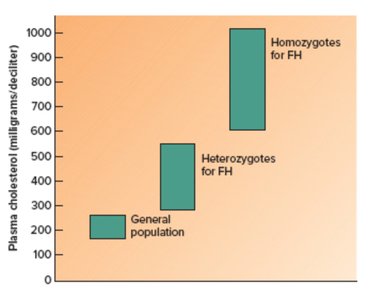
Example: Familial hypercholesterolemia (FH):
Homozygous recessive individuals lack LDL receptors, leading to extremely high cholesterol (lethal).
Heterozygotes have half the normal number of receptors and develop hypercholesterolemia.
Homozygous dominant individuals have normal cholesterol levels.
Codominance
Definition: In codominance, both alleles in a heterozygote are fully expressed, resulting in a phenotype that displays both traits equally.
Example: Human ABO blood types:
Alleles: IA (A antigen), IB (B antigen), i (no antigen).
Genotype-Phenotype Table:
Genotype
Antigen
Phenotype
IAIA or IAi
A
Type A
IBIB or IBi
B
Type B
IAIB
A and B
Type AB
ii
None
Type O
Epistasis
Definition: Epistasis occurs when one gene masks or modifies the expression of another gene.
Mechanism: The epistatic gene (modifier) can inactivate, remove, or counteract the product of another gene.
Example: Bombay phenotype: A mutation prevents the production of the H antigen, so A and B antigens cannot attach to red blood cells. Individuals test as type O but are actually a rare h-type.
Penetrance and Expressivity
Penetrance: The percentage of individuals with a specific genotype who display the associated phenotype.
Complete penetrance: All individuals with the genotype express the phenotype.
Incomplete penetrance: Some individuals with the genotype do not express the phenotype.
Example: Polydactyly (extra digits) is incompletely penetrant.
Expressivity: The degree or intensity with which a genotype is expressed in the phenotype.
Variable expressivity: The phenotype varies in severity among individuals with the same genotype.
Example: Polydactyly can range from an extra fingertip to several extra digits.
Pleiotropy
Definition: Pleiotropy occurs when a single gene influences multiple phenotypic traits.
Mechanism: The gene product may be involved in multiple biochemical pathways or affect different tissues.
Example: Marfan syndrome is caused by mutations in the fibrillin gene, affecting the aorta, eyes, bones, and more.
Phenocopy
Definition: A phenocopy is an environmentally induced phenotype that mimics a genetic disorder.
Mechanism: Environmental factors (e.g., infections, toxins) produce symptoms similar to those of inherited diseases.
Example: Congenital AIDS may appear to be an inherited immunodeficiency but is caused by viral infection.
Genetic Heterogeneity
Definition: Genetic heterogeneity occurs when mutations in different genes produce the same phenotype.
Mechanism: Different genes may encode proteins in the same pathway or affect the same body part.
Examples:
Osteogenesis imperfecta (brittle bone disease) has 18 genetically distinct forms.
Alzheimer disease is associated with mutations in six different genes.
Overlapping and Blurred Phenomena
Some genetic phenomena overlap; for example, Marfan syndrome can be both genetically heterogeneous and epistatic due to involvement of multiple genes in the same pathway.
Gene interactions can influence penetrance and expressivity, leading to variable symptoms even among individuals with the same mutation.
Advances in genetic testing are revealing more cases of pleiotropy and genetic heterogeneity, as well as complex gene interactions affecting disease expression.
Summary Table: Key Non-Mendelian Inheritance Phenomena
Phenomenon | Definition | Example |
|---|---|---|
Lethal Alleles | Alleles causing death before reproduction | Tay-Sachs Disease |
Multiple Alleles | More than two alleles for a gene in a population | Cystic Fibrosis |
Incomplete Dominance | Heterozygote phenotype is intermediate | Familial Hypercholesterolemia |
Codominance | Both alleles fully expressed in heterozygote | ABO Blood Types |
Epistasis | One gene masks/modifies another's expression | Bombay Phenotype |
Penetrance | Proportion of genotype expressing phenotype | Polydactyly |
Expressivity | Variation in phenotype severity | Polydactyly |
Pleiotropy | One gene affects multiple traits | Marfan Syndrome |
Phenocopy | Environmental mimic of genetic trait | Congenital AIDS |
Genetic Heterogeneity | Different genes, same phenotype | Osteogenesis Imperfecta |
Additional info: As genetic research advances, more examples of these phenomena are being discovered, highlighting the complexity and interconnectedness of genetic traits in human populations.
