 Indietro
Molecular Basis of Inheritance: DNA Structure, Replication, and Gene Expression
Guida di studio - Note intelligenti
 Appunti personalizzati basati sui tuoi materiali, ampliati con definizioni chiave, esempi e contesto.
MOLECULAR BASIS OF INHERITANCE
Introduction
The molecular basis of inheritance explores how genetic information is stored, replicated, and expressed in living organisms. The central molecule in this process is DNA, which acts as the genetic material in most organisms, while RNA plays key roles in gene expression and, in some viruses, as genetic material itself. This chapter covers the structure of DNA, its replication, transcription, translation, gene regulation, and applications such as the Human Genome Project and DNA fingerprinting.
DNA and Chromosome Structure
The DNA Molecule
DNA (deoxyribonucleic acid) is a long polymer of deoxyribonucleotides. The length of DNA is measured in base pairs (bp) and varies among organisms. For example, Escherichia coli has about 4.6 × 10⁶ bp, while the human haploid genome contains approximately 3.3 × 10⁹ bp.
Nucleotide Structure: Each nucleotide consists of a nitrogenous base (purines: adenine, guanine; pyrimidines: cytosine, thymine/uracil), a pentose sugar (deoxyribose in DNA, ribose in RNA), and a phosphate group.
Polynucleotide Chain: Nucleotides are linked by 3'-5' phosphodiester bonds, forming a sugar-phosphate backbone with nitrogenous bases projecting inward.
Polarity: The chain has a 5' phosphate end and a 3' hydroxyl end.
Double Helix Structure
The double helix model, proposed by Watson and Crick, describes DNA as two antiparallel polynucleotide chains coiled in a right-handed helix. The bases pair specifically (A with T via two hydrogen bonds, G with C via three hydrogen bonds), making the strands complementary.
Uniform Distance: Purine-pyrimidine pairing ensures a constant distance between the two strands.
Helical Parameters: The helix has a pitch of 3.4 nm with about 10 bp per turn, and base pairs are stacked 0.34 nm apart.
Stability: Hydrogen bonds and base stacking interactions stabilize the structure.
Packaging of DNA Helix
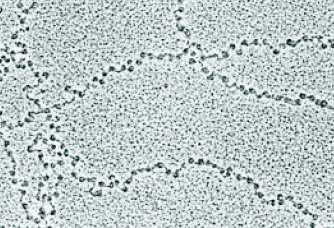
In eukaryotes, DNA is packaged with histone proteins into nucleosomes, forming chromatin. Nucleosomes appear as 'beads-on-string' under an electron microscope, and further coiling produces chromatin fibers and chromosomes. Chromatin regions can be euchromatin (loosely packed, transcriptionally active) or heterochromatin (densely packed, inactive).
The Search for Genetic Material
Historical Experiments
Griffith's Transformation: Demonstrated that a 'transforming principle' from heat-killed virulent bacteria could convert non-virulent bacteria into virulent forms.
Avery, MacLeod, McCarty: Identified DNA as the transforming principle, showing that only DNA (not protein or RNA) could transform bacteria.
Hershey-Chase Experiment: Used bacteriophages labeled with radioactive isotopes to confirm that DNA, not protein, is the genetic material.
Properties of Genetic Material (DNA vs. RNA)
Must be able to replicate, be stable, mutate, and express information as traits.
DNA is more stable than RNA due to the absence of the 2'-OH group and the presence of thymine instead of uracil.
RNA is more reactive and mutates faster, making DNA the preferred storage molecule for genetic information.
DNA Replication
Semiconservative Replication
Watson and Crick proposed that DNA replication is semiconservative: each daughter DNA molecule consists of one parental and one newly synthesized strand. This was experimentally confirmed by Meselson and Stahl using isotopic labeling and density gradient centrifugation.
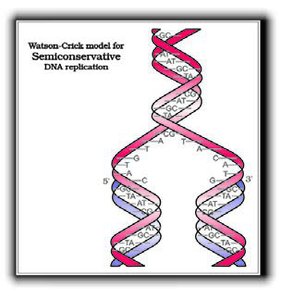
Replication Machinery: DNA-dependent DNA polymerase synthesizes new DNA using the parental strand as a template. Replication initiates at specific origins and proceeds bidirectionally.
Leading and Lagging Strands: Synthesis is continuous on the leading strand (3'→5' template) and discontinuous on the lagging strand (5'→3' template), forming Okazaki fragments joined by DNA ligase.
Transcription
Process and Units
Transcription is the synthesis of RNA from a DNA template. Only one DNA strand (the template strand) is transcribed, producing a complementary RNA molecule. The transcription unit includes a promoter, structural gene, and terminator.
Types of RNA: mRNA (messenger), tRNA (transfer), and rRNA (ribosomal) are all transcribed from DNA.
RNA Polymerases: In prokaryotes, a single RNA polymerase synthesizes all types of RNA. In eukaryotes, RNA polymerase I synthesizes rRNA, II synthesizes mRNA, and III synthesizes tRNA and some small RNAs.
RNA Processing: In eukaryotes, primary transcripts (hnRNA) undergo splicing (removal of introns), capping, and tailing to become mature mRNA.
Genetic Code
Features and Deciphering
Triplet Code: Each amino acid is encoded by a sequence of three nucleotides (codon).
Degeneracy: Multiple codons can code for the same amino acid.
Universality: The code is nearly universal across organisms.
Start and Stop Codons: AUG codes for methionine and acts as the start codon; UAA, UAG, and UGA are stop codons.
Mutations and the Genetic Code
Point Mutations: Single base changes can alter amino acid sequences (e.g., sickle cell anemia).
Frameshift Mutations: Insertions or deletions of bases (not in multiples of three) shift the reading frame, altering downstream amino acid sequence.
Translation
Mechanism
Translation is the process of synthesizing a polypeptide from an mRNA template. It occurs in ribosomes, which facilitate the binding of tRNA molecules carrying specific amino acids to the mRNA codons via their anticodons. Peptide bonds are formed between amino acids, catalyzed by rRNA (ribozyme activity).
Initiation: Ribosome assembles at the start codon (AUG) on mRNA.
Elongation: Amino acids are sequentially added to the growing polypeptide chain.
Termination: Release factors recognize stop codons, releasing the completed polypeptide.
Regulation of Gene Expression
Lac Operon Model
Gene expression can be regulated at multiple levels, but in prokaryotes, transcriptional regulation is predominant. The lac operon in E. coli is a classic example, where the presence of lactose induces the expression of genes required for its metabolism. The operon includes regulatory and structural genes, and is controlled by repressors and inducers.
Genomes and Genomics
Human Genome Project (HGP)
The HGP aimed to sequence the entire human genome, identifying all genes and their sequences. It involved large-scale sequencing, data storage, and analysis, leading to advances in bioinformatics and our understanding of genetic variation, gene function, and disease.
Key Findings: The human genome contains about 3.16 billion base pairs and approximately 30,000 genes. Less than 2% of the genome codes for proteins; the rest includes regulatory and repetitive sequences.
Applications: Insights into genetic diseases, evolutionary biology, and personalized medicine.
DNA Fingerprinting
Principle and Applications
DNA fingerprinting identifies individuals based on unique patterns in their DNA, particularly in repetitive sequences (VNTRs, microsatellites). It is widely used in forensic science, paternity testing, and studies of genetic diversity.
Summary Table: DNA vs. RNA
Feature | DNA | RNA |
|---|---|---|
Sugar | Deoxyribose | Ribose |
Bases | A, T, G, C | A, U, G, C |
Strands | Double-stranded | Single-stranded (mostly) |
Stability | More stable | Less stable |
Function | Genetic material | Messenger, adapter, catalytic |
Key Equations
Length of DNA:
Chargaff's Rule:
Glossary
Gene: Functional unit of inheritance, a segment of DNA coding for a polypeptide or RNA.
Exon: Expressed sequence in a gene that appears in mature RNA.
Intron: Non-coding sequence in a gene, removed during RNA processing.
Promoter: DNA sequence where RNA polymerase binds to initiate transcription.
Operator: Regulatory DNA sequence in operons, binding site for repressors.
Polymorphism: Genetic variation within a population, often in non-coding regions.
