 Indietro
Molecular Biology of Transcription and RNA Processing 8
Guida di studio - Note intelligenti
 Appunti personalizzati basati sui tuoi materiali, ampliati con definizioni chiave, esempi e contesto.
Chapter 8: Molecular Biology of Transcription and RNA Processing
RNA Transcripts Carry the Messages of Genes
Understanding how genetic information in DNA directs protein synthesis was a major milestone in molecular genetics. RNA, a molecule similar to DNA, was found to play a central role in this process, acting as an intermediary between DNA and protein synthesis. In eukaryotic cells, DNA is confined to the nucleus, while protein synthesis occurs in the cytoplasm, suggesting a messenger role for RNA.
RNA Nucleotides and Structure
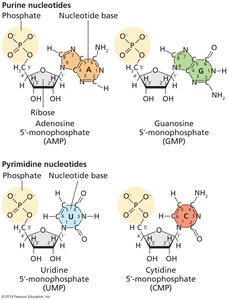
RNA is composed of ribonucleotides, each consisting of a ribose sugar, a nucleotide base, and one or more phosphate groups. There are two key differences between RNA and DNA nucleotides:
Bases: RNA contains adenine (A), guanine (G), and cytosine (C) like DNA, but uses uracil (U) instead of thymine (T).
Sugar: RNA contains ribose, whereas DNA contains deoxyribose.
RNA Assembly and Structure
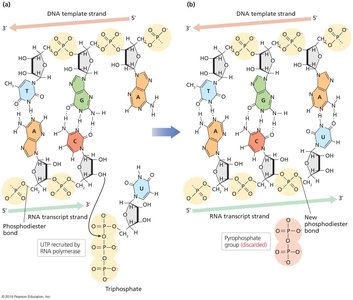
RNA and DNA have similar sugar-phosphate backbones. RNA strands are assembled by forming phosphodiester bonds between adjacent nucleotides. RNA is synthesized from a DNA template using complementary base pairing (A with U, C with G).
Categories of RNA
There are two main categories of RNA:
Messenger RNA (mRNA): Produced by protein-coding genes, mRNA serves as a short-lived intermediary between DNA and protein. It is the only RNA type that undergoes translation.
Functional RNAs: These RNAs do not encode proteins but perform essential cellular roles, including:
Ribosomal RNA (rRNA): Combines with proteins to form ribosomes.
Transfer RNA (tRNA): Binds amino acids and brings them to the ribosome during translation.
Small nuclear RNA (snRNA): Involved in mRNA processing in eukaryotes.
Micro RNA (miRNA) and Small interfering RNA (siRNA): Regulate mRNA stability and translation.
Telomerase RNA: Provides a template for telomere synthesis.
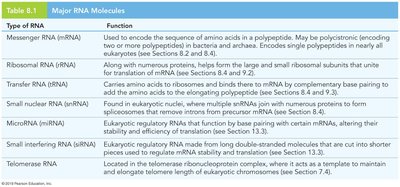
Type of RNA | Function |
|---|---|
Messenger RNA (mRNA) | Encodes amino acid sequence of polypeptides; only RNA type translated into protein. |
Ribosomal RNA (rRNA) | Forms ribosomes with proteins; site of protein synthesis. |
Transfer RNA (tRNA) | Brings amino acids to ribosomes during translation. |
Small nuclear RNA (snRNA) | Joins with proteins to form spliceosomes for mRNA processing. |
MicroRNA (miRNA) | Regulates mRNA stability and translation. |
Small interfering RNA (siRNA) | Regulates mRNA stability and translation; derived from double-stranded RNA. |
Telomerase RNA | Template for telomere synthesis. |
Transcription in Bacteria
Bacterial Transcription: Four-Stage Process
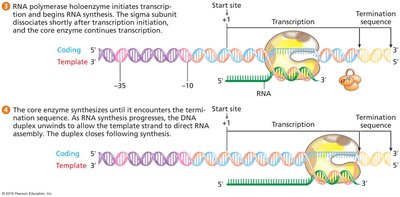
Transcription is the synthesis of a single-stranded RNA molecule from a DNA template by RNA polymerase. In bacteria, transcription occurs in four stages:
Promoter recognition
Transcription initiation
Chain elongation
Chain termination
Gene Structure
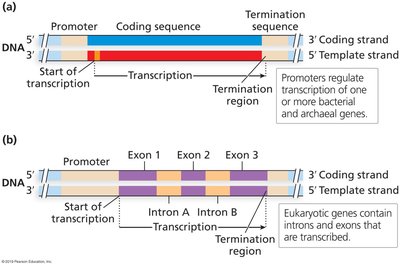
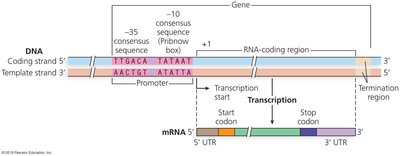
A gene contains several functional segments:
Promoter: Upstream of the transcription start site (+1), controls RNA polymerase access.
Coding region: Contains the information for protein synthesis.
Termination region: Signals the end of transcription, located downstream of the coding region.
DNA Strand Identification for Transcription
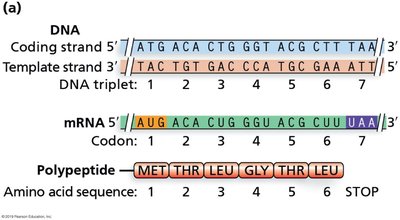
During transcription, RNA polymerase uses the template strand of DNA to assemble a complementary, antiparallel RNA strand. The coding (nontemplate) strand has the same sequence as the RNA (except T is replaced by U).
Bacterial RNA Polymerase
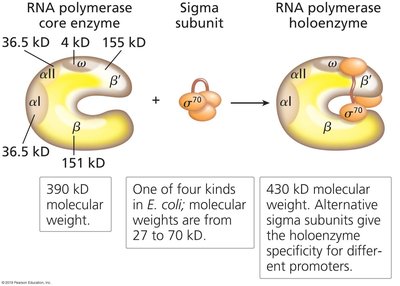
Bacteria have a single RNA polymerase that transcribes all types of RNA. The enzyme consists of a core (two α, two β, and one ω subunit) and a sigma (σ) subunit. The core enzyme can synthesize RNA but requires the sigma subunit to recognize promoters and initiate transcription. Different sigma subunits allow recognition of different promoter sequences.
Bacterial Promoters and Consensus Sequences
Promoters are double-stranded DNA sequences that serve as binding sites for RNA polymerase and other transcription proteins. Key consensus sequences include:
-10 (Pribnow box): 5'-TATAAT-3'
-35 region: 5'-TTGACA-3'
Transcription Initiation in Bacteria
Initiation involves two steps:
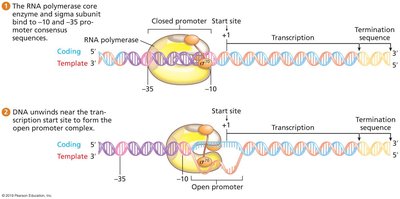
The holoenzyme loosely attaches to the promoter, then binds tightly to form the closed promoter complex.
The holoenzyme unwinds about 18 bp of DNA to form the open promoter complex, then initiates RNA synthesis at the +1 site.
Transcription Elongation and Termination
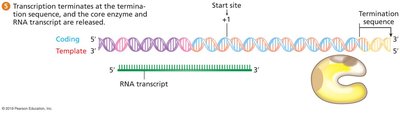
After initiation, the sigma subunit dissociates, and the core enzyme continues RNA synthesis. The DNA unwinds ahead of the enzyme and reforms behind it. Termination occurs when the core enzyme encounters a termination sequence, releasing the RNA transcript.
Transcription Termination Mechanisms
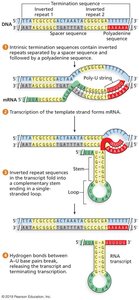
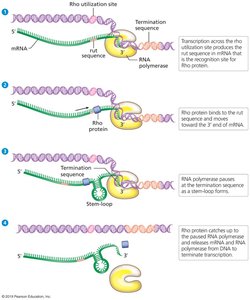
There are two main mechanisms for transcription termination in bacteria:
Intrinsic (Rho-independent) termination: Involves a GC-rich inverted repeat followed by a string of adenines. The mRNA forms a hairpin structure, causing RNA polymerase to pause and dissociate.
Rho-dependent termination: Requires the rho protein, which binds to a rut site on the mRNA and moves toward the polymerase, causing release of the transcript.
Eukaryotic Transcription
Complexity of Eukaryotic Transcription
Eukaryotes have three RNA polymerases, each transcribing different classes of genes:
RNA polymerase I: Transcribes rRNA genes.
RNA polymerase II: Transcribes protein-coding genes and most snRNA genes.
RNA polymerase III: Transcribes tRNA genes, one snRNA gene, and one rRNA gene.
Eukaryotic genes contain introns and exons, and their DNA is packaged into chromatin, affecting transcription regulation.
Eukaryotic Promoter Elements
Common promoter elements include:
TATA box (Goldberg–Hogness box): 5'-TATAAA-3', located at -25.
CAAT box: Near -80.
GC-rich box: 5'-GGGCGG-3', near -90 or further upstream.

Pol II Promoter Recognition and Enhancers
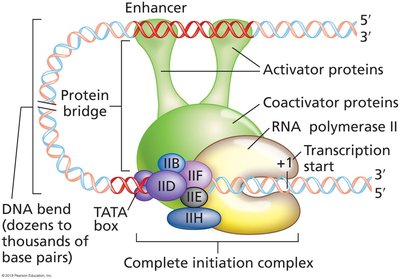
RNA polymerase II requires transcription factors (TFs) to recognize and bind promoter sequences. The TATA-binding protein (TBP), part of TFIID, binds the TATA box. Enhancer sequences, often distant from the promoter, bind activator proteins and coactivators, forming a protein bridge that bends DNA and increases transcription efficiency.
Archaeal Transcription
Archaeal transcription machinery is more similar to eukaryotic RNA polymerase II than to bacterial RNA polymerase. Archaeal promoters contain a TATA box and a TFB-recognition element, bound by homologous transcription factors.
Posttranscriptional Processing in Eukaryotes
Posttranscriptional Processing
Eukaryotic pre-mRNA undergoes several modifications to become mature mRNA:
5' capping
3' polyadenylation
Intron splicing
Capping 5' mRNA
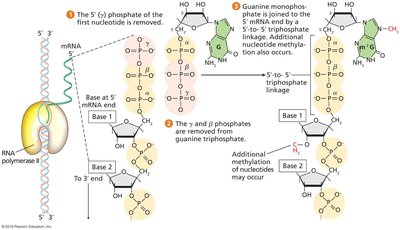
After the first 20–30 nucleotides are synthesized, a guanine is added to the 5' end by guanylyl transferase, followed by methylation. This 5' cap:
Protects mRNA from degradation
Facilitates nuclear export
Assists in splicing and translation initiation
Polyadenylation of 3' Pre-mRNA
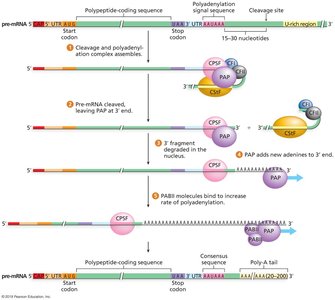
The 3' end of pre-mRNA is cleaved downstream of the polyadenylation signal (5'-AAUAAA-3'), and a poly-A tail (20–200 adenines) is added. This process involves several protein factors and enhances mRNA stability, export, and translation.
The Torpedo Model of Transcription Termination
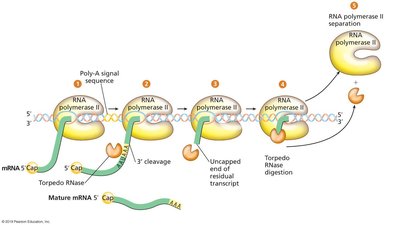
After cleavage and polyadenylation, a specialized RNase digests the residual transcript still attached to RNA polymerase II, causing the polymerase to dissociate from DNA and terminate transcription.
Introns and Exons
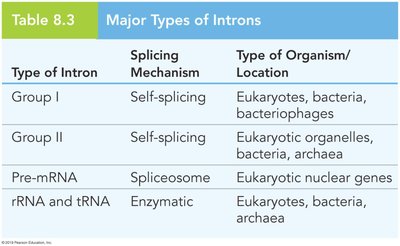
Eukaryotic genes contain exons (coding regions) and introns (non-coding regions). Introns are removed from pre-mRNA by the spliceosome, a complex of snRNAs and proteins. Accurate splicing is essential for correct protein synthesis.
Type of Intron | Splicing Mechanism | Type of Organism/Location |
|---|---|---|
Group I | Self-splicing | Eukaryotes, bacteria, bacteriophages |
Group II | Self-splicing | Eukaryotic organelles, bacteria, archaea |
Pre-mRNA | Spliceosome | Eukaryotic nuclear genes |
rRNA and tRNA | Enzymatic | Eukaryotes, bacteria, archaea |
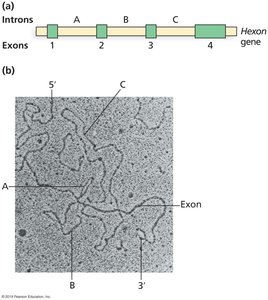
R-Looping
R-looping is an experimental technique that demonstrates the presence of introns. When DNA is hybridized with mature mRNA, regions corresponding to introns loop out, as they are absent in the mRNA.
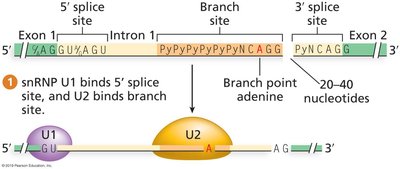
Splicing Signal Sequences and Spliceosome Function
Splicing requires specific sequences at the intron-exon boundaries:
5' splice site: Contains a nearly invariant GU dinucleotide.
3' splice site: Contains a pyrimidine-rich region and an invariant AG.
Branch site: Contains an invariant adenine (branch point) 20–40 nucleotides upstream of the 3' splice site.
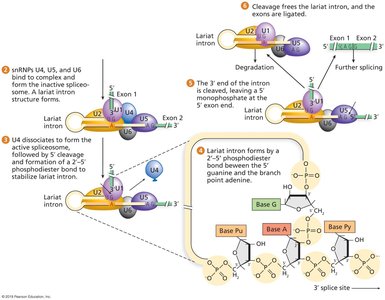
Alternative RNA Processing
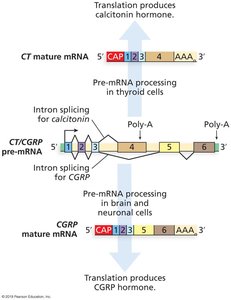
Alternative splicing, alternative promoters, and alternative polyadenylation allow a single gene to produce multiple mRNA and protein variants. For example, the human CT/CGRP gene produces different hormones in thyroid and neuronal cells by using different polyadenylation sites and splicing patterns.
Self-Splicing Introns
Some introns can catalyze their own removal (self-splicing). Group I and Group II introns are ribozymes found in various organisms and organelles. Group I introns excise themselves from mRNAs, tRNAs, and rRNAs, while Group II introns form lariat structures during splicing.
Ribosomal and Transfer RNA Processing
rRNAs are transcribed as large precursors and processed into smaller molecules by removal of spacer sequences. tRNAs are also processed from larger precursors, folded into a characteristic structure, and modified posttranscriptionally. Eukaryotic tRNAs may contain small introns that are removed during processing.
RNA Editing
RNA editing involves posttranscriptional changes to the nucleotide sequence of some mRNAs. This can include the insertion or deletion of uracils (guided by gRNA) or base substitutions, such as the creation of a premature stop codon in apolipoprotein B mRNA in human intestinal cells.
