 Indietro
Probability in Genetics: Foundations and Applications
Guida di studio - Note intelligenti
 Appunti personalizzati basati sui tuoi materiali, ampliati con definizioni chiave, esempi e contesto.
Probability and Its Role in Genetics
Introduction to Probability in Genetics
Probability is a fundamental concept in genetics, used to predict the likelihood of various genetic outcomes. Rather than determining what will happen with certainty, genetics uses probability to estimate the chances of different events, such as inheritance patterns or the appearance of specific traits.
Probability is the measure of how likely an event is to occur, expressed as a value between 0 (impossible) and 1 (certain).
Genetic predictions, such as the outcome of a cross, are based on probability, not certainty.
Random events, like the segregation of alleles during meiosis, follow the laws of probability.
Basic Probability Concepts
Single Event Probability: Coin Flipping
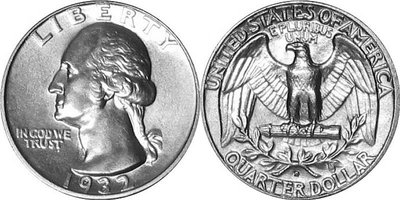
Simple random events, such as flipping a fair coin, illustrate the foundational principles of probability. Each side of a fair coin has an equal chance of appearing.
Probability of heads (or tails) in one flip:
Each flip is independent; previous outcomes do not affect future results.
Multiple Independent Events: Consecutive Coin Flips
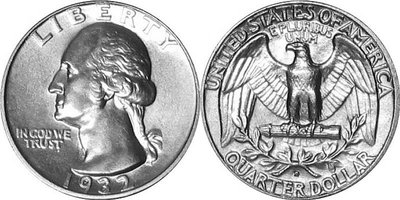
When considering multiple independent events, such as flipping a coin twice, the probability of a specific sequence is the product of the individual probabilities.
Probability of heads both times:
This principle is known as the multiplication rule for independent events.
Probability of At Least One Event Occurring
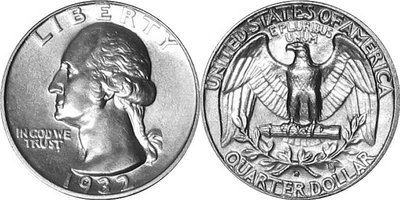
To find the probability of getting at least one heads in two coin flips, it is often easier to calculate the probability of the complementary event (no heads, i.e., two tails) and subtract from 1.
Probability of two tails:
Probability of at least one heads:
Probability with Dice: Application to Genetics
Rolling Dice: Probability of Specific Outcomes
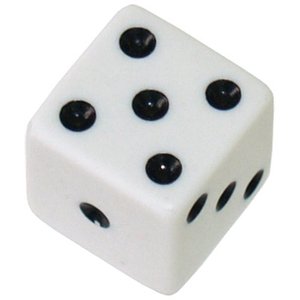
Rolling dice is another classic example of probability, analogous to predicting genetic outcomes. For a fair six-sided die, the probability of rolling any specific number (e.g., a five) is .
Probability of rolling a five on one die:
When rolling two dice, the probability of getting at least one five involves considering all possible combinations.
Calculating Probability of At Least One Five in Two Dice Rolls
To determine the probability of rolling at least one five with two dice, use the complementary probability approach:
Probability that neither die shows a five:
Probability of at least one five:
Alternatively, sum the probabilities of all mutually exclusive ways to get at least one five (as shown in the original notes).
Genetics as a Study of Probabilities
Connecting Probability to Genetic Crosses
Genetic inheritance follows the laws of probability. For example, the segregation and independent assortment of alleles during meiosis can be predicted using probability rules. Punnett squares are a visual tool for organizing and calculating the probabilities of genotypes and phenotypes in offspring.
Punnett squares display all possible combinations of parental alleles and their associated probabilities.
Each cell in a Punnett square represents a possible genotype, with its probability determined by the multiplication rule.
Phenotypic ratios can be derived from the sum of probabilities for genotypes that produce the same phenotype.
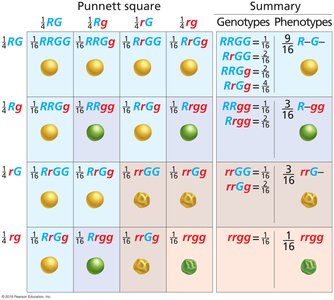
Example: In a dihybrid cross (e.g., RrGg x RrGg), the probability of obtaining a specific genotype (e.g., rrgg) is , as shown in the Punnett square.
Additional info: Understanding probability is essential for predicting genetic outcomes, analyzing inheritance patterns, and interpreting experimental results in genetics.
