 Indietro
Role of Transposable Elements in Gene Regulation in the Human Genome
Guida di studio - Note intelligenti
 Appunti personalizzati basati sui tuoi materiali, ampliati con definizioni chiave, esempi e contesto.
Transposable Elements and Gene Regulation
Overview of Transposable Elements (TEs) in the Human Genome
Transposable elements (TEs), also known as mobile elements (MEs), are interspersed repetitive DNA sequences that constitute at least 50% of the human genome. TEs are classified based on their transposition mechanisms:
Class I (Retrotransposons): Move by a copy-and-paste mechanism via an RNA intermediate. Major types include endogenous retroviruses (ERVs, with LTRs), LINEs (Long Interspersed Nuclear Elements), SINEs (Short Interspersed Nuclear Elements), and SVAs.
Class II (DNA Transposons): Move by a cut-and-paste mechanism. These are less abundant in humans and are considered inactive DNA fossils.
TEs were once considered 'junk DNA,' but are now recognized as important contributors to genome evolution, gene regulation, and the creation of new genes. They can cause genomic rearrangements, generate microsatellites, and influence gene expression through various mechanisms.
Principal Mechanisms of TE-Mediated Gene Regulation
Cis-regulatory sequences: TEs provide regulatory DNA elements (promoters, enhancers, silencers, insulators) that can control the expression of nearby or distant genes.
Regulatory RNAs: TEs contribute sequences to non-coding RNAs (miRNAs, lncRNAs), which can regulate gene expression post-transcriptionally.
Cis-Regulatory Activities of TEs
TEs in Regulatory Elements
Cis-regulatory regions are non-coding DNA sequences that regulate gene expression by providing binding sites for transcription factors and other regulatory proteins. TEs contribute to these regions in several ways:
Promoters: Orientation-dependent elements that initiate transcription.
Enhancers/Silencers: Orientation- and position-independent elements that upregulate or downregulate gene expression.
Insulators: Elements that block the influence of neighboring regulatory regions.
TEs can provide alternative promoters/enhancers or modify existing ones, and their intrinsic regulatory sequences can be co-opted (exapted) for host gene regulation.
Databases for Regulatory Elements
Several databases catalog regulatory elements and their association with TEs, including ENCODE, Roadmap Epigenomics, EnhancerAtlas, and SEdb. These resources integrate high-throughput data (e.g., DNase-seq, ChIP-seq) to annotate regulatory regions genome-wide.
Database | Description | Species |
|---|---|---|
ENCODE | Functional genomics data for many tissues/cell lines | Human |
Roadmap Epigenomics | Epigenomic data for diverse tissues/cell lines | Human |
EnhancerAtlas | Enhancer annotations across species | Human, others |
SEdb | Super-enhancer database | Human |
OCHROdb | Open chromatin regions | Human |
Intrinsic Regulatory Properties of TEs
TEs contain their own promoters, enhancers, splice sites, and terminators.
LTRs and LINEs have RNA polymerase II promoters; SINEs may have RNA polymerase III or II promoters.
Some TEs (e.g., L1s) have antisense promoters that can generate chimeric transcripts, interfering with normal gene expression.
TEs as Sources of Regulatory Elements
TEs can be exapted as promoters or enhancers for host genes, sometimes leading to tissue-specific or lineage-specific expression.
Examples include LTRs acting as neuronal enhancers for POMC, Alu elements as T cell-specific promoters/enhancers, and ERVs as enhancers in stem cells.
TEs can also act as silencers or insulators, repressing gene expression by spreading heterochromatin or blocking regulatory influences.
TEs and Transcription Factor Binding Sites (TFBSs)
TEs provide numerous TFBSs, expanding the regulatory repertoire of the genome.
Some TFBSs are present in TEs before insertion; others arise via post-insertion mutations (e.g., CpG deamination).
TE-derived TFBSs are often non-randomly distributed, with certain TFs preferentially binding specific TE families.
Differential Contribution of TE Types
SINEs (e.g., Alu elements): Most enriched in regulatory regions, especially open chromatin and enhancers.
LINEs: Less frequent in regulatory regions, possibly due to their size and disruptive potential.
LTRs/ERVs: Important for providing diverse regulatory elements and TFBSs, especially in open chromatin.
Genes Regulated by TE-Derived Sequences
Many genes have TE-derived regulatory elements in their promoters or enhancers, influencing expression in a tissue- or lineage-specific manner.
Examples: POMC, CSF1R, FCER1G, CD8, MYPN, AMY1.
Tissue- and Lineage-Specific Regulation
TE-derived regulatory elements often drive tissue-specific gene expression (e.g., LTRs in neuronal or immune genes).
Lineage- and species-specific TEs contribute to regulatory innovation, with many non-conserved regulatory elements enriched for TEs.
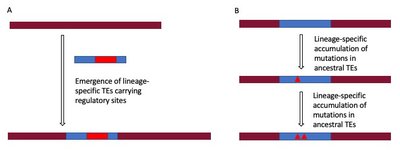
Population-Specific Regulation by Polymorphic TEs
Polymorphic TE insertions (MEIs) are common structural variants and can act as expression quantitative trait loci (eQTLs), contributing to population-specific gene expression differences.
TEs and Non-Coding Regulatory RNAs
TEs in miRNAs and lncRNAs
Many miRNAs and long non-coding RNAs (lncRNAs) are derived from or contain TE sequences.
TEs can provide the stem-loop structure necessary for miRNA biogenesis (e.g., MER53 elements for miR-1302 family).
Up to 20% of human miRNAs and 75% of lncRNAs contain TE-derived sequences.
Functional Roles of TE-Derived Regulatory RNAs
TE-derived miRNAs can target genes with complementary TE sequences in their 3' UTRs.
TEs in lncRNAs facilitate RNA-RNA pairing, circularization, and formation of stable secondary structures.
TEs provide binding sites for protein complexes (e.g., PRC2 binding to XIST lncRNA).
Lineage and Tissue Specificity of TE-Derived Regulatory RNAs
TE-derived regulatory RNAs are often lineage-specific and less conserved, reflecting the lineage-specific activity of TEs.
Many TE-derived lncRNAs show tissue-specific expression, sometimes driven by TEs in their promoters.
Differential Contribution of TE Types to Regulatory RNAs
SINEs and LINEs: Major contributors to lncRNA and miRNA sequences.
DNA transposons: Important for miRNAs entirely derived from TEs.
LTRs: Overrepresented in lncRNA exons and promoters compared to protein-coding genes.
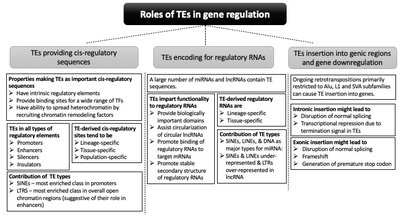
Summary Table: Roles of TEs in Gene Regulation
Role | Description |
|---|---|
TEs providing cis-regulatory sequences | Intrinsic regulatory elements, TFBSs, tissue/lineage-specific regulation, exaptation as promoters/enhancers/silencers/insulators |
TEs encoding for regulatory RNAs | miRNAs and lncRNAs with TE-derived sequences, functional domains, secondary structure, target recognition |
TE insertion into genic regions | Disruption of gene expression via alternative splicing, premature stop codons, polyadenylation signals |
Key Points and Perspectives
TEs are major contributors to gene regulatory innovation in the human genome, acting through both cis-regulatory sequences and regulatory RNAs.
They play roles in tissue-specific, lineage-specific, and population-specific gene expression.
Further research is needed to systematically characterize TE-derived regulatory elements and their functional impacts, including experimental validation and population-level studies.
