 Indietro
Sex Determination and Sex-Linked Characteristics: Study Notes
Guida di studio - Note intelligenti
 Appunti personalizzati basati sui tuoi materiali, ampliati con definizioni chiave, esempi e contesto.
Sex Determination and Sex-Linked Characteristics
Overview of Sex Determination
Sex determination refers to the biological system that establishes the sexual phenotype of an organism. This process can be governed by genetic, chromosomal, or environmental mechanisms, and is fundamental to understanding inheritance patterns and genetic diversity.
Genetic Sex Determination: Sex is determined by specific genes, not necessarily linked to sex chromosomes.
Chromosomal Sex Determination: Sex is determined by the presence or absence of particular sex chromosomes (e.g., XX for females, XY for males in humans).
Environmental Sex Determination: External factors such as temperature can influence sex determination, as seen in some reptiles.
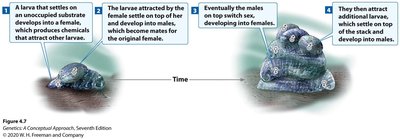
Sequential Hermaphroditism: Some organisms, like the slipper limpet, change sex during their lifetime based on environmental cues.
Homogametic Sex: Produces gametes of one type (e.g., XX females).
Heterogametic Sex: Produces gametes of two types (e.g., XY males).
Chromosomal Sex Determination Mechanisms
Chromosomal sex determination is a widely studied mechanism, especially in humans and other animals. The X and Y chromosomes play a central role, with the SRY gene on the Y chromosome being crucial for male development.
Sex Chromosomes: X and Y chromosomes differ between sexes; autosomes are the same in both.
SRY Gene: Encodes a transcription factor that initiates testis development in males.
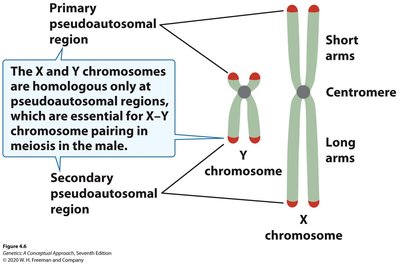
Pseudoautosomal Regions: Homologous regions on X and Y chromosomes essential for pairing during meiosis.
Nondisjunction and Sex Chromosome Aneuploidy
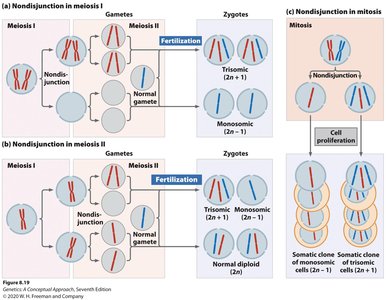
Nondisjunction is the failure of chromosomes to segregate properly during meiosis, leading to genetic syndromes such as Turner, Klinefelter, and Poly-X syndromes. These syndromes are characterized by abnormal numbers of sex chromosomes.
Turner Syndrome (XO): Females with only one X chromosome; often sterile, normal intelligence.
Klinefelter Syndrome (XXY): Males with extra X chromosome(s); taller, sterile, normal intelligence, slight feminization.
Poly-X Syndrome (XXX, XXXX, XXXXX): Females with multiple X chromosomes; mild to severe phenotypes.
Nondisjunction: Can occur in meiosis I or II, resulting in trisomic or monosomic zygotes.
Sex Determination in Drosophila melanogaster
In Drosophila, sex is determined by the ratio of X chromosomes to sets of autosomes (X:A ratio). The Y chromosome is required only for male fertility, not for sex determination.
X:A Ratio: Determines sexual phenotype; X:A = 1.0 is female, X:A = 0.5 is male.
Sex Chromosome Complements: Various combinations lead to different phenotypes (e.g., metafemale, intersex).
Sex-Chromosome Complement | Haploid Sets of Autosomes | X : A Ratio | Sexual Phenotype |
|---|---|---|---|
XX | AA | 1.0 | Female |
XY | AA | 0.5 | Male |
XO | AA | 0.5 | Male |
XXY | AA | 1.0 | Female |
XXX | AA | 1.5 | Metafemale |
XXXY | AA | 1.5 | Metafemale |
XX | AAA | 0.67 | Intersex |
XO | AAA | 0.33 | Metamale |
XXXX | AAA | 1.3 | Metafemale |
Inheritance of Sex-Linked Traits
Sex-linked traits are those whose genes are located on sex chromosomes, most commonly the X chromosome. These traits exhibit unique inheritance patterns, such as hemizygosity in males and reciprocal crosses revealing X-linkage.
Hemizygote: An individual with only one copy of a gene or chromosome (e.g., males for X-linked genes).
Thomas Hunt Morgan: Demonstrated X-linked inheritance using Drosophila.
Examples: X-linked color blindness, hemophilia.
Reciprocal Crosses: Used to determine if a trait is sex-linked.
Dosage Compensation and Barr Bodies
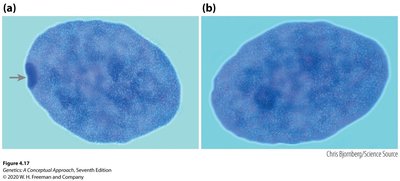
Dosage compensation ensures equal expression of X-linked genes in males and females. In mammals, one X chromosome in females is randomly inactivated, forming a Barr body. This mechanism prevents overexpression of X-linked genes.
Barr Body: Inactivated X chromosome in female somatic cells.
Mary Lyon Hypothesis: Random X inactivation in females.
Phenotypic Effects: Tortoiseshell and calico cats are examples of X-inactivation mosaicism.
Sex Chromosomes | Syndrome | Number of Barr Bodies |
|---|---|---|
XX | None | 1 |
XY | None | 0 |
XO | Turner | 0 |
XXY | Klinefelter | 1 |
XXXY | Klinefelter | 2 |
XXXXY | Klinefelter | 3 |
XXX | Triple-X | 2 |
XXXX | Poly-X female | 3 |
XXXXX | Poly-X female | 4 |
ZZ-ZW Sex Determination
In some species, such as birds and some reptiles, the ZZ-ZW system determines sex. Males are homogametic (ZZ), while females are heterogametic (ZW).
ZZ: Male (homogametic)
ZW: Female (heterogametic)
Z-linked Traits: Example: cameo (ca) in birds, a Z-linked recessive trait.
Key Terms and Genetic Symbols
Understanding genetic notation is essential for interpreting inheritance patterns.
Dominant Allele: Uppercase letter (e.g., A)
Recessive Allele: Lowercase letter (e.g., a)
Wild Type Allele: Most common allele in a species, denoted by + (e.g., y+)
Mutant Allele: Variant allele, often denoted by a number or letter (e.g., y1)
Summary Table: Sex Chromosome Syndromes
Syndrome | Chromosome Complement | Phenotype |
|---|---|---|
Turner Syndrome | XO | Female, sterile, normal intelligence |
Klinefelter Syndrome | XXY, XXXY, XXYY | Male, tall, sterile, normal intelligence, slight feminization |
Poly-X Syndrome | XXX, XXXX, XXXXX | Female, tall, thin, increasing intellectual and physical problems with more X's |
Example Problem
Hemophilia (X-linked recessive): A woman heterozygous for the hemophilia allele mates with a man with normal blood clotting. What is the probability their child will have hemophilia?
Solution: Sons have a 50% chance of inheriting hemophilia; daughters have a 0% chance (unless the father is affected).
Additional info:
These notes expand on the original content by providing definitions, context, and examples for each topic, ensuring completeness and academic quality for Genetics students.
