 Indietro
The Evolving Definition of the Gene: Historical and Molecular Perspectives
Guida di studio - Note intelligenti
 Appunti personalizzati basati sui tuoi materiali, ampliati con definizioni chiave, esempi e contesto.
The Concept and Definition of the Gene
Historical Evolution of the Gene Concept
The term gene has undergone significant changes in meaning since its introduction in the early 20th century. Initially, it was an abstract unit of inheritance, later becoming a physical segment of DNA encoding a polypeptide. The definition has continued to evolve as molecular genetics has revealed increasing complexity.
Classical Period: Genes were considered abstract units, later mapped as points on chromosomes.
Neoclassical Period: Genes acquired spatial dimension and chemical identity, defined as DNA segments encoding polypeptides.
Modern Period: The definition is challenged by phenomena such as alternative splicing, RNA editing, gene sharing, and complex gene regulatory networks.
Key Terms: Gene, Cistron, Mutation, Recombination, Gene Function
Example: The mapping of genes in Drosophila melanogaster and the development of genetic and cytological maps.
Classical and Neoclassical Genetics
Chromosome Theory and Linkage
The chromosome theory of inheritance connected genes to chromosomes, explaining Mendel's laws. Linkage and recombination provided the basis for genetic mapping.
Chromosome Theory: Genes are located on chromosomes, and their behavior during meiosis explains inheritance patterns.
Linkage: Genes on the same chromosome may be inherited together unless separated by recombination.
Genetic Mapping: The frequency of recombination between genes is proportional to their distance on the chromosome.
Example: The construction of the first genetic map by Alfred Sturtevant.
Gene Structure and Function
By the 1940s, genes were shown to have internal structure and length. The discovery that DNA is the hereditary material and the elucidation of the genetic code established the molecular basis of gene function.
One Gene-One Enzyme Hypothesis: Each gene encodes a specific enzyme (later expanded to polypeptides).
Colinearity Hypothesis: The sequence of nucleotides in a gene corresponds to the sequence of amino acids in a protein.
Cistron: The basic unit of gene function, defined by complementation tests.
Example: Benzer's cis-trans test for defining cistrons.
Modern Challenges to the Gene Concept
Complexity in Gene Expression
Recent discoveries have shown that the classical molecular definition of the gene is insufficient. Genes can produce multiple transcripts and proteins through mechanisms such as alternative splicing and RNA editing.
Alternative Splicing: A single gene can produce multiple mRNAs by joining different combinations of exons.
RNA Editing: Post-transcriptional modifications can alter the sequence and function of RNA products.
Gene Sharing: The same gene can produce proteins with different functions in different cellular contexts.
Example: Chimeric transcripts and protein moonlighting.
Gene Boundaries and Epigenetic Inheritance
Gene boundaries are often unclear, with overlapping transcripts and fusion genes. Epigenetic inheritance and phenomena such as the RNA cache hypothesis further complicate the definition.
Transgenerational Epigenetic Inheritance: Functional status of genes can be inherited through mechanisms other than DNA sequence.
Gene Fusion and Encrypted Genes: Transcripts can be formed from segments on different chromosomes.
Noncoding RNA Genes: Many genes produce functional RNAs that are not translated into proteins.
Example: Inheritance of epigenetic changes in mice and Arabidopsis.
Gene Regulatory Networks (GRNs) and Genetic Background Effects
Genes as Elements of Complex Networks
Genes are not autonomous agents but function within complex gene regulatory networks (GRNs). The effects of mutations can be modified by genetic background, leading to phenomena such as suppression and enhancement.
Genetic Background Effects: The expression of a gene's function can vary depending on other genes and environmental factors.
GRNs: Networks of interacting genes regulate development and phenotype.
Example: Variation in the expression of dental traits in humans due to genetic background.
Operational and Molecular Definitions of the Gene
Cis-Trans Test for Cistron Identification
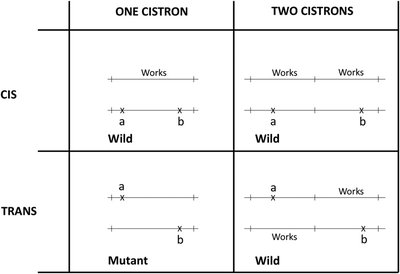
The cis-trans test is a fundamental operational method for defining the basic unit of gene function (cistron). It distinguishes whether mutations belong to the same or different cistrons based on complementation.
Cis Configuration: Mutations a and b are on the same chromosome; if wild type phenotype is observed, mutations are in different cistrons.
Trans Configuration: Mutations a and b are on different chromosomes; if mutant phenotype is observed, mutations are in the same cistron.
Example: Eye color mutations in Drosophila melanogaster.
Toward a Contemporary Definition of the Gene
Proposed Modern Definition
Given the complexities revealed by molecular genetics, a modern definition of the gene must account for its structural, functional, and regulatory dimensions. Genes are DNA sequences that specify one or more sequence-related RNAs/proteins, evoked and mediated by gene regulatory networks, with effects that may be direct or indirect.
Structural: DNA sequence, not necessarily contiguous.
Functional: Specifies RNAs/proteins, participates in GRNs.
Regulatory: Expression and function depend on cellular and network context.
Example: Genes identified by GWAS may only be regulatory elements, not true genes until their products are characterized.
Summary Table: Definitions of the Gene
The following table summarizes various contemporary definitions of the gene proposed by different authors:
Classification | Essential Content | Author(s) |
|---|---|---|
Operational | Criteria for identifying genes in DNA sequences, annotation, and function | Snyder and Gerstein (2003), Pesole (2008), Stadler et al. (2009) |
Molecular | Distinguishes structural and functional gene concepts | Scherrer and Jost (2007), Keller and Harel (2007), Burian (2004) |
Complex | Distinguishes gene-P (preformationist) and gene-D (developmental); instrumental, nominal, and postgenomic concepts | Moss (2003), Griffiths and Stotz (2006) |
New Kind | Defines gene based on its products, separates from DNA | Waters (1994) |
Conclusion
The definition of the gene has evolved from an abstract unit of heredity to a complex molecular entity embedded in regulatory networks. Modern genetics requires a definition that integrates structure, function, and regulation, reflecting the multi-dimensional nature of genes and their products.
Additional info: The notes above expand on the article's brief points with academic context, definitions, and examples to provide a self-contained study guide suitable for Genetics college students.
