 Indietro
Transmission Genetics: Mendel’s Principles and Modern Applications
Guida di studio - Note intelligenti
 Appunti personalizzati basati sui tuoi materiali, ampliati con definizioni chiave, esempi e contesto.
Transmission Genetics
Introduction to Mendel’s Principles
Transmission genetics is the study of how genetic traits are passed from one generation to the next. Gregor Mendel’s experiments with pea plants established the foundational principles of heredity, which remain central to modern genetics.
Gregor Mendel and the Foundations of Genetic Transmission
Mendel’s Experimental Approach
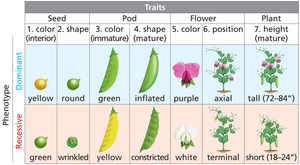
Mendel selected pea plants (Pisum sativum) for his studies due to their ease of cultivation, availability of distinct varieties, and suitability for controlled breeding. He identified seven dichotomous traits, each with two easily distinguishable forms.
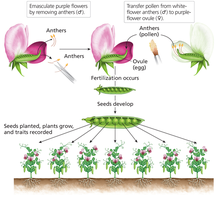
Controlled Crosses: Mendel used artificial cross-fertilization to ensure precise mating between selected plants.
Pure-Breeding Strains: He established strains that consistently produced the same phenotype, ensuring reliable results.
Selection of Dichotomous Traits: Traits with only two phenotypes (e.g., yellow vs. green seeds) were chosen for clarity.
Quantification: Mendel counted progeny and analyzed ratios, laying the groundwork for statistical genetics.
Replicate, Reciprocal, and Test Crosses: Multiple experimental designs were used to validate findings.
Life Cycle and Fertilization in Pea Plants
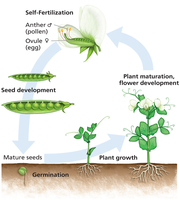
Pea plants can self-fertilize or be cross-fertilized. Mendel used artificial cross-fertilization by removing anthers and applying pollen from another plant.
Monohybrid Crosses and the Segregation of Alleles
Dominant and Recessive Traits
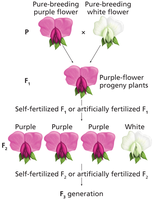
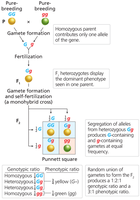
When crossing pure-breeding parental strains, all F1 offspring displayed the phenotype of only one parent (dominant). The other phenotype (recessive) reappeared in the F2 generation, disproving the blending theory of inheritance.
Homozygous: Individuals with identical alleles for a trait.
Heterozygous: Individuals with two different alleles for a trait.
Segregation of Alleles and Mendel’s First Law
Mendel’s law of segregation states that each individual has two alleles for each trait, which segregate during gamete formation. The random union of gametes produces predictable ratios in offspring.
Phenotypic Ratio: 3:1 in F2 generation (dominant:recessive).
Genotypic Ratio: 1:2:1 (homozygous dominant : heterozygous : homozygous recessive).
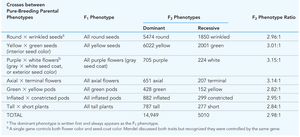
Mendel’s Observations for Seven Monohybrid Traits
Mendel observed consistent ratios for all seven traits, supporting the theory of particulate inheritance.
Trait | F1 Phenotype | F2 Phenotypes | F2 Ratio |
|---|---|---|---|
Round vs. wrinkled seeds | All round | 5474 round, 1850 wrinkled | 2.96:1 |
Yellow vs. green seeds | All yellow | 6022 yellow, 2001 green | 3.01:1 |
Purple vs. white flowers | All purple | 705 purple, 224 white | 3.15:1 |
Axial vs. terminal flowers | All axial | 651 axial, 207 terminal | 3.14:1 |
Inflated vs. constricted pods | All inflated | 882 inflated, 299 constricted | 2.95:1 |
Tall vs. short plants | All tall | 787 tall, 277 short | 2.84:1 |
Test-Cross Analysis
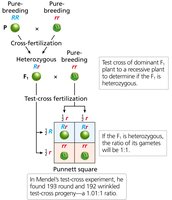
A test cross is used to determine the genotype of an individual with a dominant phenotype by crossing it with a homozygous recessive individual. If the dominant individual is heterozygous, the progeny will show a 1:1 ratio.
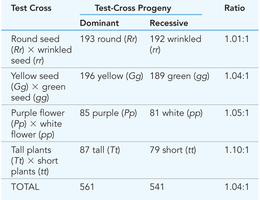
Test Cross | Dominant | Recessive | Ratio |
|---|---|---|---|
Round seed (Rr) × wrinkled seed (rr) | 193 | 192 | 1.01:1 |
Yellow seed (Gg) × green seed (gg) | 196 | 189 | 1.04:1 |
Purple flower (Pp) × white flower (pp) | 85 | 81 | 1.05:1 |
Tall plants (Tt) × short plants (tt) | 87 | 79 | 1.10:1 |
Self-Fertilization Experiments
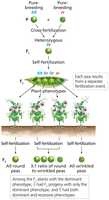
Self-fertilization of F2 plants with the dominant phenotype can reveal whether they are homozygous or heterozygous. Homozygous plants produce only dominant progeny, while heterozygous plants produce both dominant and recessive progeny.
Dihybrid and Trihybrid Crosses: Independent Assortment
Mendel’s Second Law: Law of Independent Assortment
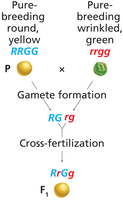
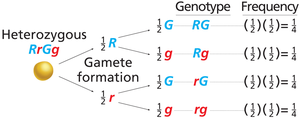
Mendel’s law of independent assortment states that the segregation of alleles for one gene is independent of the segregation of alleles for another gene. This principle was demonstrated through dihybrid and trihybrid crosses.
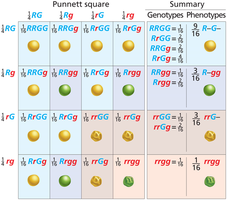
Dihybrid Cross: Cross between individuals heterozygous for two genes (e.g., RrGg × RrGg).
Predicted Phenotypic Ratio: 9:3:3:1 in F2 generation.
Probability Theory in Genetics
Rules of Probability
Probability theory is used to predict Mendelian ratios and outcomes in genetic crosses.
Product Rule: Probability of independent events occurring together is the product of their individual probabilities.
Sum Rule: Probability of mutually exclusive events is the sum of their individual probabilities.
Conditional Probability: Probability modified by additional information after a cross.
Binomial Probability: Used for predicting the likelihood of a series of events, such as progeny phenotypes in multiple offspring.
Binomial Expansion Formula:
Where p and q are the probabilities of two outcomes, and n is the number of events.
Chi-Square Analysis in Genetics
Testing Fit Between Observed and Expected Outcomes
The chi-square test quantifies how closely observed data match expected outcomes. The formula is:
Where O is observed value and E is expected value. The result is interpreted using a probability (P) value and degrees of freedom (df = n - 1).
Autosomal Inheritance and Molecular Genetics
Autosomal Inheritance
Autosomal inheritance refers to genes located on autosomes (non-sex chromosomes). In humans, there are 22 pairs of autosomes.
Pedigrees
Pedigrees are diagrams used to trace inheritance patterns in families. Standard symbols indicate gender, relationships, and trait presence.
Autosomal Dominant and Recessive Inheritance
Autosomal Dominant: Trait appears in every generation; affected individuals have at least one affected parent.
Autosomal Recessive: Trait often skips generations; affected individuals may have unaffected parents who are carriers.
Molecular Genetics of Mendel’s Traits
Modern genetics has identified the molecular basis of Mendel’s traits:
Seed Shape (Sbe1): Enzyme converts amylose to amylopectin; mutant allele leads to wrinkled seeds.
Stem Length (Le): Enzyme involved in giberellin production; mutant allele results in short plants.
Seed Color (Sgr): Enzyme breaks down chlorophyll; mutant allele results in green seeds.
Flower Color (bHLH): Transcription factor activates pigment genes; mutant allele results in white flowers.
Dominant alleles are typically functional, while recessive alleles are loss-of-function mutations.
Summary
Mendel’s principles of segregation and independent assortment form the basis of transmission genetics. Modern molecular analysis has confirmed and expanded these principles, linking genotype to phenotype through DNA, RNA, and protein function.
