 Indietro
Addition Reactions of Alkenes and Aromatic Compounds
Guida di studio - Note intelligenti
 Appunti personalizzati basati sui tuoi materiali, ampliati con definizioni chiave, esempi e contesto.
Addition Reactions for Alkenes and Aromatic Rings
Overview of Addition Reactions
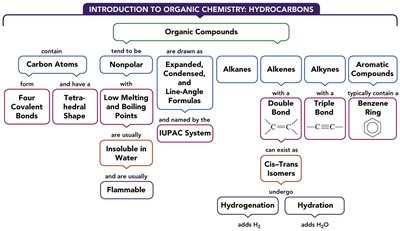
Addition reactions are fundamental transformations in organic chemistry, particularly involving alkenes and alkynes. These reactions occur when atoms are added to the carbon atoms of a double or triple bond, resulting in the conversion of unsaturated compounds to saturated ones. Aromatic compounds, such as benzene, exhibit unique bonding and naming conventions due to their ring structure and electron delocalization.
Alkenes and alkynes are highly reactive due to their double and triple bonds.
These bonds are easily broken, allowing new atoms to be added.
Addition reactions include hydrogenation and hydration.
Types of Addition Reactions
The two primary addition reactions for alkenes are hydrogenation and hydration. Each involves specific reactants, catalysts, and products.
Name of Addition Reaction | Reactants | Catalysts | Product |
|---|---|---|---|
Hydrogenation | Alkene + H2 | Pt, Ni, or Pd | Alkane |
Hydration | Alkene + H2O | H+ (strong acid) | Alcohol |

Hydrogenation of Alkenes
Mechanism and Example
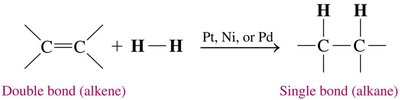
Hydrogenation is the addition of hydrogen (H2) to the carbon atoms of a double or triple bond in an alkene or alkyne. This reaction requires a metal catalyst such as platinum (Pt), nickel (Ni), or palladium (Pd) to proceed efficiently.
Reactants: Alkene and hydrogen gas (H2).
Catalyst: Pt, Ni, or Pd.
Product: Alkane (saturated hydrocarbon).
Equation:
Hydrogenation of Oils
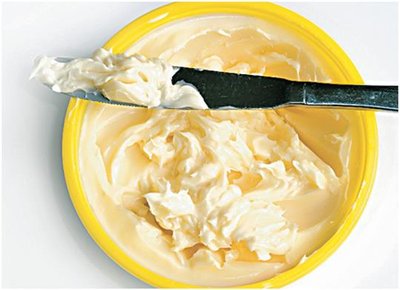
Hydrogenation is used industrially to convert unsaturated fats (oils) into saturated fats, increasing their melting points and making them solid at room temperature. This process is used to produce margarine and shortening.
Unsaturated fats contain cis double bonds (e.g., oleic acid).
Hydrogenation converts these to single bonds (e.g., stearic acid).
Resulting compounds are more solid and have higher melting points.

Example: Hydrogenation Equation
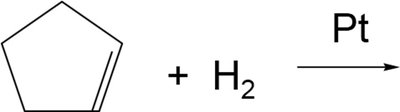
Write an equation for the hydrogenation of cyclopentene using a platinum catalyst:
Reactants: Cyclopentene + H2
Catalyst: Pt
Product: Cyclopentane
Equation:
Hydration of Alkenes
Mechanism and Example
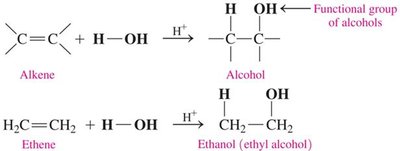
Hydration is the addition of water (H–OH) to an alkene, resulting in the formation of an alcohol. The reaction is catalyzed by a strong acid, typically sulfuric acid (H2SO4).
Reactants: Alkene and water (H2O).
Catalyst: H+ (strong acid).
Product: Alcohol.
Markovnikov's Rule: The H atom from water attaches to the carbon with more H atoms; the –OH attaches to the carbon with fewer H atoms.
Equation:
Aromatic Compounds: Benzene and Its Derivatives
Structure and Bonding in Benzene
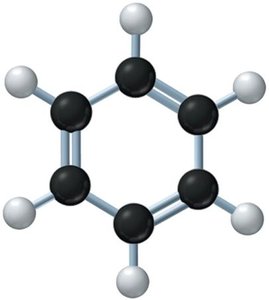
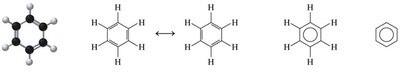
Benzene is a unique aromatic compound consisting of a six-carbon ring with alternating double bonds. The electrons are delocalized, making the ring structure stable and flat. Benzene is often represented by a circle within a hexagon to indicate electron sharing.
Molecular formula: C6H6
Structure: Flat ring with alternating double bonds
Electron delocalization: Electrons are shared equally among all carbon atoms
Representation: Skeletal formula with a circle in the center
Naming Aromatic Compounds
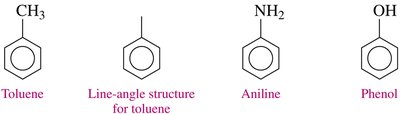
Aromatic compounds containing a benzene ring and a single substituent are named as benzene derivatives. The ring is not numbered if there is only one substituent. Common names such as toluene, aniline, and phenol are accepted by IUPAC rules.
Toluene: Benzene ring with a methyl group (CH3)
Aniline: Benzene ring with an amine group (NH2)
Phenol: Benzene ring with a hydroxyl group (OH)
Naming Aromatic Compounds with Multiple Substituents
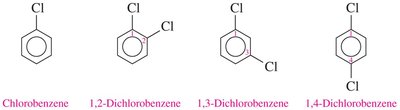
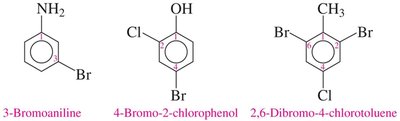
When there are two or more substituents, the benzene ring is numbered to give the lowest possible numbers to the substituents. If toluene, phenol, or aniline has substituents, the carbon attached to the functional group is numbered as carbon 1, and other substituents are named alphabetically.
Examples: Chlorobenzene, 1,2-dichlorobenzene, 1,3-dichlorobenzene, 1,4-dichlorobenzene
Complex derivatives: 3-bromoaniline, 4-bromo-2-chlorophenol, 2,6-dibromo-4-chlorotoluene
Common Aromatic Compounds and Their Uses
Benzene rings are found in many important compounds, including drugs, dyes, explosives, pain relievers, and flavorings.
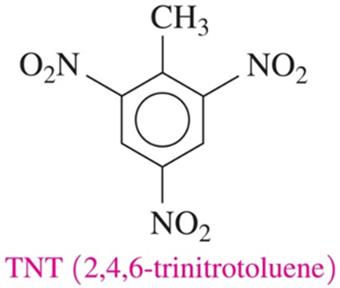
Toluene: Used in the manufacture of drugs, dyes, and explosives (e.g., TNT).
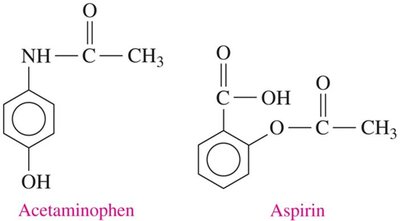
Aspirin and Acetaminophen: Pain relievers containing benzene rings.
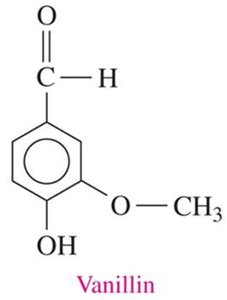
Vanillin: Flavoring agent with a benzene ring structure.
Summary
Addition reactions are essential for understanding the reactivity of alkenes and aromatic compounds. Hydrogenation and hydration transform unsaturated hydrocarbons into saturated ones and alcohols, respectively. Benzene and its derivatives are central to organic chemistry, with unique bonding and naming conventions.
