 Indietro
Aqueous Equilibria: Buffers, Titrations, and Solubility (GOB Chemistry Study Notes)
Guida di studio - Note intelligenti
 Appunti personalizzati basati sui tuoi materiali, ampliati con definizioni chiave, esempi e contesto.
Additional Aspects of Aqueous Equilibria
Introduction
This chapter explores advanced concepts in aqueous equilibria, focusing on the common-ion effect, buffer solutions, acid-base titrations, solubility equilibria, and the factors affecting solubility. These topics are essential for understanding chemical reactions in biological and environmental systems, as well as for laboratory applications.
The Common-Ion Effect
Definition and Principle
Common-Ion Effect: When a solution contains two substances that share a common ion, the ionization of the weaker electrolyte is suppressed by the presence of the strong electrolyte.
According to Le Chatelier’s Principle, adding a common ion shifts the equilibrium to reduce the effect of the added ion.
Example: In a solution of acetic acid (CH3COOH) and sodium acetate (CH3COONa), the addition of acetate ions from sodium acetate suppresses the ionization of acetic acid, increasing the pH.
Equation:
Adding CH3COONa increases [CH3COO−], shifting equilibrium left, decreasing [H+], and raising pH.
Key Point: The common-ion effect is crucial in buffer solutions and solubility equilibria.
Buffer Solutions
Composition and Action
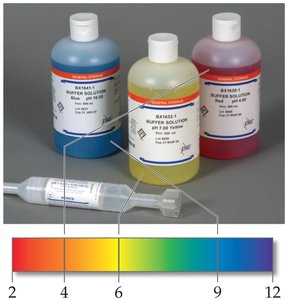
Buffer Solution: A solution containing a weak acid and its conjugate base (or a weak base and its conjugate acid) that resists changes in pH upon addition of small amounts of acid or base.
Buffers are prepared by mixing a weak acid with a salt of its conjugate base, or by partial neutralization of a weak acid/base with a strong base/acid.
How Buffers Work: Buffers neutralize added acids (H+) or bases (OH−) by shifting equilibrium, keeping pH nearly constant.
Calculating Buffer pH: Henderson-Hasselbalch Equation
The Henderson-Hasselbalch equation relates the pH of a buffer to the concentrations of acid and conjugate base:
If [base] = [acid], then pH = pKa.
Buffer capacity is highest when [acid] ≈ [base].
Buffer Capacity and pH Range
Buffer Capacity: The amount of acid or base a buffer can neutralize before pH changes significantly.
Effective pH Range: Buffers are most effective within ±1 pH unit of the pKa of the acid.
Addition of Strong Acids and Bases to Buffers
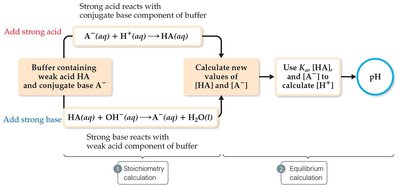
When a strong acid is added, the conjugate base neutralizes it; when a strong base is added, the weak acid neutralizes it.
After neutralization, use the Henderson-Hasselbalch equation to calculate the new pH.
Acid-Base Titrations
Principles and Setup
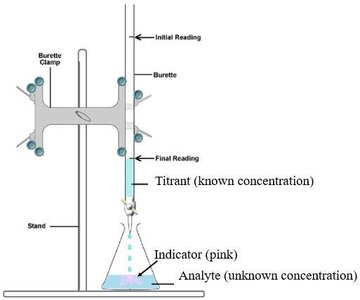
Titration: A quantitative technique to determine the concentration of an unknown acid or base by reacting it with a standard solution.
The equivalence point is when moles of acid equal moles of base.
The endpoint is detected by an indicator, which changes color near the equivalence point.
Indicators
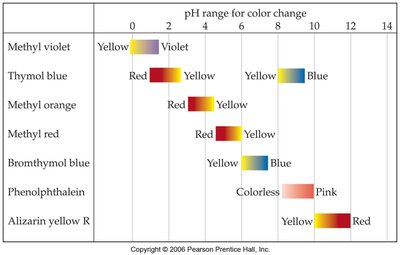
Indicators are weak acids or bases that change color depending on the pH.
The color change occurs when pH ≈ pKa of the indicator.
Choose an indicator whose transition range matches the expected equivalence point pH.
Titration Curves
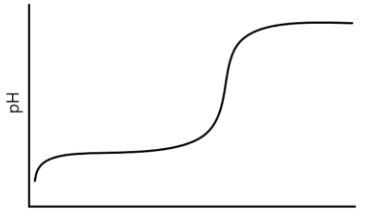
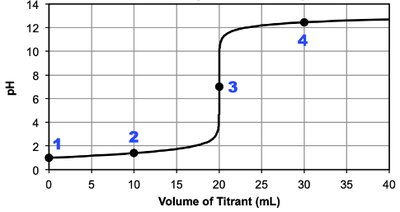
Titration curve: A plot of pH versus volume of titrant added.
Strong acid–strong base titrations have a sharp pH change at the equivalence point (pH = 7).
Weak acid–strong base titrations have a buffer region and equivalence point at pH > 7.
Polyprotic acids show multiple equivalence points.
Solubility Equilibria
The Solubility-Product Constant (Ksp)
Ksp: The equilibrium constant for the dissolution of a sparingly soluble salt.
For a salt AB:
For Ba3(PO4)2:
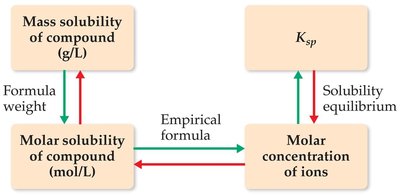
Solubility vs. Solubility Product
Solubility: The amount of solute that dissolves to form a saturated solution (g/L or mol/L).
Ksp: Depends on the concentrations of ions at equilibrium, not the total amount dissolved.
Predicting Precipitation: The Ion Product (Q)
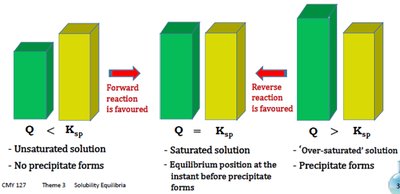
Ion Product (Q): Calculated like Ksp, but with initial concentrations.
If Q < Ksp: No precipitate forms (unsaturated).
If Q = Ksp: Solution is saturated (at equilibrium).
If Q > Ksp: Precipitate forms (supersaturated).
Factors Affecting Solubility
Common-Ion Effect
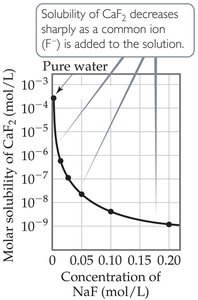
The presence of a common ion decreases the solubility of a salt due to Le Chatelier’s principle.
For example, adding NaF to a solution of CaF2 decreases the solubility of CaF2.
Effect of pH
Salts with basic anions are more soluble in acidic solutions because H+ reacts with the anion, shifting equilibrium to dissolve more salt.
Buffers maintain pH, preventing changes in solubility due to pH shifts.
Precipitation and Separation of Ions
Selective Precipitation
Ions can be separated from mixtures by adding reagents that form precipitates with specific ions based on their Ksp values.
The least soluble salt precipitates first, allowing for qualitative analysis and separation of ions.
Qualitative Analysis for Metallic Elements
Differences in solubility are used to identify and separate metal ions in solution.
This technique is fundamental in analytical chemistry for detecting the presence of specific ions.
Summary Table: Key Equations and Concepts
Concept | Equation/Definition |
|---|---|
Buffer pH | |
Solubility Product (Ksp) | |
Ion Product (Q) | Same form as Ksp, but with initial concentrations |
Precipitation Condition | Q > Ksp: Precipitate forms |
Buffer Capacity | Greatest when [acid] ≈ [base] |
Additional info: These concepts are foundational for understanding chemical equilibria in biological, environmental, and industrial contexts, and are directly relevant to GOB Chemistry curricula.
