Indietro
Atoms, Molecules, and Ions: Foundations of Modern Atomic Theory
Guida di studio - Note intelligenti
 Appunti personalizzati basati sui tuoi materiali, ampliati con definizioni chiave, esempi e contesto.
Atoms, Molecules, and Ions
Development of Modern Atomic Theory
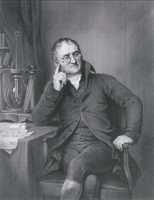
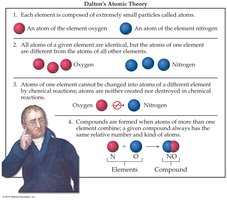
The concept that atoms are the fundamental building blocks of matter was revitalized in the early nineteenth century, primarily by John Dalton. Dalton's atomic theory provided a systematic explanation for the laws of chemical combination and laid the groundwork for modern chemistry.
Atomic Theory of Matter: Dalton proposed that all matter is composed of small, indivisible particles called atoms.
Law of Conservation of Mass: The total mass of substances remains unchanged during a chemical reaction.
Law of Multiple Proportions: When two elements form more than one compound, the masses of one element that combine with a fixed mass of the other are in ratios of small whole numbers.
Example: Carbon monoxide (CO) and carbon dioxide (CO2) both consist of carbon and oxygen, but the ratio of oxygen masses that combine with a fixed mass of carbon is 2:1.
Discovery of Subatomic Particles
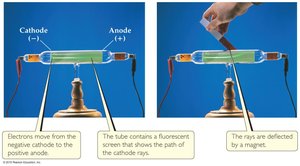
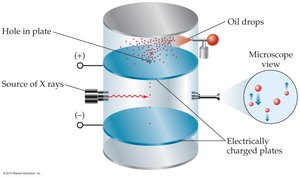
Dalton's model of the atom as indivisible was later revised with the discovery of subatomic particles: electrons, protons, and neutrons. These discoveries were made through a series of experiments involving cathode rays, radioactivity, and atomic structure investigations.
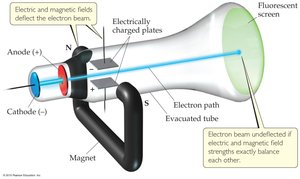
Electrons: Discovered by J.J. Thomson using cathode ray tubes. Electrons are negatively charged particles found outside the nucleus.
Protons: Positively charged particles located in the nucleus.
Neutrons: Neutral particles also found in the nucleus.
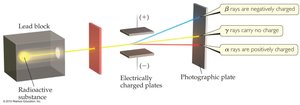
Radioactivity: The spontaneous emission of radiation by certain elements, first observed by Henri Becquerel and further studied by Marie and Pierre Curie.
Models of the Atom
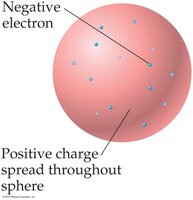
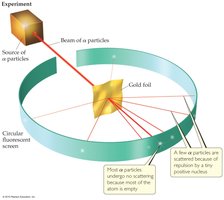
Early atomic models evolved as new discoveries were made. Thomson's "plum pudding" model was replaced by Rutherford's nuclear model after the gold foil experiment demonstrated the existence of a dense, positively charged nucleus.
Plum Pudding Model: Atoms consist of a diffuse positive charge with embedded electrons.
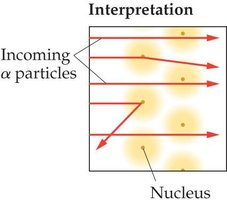
Gold Foil Experiment: Alpha particles were deflected by a small, dense nucleus, indicating that most of the atom is empty space.
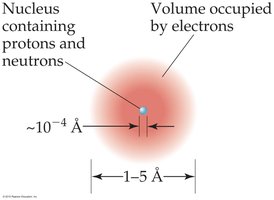
Nuclear Model: Atoms have a tiny, dense nucleus containing protons and neutrons, with electrons occupying the surrounding space.
Subatomic Particles: Properties and Comparison
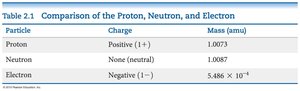
Atoms are composed of three main subatomic particles: protons, neutrons, and electrons. Their properties are summarized below.
Particle | Charge | Mass (amu) |
|---|---|---|
Proton | Positive (1+) | 1.0073 |
Neutron | None (neutral) | 1.0087 |
Electron | Negative (1–) | 5.486 × 10⁻⁴ |
Atomic Mass, Isotopes, and Atomic Weight
Atoms of the same element can have different numbers of neutrons, resulting in isotopes. The atomic mass unit (amu) is used to express atomic and molecular masses. The atomic weight of an element is the weighted average of the masses of its isotopes.
Isotopes: Atoms of the same element with different numbers of neutrons.
Atomic Weight Calculation:
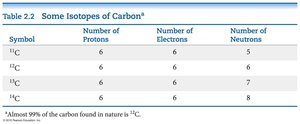
Symbol | Number of Protons | Number of Electrons | Number of Neutrons |
|---|---|---|---|
11C | 6 | 6 | 5 |
12C | 6 | 6 | 6 |
13C | 6 | 6 | 7 |
14C | 6 | 6 | 8 |
Mass Spectrometry
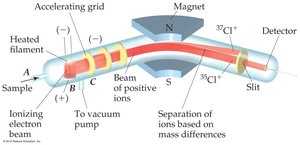
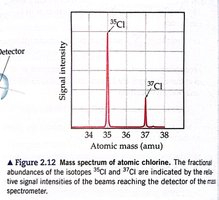
Mass spectrometry is a technique used to measure the masses and relative abundances of isotopes in a sample. The output is a mass spectrum, where the x-axis represents mass and the y-axis represents abundance.
The Periodic Table
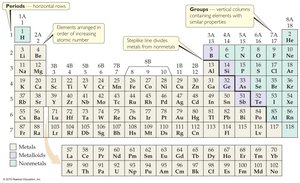
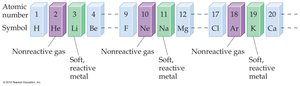
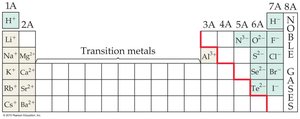
The periodic table organizes elements by increasing atomic number and groups elements with similar chemical properties into columns called groups or families. Rows are called periods.
Groups: Vertical columns; elements in the same group have similar properties.
Periods: Horizontal rows.
Metals, Nonmetals, Metalloids: Metals are on the left, nonmetals on the right, and metalloids border the staircase line.
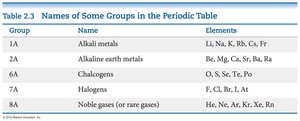
Group | Name | Elements |
|---|---|---|
1A | Alkali metals | Li, Na, K, Rb, Cs, Fr |
2A | Alkaline earth metals | Be, Mg, Ca, Sr, Ba, Ra |
6A | Chalcogens | O, S, Se, Te, Po |
7A | Halogens | F, Cl, Br, I, At |
8A | Noble gases | He, Ne, Ar, Kr, Xe, Rn |
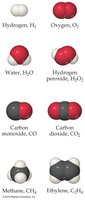
Diatomic Molecules
Some elements naturally exist as diatomic molecules, meaning they are found as molecules composed of two atoms.
Diatomic Elements: H2, N2, F2, O2, I2, Cl2, Br2
Chemical Formulas and Models
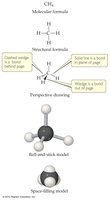
Chemical formulas represent the composition of compounds. Empirical formulas show the simplest ratio of elements, while molecular formulas show the actual number of atoms. Structural formulas and models illustrate the arrangement of atoms.
Empirical Formula: Simplest whole-number ratio of elements.
Molecular Formula: Actual number of atoms of each element.
Structural Formula: Shows how atoms are bonded.
Perspective Drawings and Models: Illustrate three-dimensional structure.
Ionic Compounds and Ions
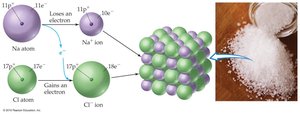
Ionic compounds are formed from the transfer of electrons between metals and nonmetals, resulting in cations (positive ions) and anions (negative ions). The formula of an ionic compound reflects the ratio needed for electrical neutrality.
Cations: Formed by loss of electrons (usually metals).
Anions: Formed by gain of electrons (usually nonmetals).
Empirical Formula: Only the simplest ratio is written for ionic compounds.
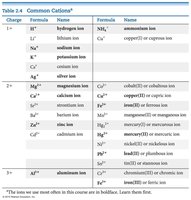
Charge | Formula | Name |
|---|---|---|
1+ | H+ | hydrogen ion |
2+ | Mg2+ | magnesium ion |
3+ | Al3+ | aluminum ion |
Charge | Formula | Name |
|---|---|---|
1– | F– | fluoride ion |
2– | O2– | oxide ion |
3– | N3– | nitride ion |
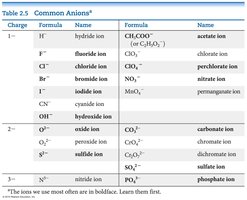
Oxyanions and Nomenclature Patterns
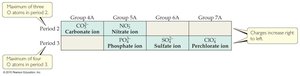
Oxyanions are polyatomic ions containing oxygen. Their names depend on the number of oxygen atoms present.
-ite: Fewer oxygens (e.g., NO2–: nitrite)
-ate: More oxygens (e.g., NO3–: nitrate)
Prefixes: 'hypo-' (fewest), 'per-' (most)
Writing Formulas for Ionic Compounds
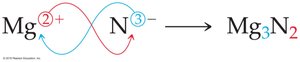
The charges on ions determine the subscripts in the formula of an ionic compound. The total positive and negative charges must balance.
Method: The charge on the cation becomes the subscript for the anion and vice versa. Reduce to the lowest whole-number ratio if necessary.
Example:
Nomenclature of Inorganic and Organic Compounds
Naming compounds follows systematic rules. For ionic compounds, the cation is named first, followed by the anion. For molecular compounds, prefixes indicate the number of atoms. Organic compounds have their own nomenclature system based on the structure and functional groups.
Binary Ionic Compounds: Name the cation, then the anion (ending in -ide).
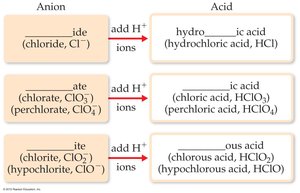
Acids: The name depends on the anion (e.g., chloride → hydrochloric acid).
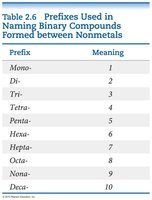
Binary Molecular Compounds: Use prefixes (mono-, di-, tri-, etc.) to indicate the number of atoms.
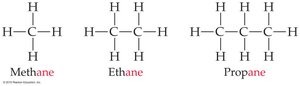
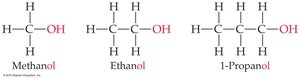
Organic Compounds: Alkanes are named based on the number of carbons (meth-, eth-, prop-, etc.). Alcohols end in -ol.
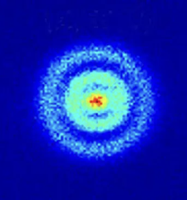
Additional info: The first image is a photograph of the hydrogen atom, illustrating the quantum mechanical probability distribution of the electron. This is a modern confirmation of atomic theory, showing the atom's structure at the quantum level.