 Indietro
Building Blocks of Molecules: Foundations of GOB Chemistry
Guida di studio - Note intelligenti
 Appunti personalizzati basati sui tuoi materiali, ampliati con definizioni chiave, esempi e contesto.
Introduction to Matter and Its Building Blocks
Definitions and Basic Concepts
Understanding the fundamental components of matter is essential for studying chemistry and biochemistry. Matter is anything that has mass and occupies space. The smallest units of matter are atoms, which combine to form molecules and compounds. These building blocks are the foundation of all substances, including those found in biological systems.
Matter: Anything with mass and volume.
Mass: The amount of matter in an object.
Pure Substance: Has a uniform chemical composition (e.g., elements, compounds).
Mixture: Contains two or more substances physically combined, variable composition.
Atom: The smallest particle of an element that retains its properties.
Element: A pure substance made of only one kind of atom.
Compound: A pure substance composed of two or more different atoms chemically bonded.
Molecule: The smallest unit of a compound that retains its chemical properties.
Example: Water (H2O) is a molecule and a compound, consisting of two hydrogen atoms and one oxygen atom.
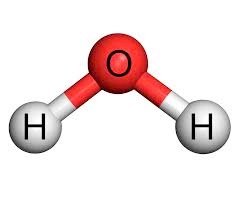
Additional info: The structure and function of biological molecules are determined by the types and arrangements of atoms they contain.
Elements in Biological Systems
Most Common Elements in the Human Body
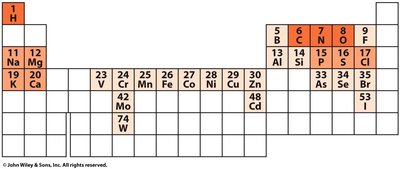
Only a small subset of the 118 known elements are commonly found in living organisms. These elements are essential for life and are involved in the structure and function of biomolecules.
Major elements: Carbon (C), Nitrogen (N), Oxygen (O), Hydrogen (H)
Other important elements: Calcium (Ca), Phosphorus (P), Potassium (K), Sulfur (S), Chlorine (Cl), Sodium (Na), Magnesium (Mg)
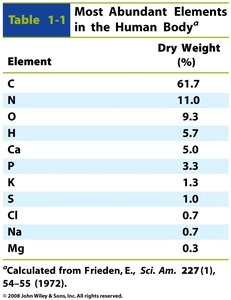
Element | Dry Weight (%) |
|---|---|
C | 61.7 |
N | 11.0 |
O | 9.3 |
H | 5.7 |
Ca | 5.0 |
P | 3.3 |
K | 1.0 |
S | 1.0 |
Cl | 0.7 |
Na | 0.7 |
Mg | 0.3 |
Example: Glucose (C6H12O6) is a compound made of carbon, hydrogen, and oxygen.
Atomic Structure and Subatomic Particles
Subatomic Particles
Atoms are composed of three main subatomic particles: protons, neutrons, and electrons. The arrangement and number of these particles determine the properties of each element.
Proton (p): Positively charged, located in the nucleus.
Neutron (n): Neutral (no charge), located in the nucleus.
Electron (e-): Negatively charged, found in the electron cloud surrounding the nucleus.
Atomic number (Z): Number of protons in the nucleus; defines the element.
Mass number (A): Total number of protons and neutrons in the nucleus.
Isotopes: Atoms of the same element (same Z) with different numbers of neutrons (different A).
Atomic weight: The weighted average mass of all isotopes of an element, based on their natural abundance.
Example: Hydrogen has three isotopes: protium (), deuterium (), and tritium ().
The Periodic Table and Electronic Structure
Organization of the Periodic Table
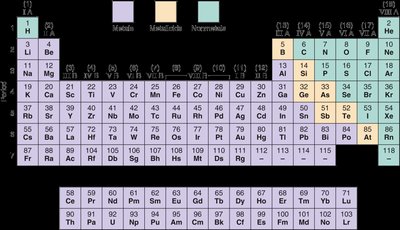
The periodic table arranges elements by increasing atomic number and groups elements with similar chemical properties into columns called groups or families. Rows are called periods.
Groups/Families: Vertical columns; elements in the same group have similar properties.
Periods: Horizontal rows; elements in the same period have the same number of electron shells.
Valence electrons: Electrons in the outermost shell; determine chemical reactivity and bonding.
Example: Group 1 elements (alkali metals) all have one valence electron and similar reactivity.
Periodic Properties of Elements
Major Periodic Trends
Several properties of elements change in predictable ways across the periodic table:
Metallic character: Increases down a group and to the left across a period.
Atomic size: Increases down a group, decreases across a period from left to right.
Ionization energy: Energy required to remove an electron; increases up a group and to the right across a period.
Electronegativity: Tendency to attract electrons; increases up a group and to the right across a period.
Example: Fluorine (F) has the highest electronegativity of all elements.
The Octet Rule and Chemical Bonding
Noble Gases and the Octet Rule
Noble gases (Group 18) have full valence shells (8 electrons, except helium with 2) and are chemically inert. The octet rule states that atoms tend to gain, lose, or share electrons to achieve a full valence shell, usually 8 electrons.
Ionic bonding: Transfer of electrons from one atom to another, forming cations and anions that attract each other.
Covalent bonding: Sharing of electrons between atoms to achieve full octets.
Example: Sodium chloride (NaCl) forms when sodium donates an electron to chlorine, creating Na+ and Cl- ions.
Ions and Ionic Compounds
Formation of Ions
Atoms form ions to achieve stable electron configurations. Metals tend to lose electrons and form cations (positive ions), while nonmetals gain electrons to form anions (negative ions).
Cation: Positively charged ion (more protons than electrons).
Anion: Negatively charged ion (more electrons than protons).
Polyatomic ion: A charged group of covalently bonded atoms (e.g., NH4+, SO42-).
Example: Magnesium fluoride (MgF2) forms from Mg2+ and two F- ions.
Summary Table: Common Polyatomic Ions
Ion | Name |
|---|---|
NH4+ | Ammonium |
H3O+ | Hydronium |
OH- | Hydroxide |
HCO3- | Bicarbonate |
CO32- | Carbonate |
SO42- | Sulfate |
PO43- | Phosphate |
CN- | Cyanide |
Key Takeaways
Atoms are the fundamental units of matter, composed of protons, neutrons, and electrons.
Elements are defined by their atomic number (number of protons).
The periodic table organizes elements by atomic number and groups elements with similar properties.
Valence electrons determine chemical reactivity and bonding behavior.
The octet rule explains why atoms form bonds: to achieve a stable, full valence shell.
Ionic and covalent bonds are the two main types of chemical bonds.
Common biological ions include both simple and polyatomic ions.
