 Indietro
Carboxylic Acids and Esters: Structure, Properties, and Reactions
Guida di studio - Note intelligenti
 Appunti personalizzati basati sui tuoi materiali, ampliati con definizioni chiave, esempi e contesto.
Carboxylic Acids and Esters
Introduction
This chapter explores the structure, nomenclature, properties, and reactions of carboxylic acids and esters. These compounds are essential in organic and biological chemistry, with significant roles in metabolism, industry, and daily life.
Carboxylic Acids
Structure of Carboxylic Acids
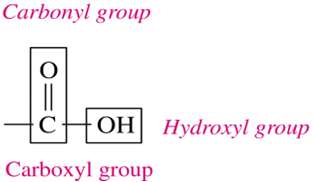
Carboxylic acids contain the carboxyl group (-COOH), which consists of a carbonyl group (C=O) attached to a hydroxyl group (-OH).
General formula: R-COOH, where R is a hydrocarbon group.
Three common ways to write the carboxyl group: CH3COOH, CH3CO2H, CH3C(O)OH.
Examples of Carboxylic Acids
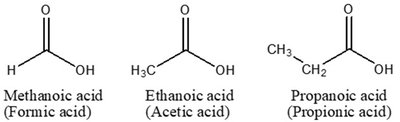
Methanoic acid (Formic acid): HCOOH
Ethanoic acid (Acetic acid): CH3COOH
Propanoic acid (Propionic acid): CH3CH2COOH
Naming Carboxylic Acids
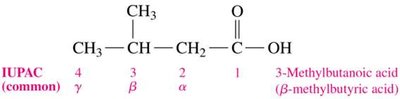
IUPAC: Replace the -e ending of the alkane with -oic acid. Numbering starts from the carboxyl carbon (carbon 1).
Common names: Use prefixes such as form-, acet-, propion-, butyr-.
Greek letters (α, β, γ) are used to indicate positions relative to the carboxyl group in common names.
Aromatic Carboxylic Acids
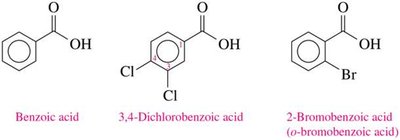
Carboxylic acids attached to aromatic rings are named as derivatives of benzoic acid. Substituents are indicated by ortho (o-), meta (m-), and para (p-) prefixes.
Common Carboxylic Acids
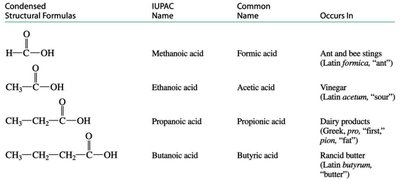
Condensed Structural Formula | IUPAC Name | Common Name | Occurs In |
|---|---|---|---|
HCOOH | Methanoic acid | Formic acid | Ant and bee stings |
CH3COOH | Ethanoic acid | Acetic acid | Vinegar |
CH3CH2COOH | Propanoic acid | Propionic acid | Dairy products |
CH3CH2CH2COOH | Butanoic acid | Butyric acid | Rancid butter |
Preparation of Carboxylic Acids
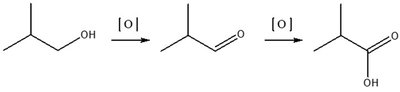
Carboxylic acids are commonly prepared by the oxidation of primary alcohols to aldehydes, followed by further oxidation to carboxylic acids.
Example: Ethanol → Acetaldehyde → Acetic acid
Alpha Hydroxy Acids (AHAs)
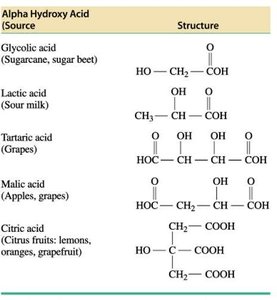
Alpha hydroxy acids are naturally occurring carboxylic acids with a hydroxyl group on the carbon adjacent to the carboxyl group. They are found in fruits, milk, and sugar cane, and are used in dermatology for skin treatments.
Alpha Hydroxy Acid (Source) | Structure |
|---|---|
Glycolic acid (Sugarcane, sugar beet) | HOCH2COOH |
Lactic acid (Sour milk) | CH3CHOHCOOH |
Tartaric acid (Grapes) | HOOCCH(OH)CH(OH)COOH |
Malic acid (Apples, grapes) | HOOCCH2CH(OH)COOH |
Citric acid (Citrus fruits) | HOOCCH2C(OH)(COOH)CH2COOH |
Properties of Carboxylic Acids
Polarity and Hydrogen Bonding
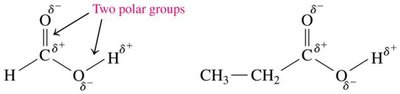
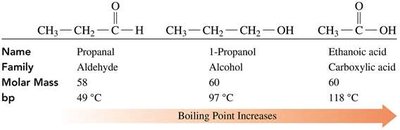
Carboxylic acids are strongly polar due to the presence of both a carbonyl and a hydroxyl group. This allows them to form multiple hydrogen bonds, resulting in higher boiling points compared to alcohols, ketones, and aldehydes of similar molar mass.
Dimer Formation
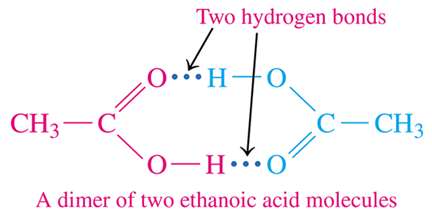
Carboxylic acids can form dimers through two hydrogen bonds between their carboxyl groups, further increasing their boiling points.
Solubility in Water
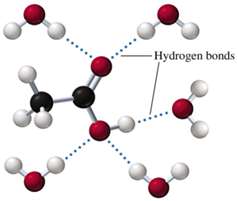
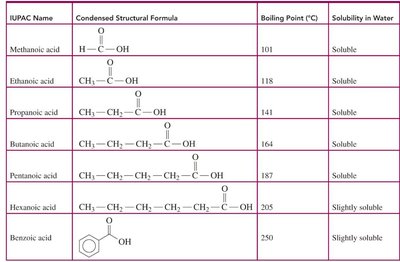
Carboxylic acids with 1-5 carbon atoms are very soluble in water due to their ability to form hydrogen bonds with water molecules. Solubility decreases as the hydrocarbon chain length increases.
IUPAC Name | Condensed Structural Formula | Boiling Point (°C) | Solubility in Water |
|---|---|---|---|
Methanoic acid | HCOOH | 101 | Soluble |
Ethanoic acid | CH3COOH | 118 | Soluble |
Propanoic acid | CH3CH2COOH | 141 | Soluble |
Butanoic acid | CH3CH2CH2COOH | 164 | Soluble |
Pentanoic acid | CH3(CH2)3COOH | 187 | Soluble |
Hexanoic acid | CH3(CH2)4COOH | 205 | Slightly soluble |
Benzoic acid | C6H5COOH | 250 | Slightly soluble |
Acidity of Carboxylic Acids
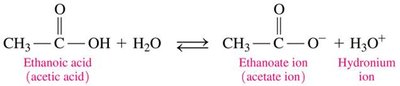
Carboxylic acids are weak acids that partially dissociate in water to produce carboxylate ions and hydronium ions.
General equation:
Salts of Carboxylic Acids
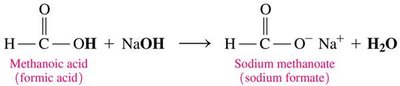
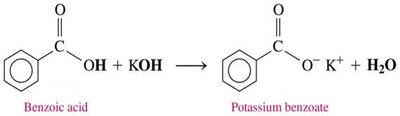
When carboxylic acids react with strong bases, they form carboxylate salts, which are often used as preservatives and flavor enhancers.
Example: Methanoic acid + NaOH → Sodium methanoate + H2O
Esters
Structure and Synthesis of Esters
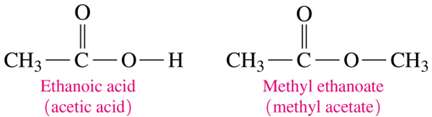
Esters are derived from carboxylic acids, where the hydrogen of the carboxyl group is replaced by an alkyl group. They are commonly synthesized by the reaction of a carboxylic acid with an alcohol in the presence of an acid catalyst (esterification).
General equation:
Naming Esters
The name consists of two words: the alkyl group from the alcohol and the carboxylate name from the acid.
Example: Ethyl ethanoate (from ethanol and ethanoic acid)

Esters in Nature
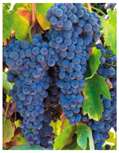
Esters are responsible for the aromas and flavors of many fruits and flowers. They are also found in fats and oils.
Condensed Structural Formula | Name | Flavor/Odor |
|---|---|---|
HCOOCH2CH3 | Ethyl methanoate | Rum |
HCOOCH(CH3)2 | Isobutyl methanoate | Raspberries |
CH3COOCH2CH2CH3 | Propyl ethanoate | Pears |
CH3COOCH2CH2CH2CH2CH3 | Pentyl ethanoate | Bananas |
CH3COOCH2CH2CH2CH2CH2CH3 | Octyl ethanoate | Oranges |
CH3CH2COOCH2CH2CH2CH3 | Ethyl butanoate | Pineapples |
Hydrolysis of Esters
Esters can be hydrolyzed in the presence of an acid or base. Acid hydrolysis produces a carboxylic acid and an alcohol, while base hydrolysis (saponification) produces a carboxylate salt and an alcohol.
Acid hydrolysis:
Base hydrolysis (saponification):


Summary Table: Carboxylic Acids and Esters
Class | General Structure | Key Properties | Example |
|---|---|---|---|
Carboxylic Acid | R-COOH | Weak acid, high boiling point, soluble (short chains) | Acetic acid |
Ester | R-COOR' | Pleasant aroma, found in fruits, hydrolyzed by acid/base | Ethyl acetate |
