 Indietro
Ch. 4 Nuclear Chemistry: Radioactivity, Nuclear Reactions, and Measurement
Guida di studio - Note intelligenti
 Appunti personalizzati basati sui tuoi materiali, ampliati con definizioni chiave, esempi e contesto.
Ch. 4 Nuclear Chemistry
Introduction to Radioactivity
Radioactivity is the process by which unstable atomic nuclei spontaneously decompose, emitting radiation in the process. This instability arises from an excess of protons or neutrons in the nucleus, leading to the transformation of the original atom into a new element or isotope.
Radioactivity: The spontaneous emission of particles or energy from an unstable nucleus.
Instability: Caused by an imbalance in the number of protons and neutrons.
Product: A new element or isotope is formed, and radiation is emitted.
Isotope and Subatomic Particle Notations: Isotopes are represented by their mass number (A) and atomic number (Z):
Mass Number (A): Total number of protons and neutrons.
Atomic Number (Z): Number of protons.
Neutron Number (N):
Chemical vs. Nuclear Reactions
Chemical Reactions: The number and type of elements remain unchanged; only electron arrangements are altered.
Nuclear Reactions: The identity of the elements changes due to changes in the nucleus. However, mass and charge are conserved.
Understanding Nuclear Reactions
Parent Nuclide: The original unstable isotope (on the reactant side).
Daughter Nuclide: The more stable product isotope (on the product side).
Energetic Particle: Subatomic particle emitted or absorbed during the reaction (e.g., alpha, beta, positron, electron).
Types of Radioactivity
Overview of Radioactive Decay Types
There are several types of radioactive decay, each involving the emission or capture of different particles:
Alpha Decay (α): Emission of an alpha particle (2 protons, 2 neutrons).
Beta Decay (β-): Emission of a beta particle (electron).
Gamma Emission (γ): Emission of high-energy photons (gamma rays).
Positron Emission (β+): Emission of a positron (antiparticle of the electron).
Electron Capture: Absorption of an inner orbital electron by the nucleus.
Decay (emission) occurs when an energetic particle is released from an unstable nucleus. Electron capture is a process where an electron is absorbed by the nucleus.
Alpha Decay
Mechanism and Characteristics
Alpha decay occurs when an unstable nucleus emits an alpha particle, which consists of 2 protons and 2 neutrons (symbolized as or ). This process typically occurs in heavy nuclei with excess protons and neutrons, resulting in the formation of a more stable nucleus.
Balancing Nuclear Reactions: Both atomic number (Z) and mass number (A) must be balanced on both sides of the equation.
Ionizing Power: Alpha particles have high ionizing power, making them the most damaging to biological tissues if ingested or inhaled.
Penetrating Power: Alpha particles have low penetrating power and can be stopped by paper or skin.
Example Equation:
Beta Decay
Mechanism and Characteristics
Beta decay occurs when a neutron in an unstable nucleus splits into a proton and an electron. The electron (beta particle) is ejected from the nucleus, increasing the atomic number by one while the mass number remains unchanged.
Beta Particle: Symbolized as or .
Ionizing Power: Lower than alpha particles.
Penetrating Power: Higher than alpha particles; can penetrate skin but is stopped by materials like plastic or glass.
Example Equation:
Gamma Emission
Mechanism and Characteristics
Gamma emission often accompanies alpha or beta decay and involves the emission of gamma rays, which are high-energy photons. Gamma rays have no mass or charge and are symbolized as .
Penetrating Power: Highest among radioactive emissions; can pass through most materials and require dense substances like lead for shielding.
Ionizing Power: Lowest among the three main types of radiation.
Example Equation:
Electron Capture & Positron Emission
Mechanisms
Electron Capture: The nucleus absorbs an inner orbital electron (), converting a proton into a neutron. Occurs in nuclei with excess protons.
Positron Emission: The nucleus emits a positron (), the antiparticle of the electron, converting a proton into a neutron. When a positron and electron collide, they annihilate, producing two gamma rays.
Example Equations:
Electron Capture:
Positron Emission:
Radioactive Half-Life
Concept and Calculations
The half-life () is the time required for half of a sample of a radioisotope to decay. The fraction, percentage, and final amount of a radioisotope remaining after each half-life can be calculated using exponential decay formulas.
Fraction Remaining:
Final Amount:
n: Number of half-lives elapsed ()
Example: If the half-life of arsenic-74 is 18 days, and you start with 100 mg, after 72 days (4 half-lives), the remaining mass is:
mg
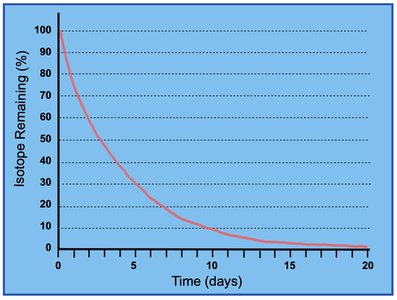
This graph shows the exponential decrease in the percentage of isotope remaining over time, illustrating the concept of half-life.
Measuring Radioactivity
Units and Biological Effectiveness
Radioactivity can be measured in several ways, depending on the property of interest:
Becquerel (Bq): 1 disintegration per second.
Curie (Ci): disintegrations per second.
Gray (Gy): Absorbed dose of radiation (1 Gy = 1 J/kg).
Rad: 0.01 Gy.
Sievert (Sv): Effective dose, accounting for biological effect (1 Sv = 100 rem).
Rem: Roentgen equivalent man; measures biological effect.
Relative Biological Effectiveness (RBE): Accounts for both radiation intensity and biological effect:
X-rays, gamma rays, beta particles: RBE = 1
Alpha particles: RBE = 20
Example Conversions:
1 Gy = 100 rad
1 Sv = 100 rem
Summary Table: Types of Radioactive Decay
Type | Symbol | Change in Nucleus | Penetrating Power | Ionizing Power |
|---|---|---|---|---|
Alpha Decay | Mass # -4, Atomic # -2 | Low | High | |
Beta Decay | Atomic # +1 | Moderate | Moderate | |
Gamma Emission | No change | Very High | Low | |
Positron Emission | Atomic # -1 | Moderate | Moderate | |
Electron Capture | (absorbed) | Atomic # -1 | N/A | N/A |
Additional info: This guide covers all major types of nuclear decay, their mechanisms, and how to calculate and interpret half-life and radiation measurements, as relevant to GOB Chemistry.
